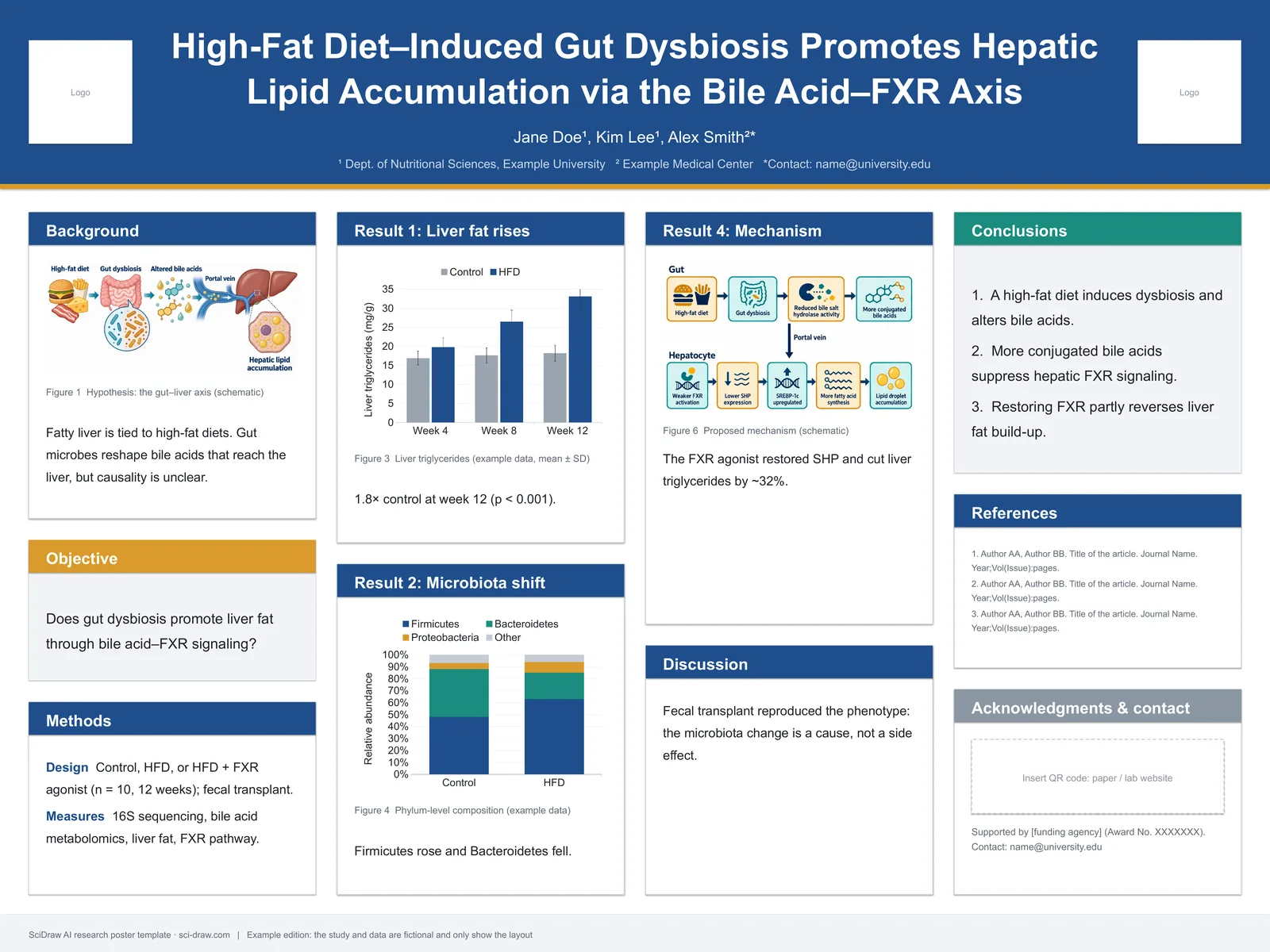
There is no single standard poster size. Most meetings in Europe and Asia ask for A0 portrait (841 × 1189 mm, 33.1 × 46.8 in), and most North American meetings use landscape boards that take a 48 × 36 in poster or larger. What actually decides your size is the conference's board: print anything that fits it, in the orientation it asks for.
This guide gives the common sizes in both units, explains how to read a board size, and lists the official 2026 rules for ten major meetings, each checked on the conference's own site on 22 September 2026. Every size below links to a free, editable PowerPoint template in exactly that size.
Jump to your conference: SfN · NeurIPS · ICML · ICLR · CVPR · AGU · EGU · AACR · ACS · ASCO · ATS
Standard poster sizes
| Size | Inches | Centimetres | Where you meet it | Template |
|---|---|---|---|---|
| A0 portrait | 33.1 × 46.8 | 84.1 × 118.9 | The usual choice in Europe, Japan, Korea, Brazil and Russia | A0 portrait |
| A0 landscape | 46.8 × 33.1 | 118.9 × 84.1 | Landscape boards where height is tight (ICLR's 90 cm limit; EGU, where A0 portrait is 6 mm too tall) | A0 landscape |
| A1 portrait | 23.4 × 33.1 | 59.4 × 84.1 | Workshop posters with a 24 × 36 in maximum | A1 portrait |
| 36 × 48 in portrait | 36 × 48 | 91.4 × 121.9 | US meetings with portrait boards | 36 × 48 in |
| 48 × 36 in landscape | 48 × 36 | 121.9 × 91.4 | The most common US size; fits almost every landscape board | 48 × 36 in |
| 72 × 48 in landscape | 72 × 48 | 182.9 × 121.9 | The full 6 × 4 ft board (SfN); 8 × 4 ft boards. Designed at 50%, print at 200% | 72 × 48 in |
| 72 × 36 in landscape | 72 × 36 | 182.9 × 91.4 | 2:1 posters (ICML, ATS); scales to CVPR's 84 × 42 in. Designed at 50%, print at 200% | 72 × 36 in |
| 90 × 120 cm portrait | 35.4 × 47.2 | 90 × 120 | The usual size at meetings in mainland China and Taiwan | 90 × 120 cm |
| 16:9 e-poster | screen | screen | Virtual posters and poster uploads (for example 5120 × 2880 px) | 16:9 e-poster |
A0 and 36 × 48 in are close but not the same: A0 is about 3 in (7 cm) narrower and 1 in (3 cm) shorter. A poster designed at A0 fits wherever 36 × 48 in fits, but not the other way round.
Why the 72 in templates are half size: PowerPoint cannot make a slide larger than 56 in (142 cm) on either side. Posters wider than that are designed at 50% (36 × 24 in for 72 × 48 in) with the type sized for the printed poster, then printed at 200%. PowerPoint's shapes, charts and text are vector, so they print sharp at double size; place photos at 300–600 dpi at the half-size page so they still reach 150–300 dpi when printed.
Board size is not poster size
Most conferences publish the size of the board (the display surface) rather than a required poster size. The board is a maximum. Three rules cover almost every case:
- Stay inside the board with a margin. Leave about 1–2 in (3–5 cm) on each side for pins and for the board number. A poster exactly the size of the board has no room for either, so print it a few per cent smaller.
- Match the orientation. A landscape board wider than 72 in will hold a portrait A0, but it looks lost. A portrait board 90 cm wide will not hold anything landscape.
- Only a few meetings fix the exact size. CVPR prints every poster at 84 × 42 in, and some societies in China require 90 × 120 cm. When a size is required rather than a maximum, the guidelines say so explicitly.
Portrait or landscape
Follow the board. Landscape boards are standard in North America and at large computing and chemistry meetings; portrait boards are standard in Europe and East Asia. If the guidelines allow either, landscape suits posters built around several result figures side by side, and portrait suits a poster read top to bottom in two or three columns.
Scaling a finished poster to another size keeps the layout but changes the type size in proportion. Scaling is fine between sizes with the same ratio (36 × 48 in and 90 × 120 cm are both 3:4; 72 × 36 in and 84 × 42 in are both 2:1). Between different ratios, start from a template in the right size instead of stretching.
Conference poster requirements (2026)
Each entry gives the edition the rules come from, the official page they were read on, and the template size that fits. Rules change every year, so confirm the page for your own edition before you print.
SfN Neuroscience 2026
- Dedicated page: SfN poster template, sizes and rules
- Meeting: 14–18 November 2026, Washington, D.C.
- Board: 6 ft wide × 4 ft high (1.8 × 1.2 m). There is no required poster size; anything that fits the board is accepted.
- Practical rules: posters stay up for a four-hour session and you attend your assigned hour; set up 15 minutes before; pushpins are provided. Virtual presenters upload a poster PDF.
- Template: 72 × 48 in landscape matches the board exactly, so print it at about 97% (70 × 46.5 in) to leave room for pins. 48 × 36 in landscape fits with space to spare.
- Source: SfN poster presentations, checked 22 September 2026.
NeurIPS
- Dedicated page: NeurIPS poster template, sizes and rules
- Meeting: NeurIPS 2026 runs 6–12 December 2026 in Sydney, with satellite venues in Atlanta and Paris. Its poster instructions are not published yet; the rules below are NeurIPS 2025's.
- Main conference board (2025): 96 in wide × 48 in high (8 × 4 ft). Any poster that fits is accepted.
- Workshop posters (2025): 24 in wide × 36 in high, portrait, taped to the wall.
- Upload: optional poster image, PNG, landscape, up to 5120 × 2880 px and 10 MB.
- Template: for the main conference, 72 × 48 in landscape (it is as tall as the board, so print it slightly smaller) or 48 × 36 in landscape; A1 portrait for workshops; 16:9 e-poster for the upload.
- Source: NeurIPS 2025 poster instructions, checked 22 September 2026. Recheck the 2026 page once it is filled in, as the new venues may change board sizes.
ICML 2026
- Meeting: 6–11 July 2026, Seoul (ICML 2027 is in South America; dates not yet published).
- Main conference: suggested sizes 48 × 36, 60 × 36 or 72 × 36 in (W × H), landscape.
- Workshop posters: no larger than 24 × 36 in (W × H), portrait required.
- Upload: same PNG spec as NeurIPS (5120 × 2880 px, 10 MB).
- Template: 48 × 36 in landscape or 72 × 36 in landscape; A1 portrait for workshops.
- Source: ICML 2026 poster instructions, checked 22 September 2026.
ICLR 2026
- Meeting: 23–27 April 2026, Rio de Janeiro. ICLR 2027 is 26–30 April 2027 in California.
- Main conference: landscape, no larger than 1.90 m wide × 0.90 m high. Note the height: a 48 × 36 in poster is 91.4 cm tall, so it is slightly over the limit.
- Workshop posters: no larger than 61 × 91 cm, portrait required.
- Template: A0 landscape (118.9 × 84.1 cm) fits under the height cap; A1 portrait for workshops.
- Source: ICLR 2026 poster instructions, checked 22 September 2026.
CVPR 2026
- Meeting: 3–7 June 2026, Denver. CVPR 2027 is 20–25 June 2027 in Seattle.
- Size: posters are printed at 84 × 42 in (213 × 107 cm), 2:1 landscape. Workshop posters are limited to half size, 42 × 21 in, and main-conference posters may use the half size too.
- Printing: PDF preferred, 100 DPI or vector at full size, no bleed.
- Upload: optional poster image, PNG up to 5120 × 2880 px and 10 MB, plus a five-minute video.
- Template: 72 × 36 in landscape has the same 2:1 ratio. Export a vector PDF and print it at 84 × 42 in (or 42 × 21 in for workshops); a vector PDF scales without loss.
- Source: CVPR 2026 poster printing, checked 22 September 2026.
AGU Annual Meeting (AGU26)
- Dedicated page: AGU poster template, sizes and rules
- Meeting: 7–11 December 2026, San Francisco. In-person posters may also be shown online; online posters use iPoster.
- Size: not published yet. AGU's poster-session page for AGU26 was not available when we checked, and AGU says the scientific programme goes live in early October 2026. We will add the board size here once it is published.
- Template: until then, 48 × 36 in landscape is the safest choice for a US landscape board.
- Source: AGU26 dates, checked 22 September 2026.
EGU General Assembly
- Meeting: EGU26 was 3–8 May 2026 in Vienna; EGU27 is 4–9 April 2027, also in Vienna. The rules below are EGU26's.
- Board: landscape, 1978 mm wide × 1183 mm high; you can use the full board.
- Watch the height: A0 portrait (1189 mm tall) is 6 mm too tall for the board.
- Other rules: every poster must carry one of EGU's official graphics saying whether photography is allowed; pins are provided; a live presentation file is uploaded at least 24 hours before the session.
- Template: A0 landscape, or 48 × 36 in landscape.
- Source: EGU26 poster presenter guidelines, checked 22 September 2026.
AACR Annual Meeting
- Dedicated page: AACR poster and e-poster template
- Meeting: AACR 2026 was 17–22 April 2026 in San Diego; AACR 2027 is 2–7 April 2027 in Orlando, and its presenter rules are not out yet.
- E-poster (required for every poster presenter in 2026): either a PDF about 24–36 in wide, up to 50 MB, or an MP4 slide video in 16:9 (title slide plus up to five slides).
- Printed poster: AACR has not published a current board size. For 2027, all posters must be presented in person.
- Template: 16:9 e-poster for the slide video; 48 × 36 in landscape exported to PDF at 36 in wide for the PDF e-poster.
- Source: AACR instructions for creating e-posters (2026), checked 22 September 2026.
ACS Spring and Fall
- Meetings: ACS Spring 2027 is 21–25 March 2027 in New Orleans; ACS Fall 2027 is 22–26 August 2027 in San Diego. The rules below are from ACS Spring and Fall 2026.
- Board: all materials must fit a 4 ft high × 8 ft wide display board. No specific poster size is prescribed.
- Practical rules: pushpins are provided; mount your poster up to one hour before the session and stay with it for the whole session. Spring 2026 also offered an iPoster (digital interactive poster) format, for selected presenters only.
- Template: 72 × 48 in landscape (as tall as the board, so print it slightly smaller) or 48 × 36 in landscape.
- Source: ACS Fall 2026 presenter hub and ACS Spring poster presenter FAQ, checked 22 September 2026.
ASCO Annual Meeting
- Meeting: ASCO 2026 was 29 May – 2 June 2026 in Chicago; ASCO 2027 is 4–8 June 2027, also in Chicago, with updated rules due in early November.
- Regular poster: landscape required, no larger than 77 in wide × 48 in high (the board).
- Trials in Progress posters: half-size, 36 in wide × 42 in high, portrait, two per board.
- E-poster: every presenter also uploads an electronic version (PDF, PPTX, PPT, JPEG or PNG); the 2026 deadline was 18 May.
- Other rules: include the abstract number and one contact email; no commercial logos or brand names.
- Template: 72 × 48 in landscape for regular posters, printed slightly smaller than 48 in tall. For Trials in Progress, start from 36 × 48 in portrait and print it scaled to 31.5 × 42 in, which fits the 42 in height.
- Source: ASCO poster presenter guidelines, checked 22 September 2026.
ATS International Conference
- Meeting: ATS 2026 was 15–20 May 2026 in Orlando; ATS 2027 is 14–19 May 2027 in New Orleans.
- Board: 4 ft high × 6.48 ft wide (1.22 × 1.975 m).
- Poster: landscape required; recommended sizes 48 × 36, 60 × 36 or 72 × 36 in (W × H).
- Other rules: QR codes may only link to a PDF of the poster; no industry logos or brand names.
- Template: 48 × 36 in landscape or 72 × 36 in landscape.
- Source: ATS 2026 poster guidelines (PDF), checked 22 September 2026.
Printing and file checks
- Resolution: place photos and micrographs at 150–300 dpi at final print size. Charts, diagrams and text should stay vector, which PowerPoint does by default for native charts and shapes.
- Export: save a PDF at the exact page size of the template rather than printing from PowerPoint, and open it once at 100% to check fonts and images.
- Type size: body text of about 24–32 pt on an A0 or 48 × 36 in poster reads from 1–2 m away. When you scale a poster, the type scales with it.
- Lead time: order printing at least three to five working days before you travel, and ask for fabric if you are flying.
Frequently asked questions (FAQ)
What is the standard size for a scientific poster?
There is no universal standard. A0 portrait (841 × 1189 mm, 33.1 × 46.8 in) is the most common size in Europe and Asia, and 48 × 36 in landscape is the most common in North America. The conference's board size is what counts, so check the guidelines for your meeting before choosing.
Is A0 bigger than 36 × 48 in?
No. A0 is 33.1 × 46.8 in, so it is about 3 in narrower and 1 in shorter than 36 × 48 in. A poster designed at A0 fits anywhere a 36 × 48 in poster fits, but not the other way round.
Can I resize my poster after designing it?
Yes, if the new size has the same ratio: 36 × 48 in and 90 × 120 cm are both 3:4, and 72 × 36 in scales to 84 × 42 in. Everything, including the type, scales in proportion. For a different ratio, start from a template in the target size so the columns and type are set for it.
What size should an e-poster be?
Use the conference's own spec. For NeurIPS, ICML, ICLR and CVPR, that is a landscape PNG up to 5120 × 2880 px (16:9) and 10 MB. For a slide-based e-poster, use a 16:9 page. AACR also accepts a PDF about 24–36 in wide.
Where can I get a poster template in the right size?
Our research poster templates are free PowerPoint files in every size in this guide, in three layouts and up to four colour schemes, with no sign-up needed. To lay out a poster from your own abstract or PDF instead, use the scientific poster maker. For layout and typography advice, see the research poster design guide.