LogoLogoSciDraw AI
  • Start Creating
  • Tools
  • Blog
  • Pricing
  • Education Discount
LogoLogoSciDraw AI

AI-powered scientific figure platform for researchers, students, educators, and science communicators. Create publication- and classroom-ready figures, graphical abstracts, TOC graphics, posters, and teaching illustrations in minutes. No design skills required.

EmailYouTubeXGitHubLinkedInInstagramStripe ClimateStripe Climate Contribution
Tools
  • AI Drawing
  • Graphical Abstract Maker
  • Scientific Figure Maker
  • Image Converter
  • Vectorize Image
  • All Tools
Popular tools
  • Scientific Diagram Maker
  • Scientific Poster Maker
  • Research Poster Template
  • Plant Cell Diagram
  • Lewis Dot Structure Generator
  • Molecular Orbital Diagram Generator
  • PRISMA Flow Diagram Generator
  • Conceptual Framework Maker
Use Cases
  • For PhD Students
  • For Educators
  • For Journal Submission
  • BioRender Alternative
Resources
  • Blog
  • Gallery
  • Published references
  • Media Kit
  • Developers
Company
  • About
  • Pricing
  • Affiliate
  • Institutional invoicing
  • Privacy Policy
  • Terms of Service
© 2026 SciDraw AI All Rights Reserved.
"Figure Is Unclear": 6 Checkpoints to Revise a Paper Figure with AI After Peer Review
2026/06/18

"Figure Is Unclear": 6 Checkpoints to Revise a Paper Figure with AI After Peer Review

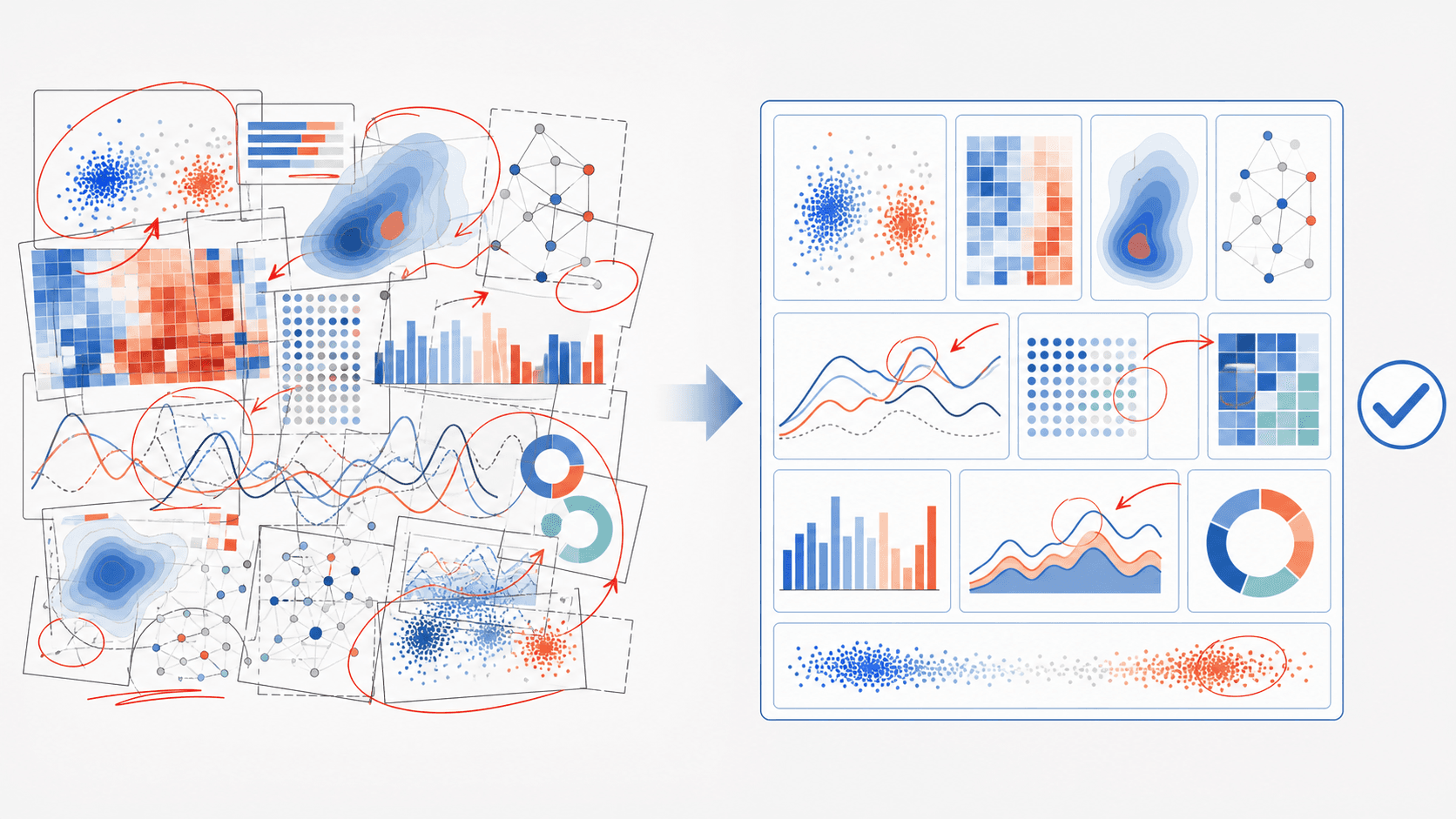
When a reviewer says "Figure is unclear," don't rush to draw a more complex one. Use 6 checkpoints to pinpoint problems in hierarchy, reading order, arrows, labels, and panel logic, then rebuild a clearer version with AI. Includes revision prompts and a pre-submission checklist.

One of the most frustrating kinds of revision comments is: Figure is unclear, The schematic is confusing, Please improve the graphical representation. It doesn't tell you exactly what to change, but you know the figure has to be redone.

When this happens, don't rush to draw a more complex figure. When a reviewer says it's unclear, it's usually not because the figure isn't fancy enough — it's a problem with information hierarchy, reading order, labels, arrows, or panel logic.

This article walks through a checklist for revising a figure, and you can use SciDraw AI to help generate a clearer version.

Scientific figure checker

First, diagnose: which kind of problem is "unclear"?

More Posts

Create your scientific figures with AI

Thousands of researchers use SciDraw AI to make publication-ready figures for papers, grants, and journal submissions — in minutes, with no design skills.

Start for free

1. Too much information

If a mechanism figure has 20 molecules, 8 branches, and 5 kinds of arrows, the reader can't tell what the main thread is.

2. The reading order isn't obvious

A paper figure should read naturally left-to-right or top-to-bottom. If the reader doesn't know where to start, that's a structural problem.

3. Arrow meanings are tangled

Within one figure, normal arrows, inhibition arrows, transport arrows, and causal arrows must be clearly distinguished.

4. Labels are too long

Labels in a figure are not the caption. Full sentences inside the figure make it cramped.

5. No logical relationship between panels

Panels A, B, and C can't just sit next to each other. There should be a clear progression, comparison, or causal relationship between them.

Checkpoint 1: Can you explain the figure in one sentence?

Before revising, write a single sentence:

This figure shows that Drug X suppresses NF-kB activation and reduces inflammatory cytokine expression in macrophages.

If you can't explain the figure in one sentence yourself, the reader has even less chance.

Checkpoint 2: Is only one main path kept?

When revising a mechanism figure, the most effective move is often to delete branches.

Not recommended direction

Add more molecular details and make the pathway more comprehensive.

Recommended direction

Simplify the mechanism figure.
Keep only the main pathway:
LPS -> TLR4 -> MyD88 -> NF-kB -> cytokines.
Move secondary molecules to the caption or supplementary figure.
Highlight Drug X inhibition between MyD88 and NF-kB.

Reviewers want clarity, not necessarily completeness.

Checkpoint 3: Can labels be cut by 30%?

A practical method: cut the text in the figure by 30% first.
Anything that can go in the caption shouldn't be in the figure.
Anything that can be a short label shouldn't be a full sentence.

For example:

  • Inflammatory cytokine expression is significantly reduced → Reduced cytokines
  • Drug X treatment group → Drug X
  • Nuclear translocation of NF-kB → NF-kB translocation

Checkpoint 4: Do the colors have clear meaning?

Color isn't decoration; it should carry meaning.

You can fix the rules:

  • Blue: main pathway
  • Orange: drug or intervention
  • Gray: background structures
  • Red: risk, injury, or enhancement

Don't let the same color mean activation in Figure 1 and inhibition in Figure 3.

Checkpoint 5: Is it still readable when shrunk?

At submission, many figures get compressed to single- or double-column width. Check:

  • Are fonts still readable?
  • Do thin arrows disappear?
  • Do icons blur into a blob?
  • Are panel letters clear?
  • Is it still distinguishable in grayscale?

If it's unreadable when shrunk, the figure isn't "submission-ready" — it just "looks good on a big screen."

Checkpoint 6: When redrawing with AI, don't just say "clearer"

Not recommended

Make this figure clearer and more professional.

Recommended

Revise this scientific mechanism figure for journal peer review.
Keep a left-to-right reading order.
Reduce label density by 30%.
Remove minor pathway branches.
Use one main activation arrow style and one inhibition arrow style.
Make the intervention point visually prominent.
Keep all labels horizontal.
White background, clean vector style.

These instructions can go directly into SciDraw AI's regeneration or editing workflow.

Pre-submission figure self-check checklist

Before submitting, go through these one by one:

  • Is there one clear main message?
  • Does the panel order match the body text description?
  • Are labels consistently in English?
  • Are fonts, line widths, and arrow styles unified?
  • Is the color still readable in grayscale?
  • Does it meet the journal's resolution and format requirements?
  • Are abbreviations in the figure explained in the caption?

FAQ: common search questions

A reviewer said my figure is unclear — what do I do?

Don't add detail first. First check the main message, reading order, arrow meanings, label density, and panel logic.

How do I simplify an overly complex mechanism figure?

Keep only the main path directly relevant to your paper's new finding, and move secondary molecules to the caption, supplementary figure, or body text.

Can AI help me revise a figure for revision?

Yes. It's best to give specific revision requirements — reduce labels, keep the main path, unify arrows, emphasize the intervention point — rather than just "make it more professional."

What formats should I check before submission?

At minimum: resolution, font size, line width, image format, grayscale readability, single/double-column width, and caption correspondence.

Is SciDraw AI suitable for the revision stage?

Yes, for quickly generating a clearer rebuilt version — especially mechanism diagrams, workflows, graphical abstracts, and multi-panel schematics.

The goal of revising a figure isn't to make it more complex — it's to let the reader understand your finding with less effort.

You can use SciDraw AI to rebuild a mechanism diagram or workflow first, then do a final check against the journal format.

All Posts

Author

avatar for Davie Chen / SciDraw AI
Davie Chen / SciDraw AI

Researcher

Davie Chen is a researcher at the Faculty of Animation and Intermedia, University of Arts in Poznan, studying generative AI for scientific figure creation, patent illustration, and manuscript drafting. SciDraw AI is one of the research-to-product tools built from this work.
Author profile

Categories

  • Tutorials
First, diagnose: which kind of problem is "unclear"?1. Too much information2. The reading order isn't obvious3. Arrow meanings are tangled4. Labels are too long5. No logical relationship between panelsCheckpoint 1: Can you explain the figure in one sentence?Checkpoint 2: Is only one main path kept?Not recommended directionRecommended directionCheckpoint 3: Can labels be cut by 30%?Checkpoint 4: Do the colors have clear meaning?Checkpoint 5: Is it still readable when shrunk?Checkpoint 6: When redrawing with AI, don't just say "clearer"Not recommendedRecommendedPre-submission figure self-check checklistFAQ: common search questionsA reviewer said my figure is unclear — what do I do?How do I simplify an overly complex mechanism figure?Can AI help me revise a figure for revision?What formats should I check before submission?Is SciDraw AI suitable for the revision stage?
How to Add an Element, Label, or Arrow to a Figure with AI (2026)
Tutorials

How to Add an Element, Label, or Arrow to a Figure with AI (2026)

Add an element, label, or arrow to a scientific figure without redrawing it — drop in a new organelle, annotation, leader line, or directional arrow just by telling the AI what to add and where. Copy-paste prompts, a reusable template, and an AI figure editor that does the work.

avatar for Davie Chen / SciDraw AI
Davie Chen / SciDraw AI
2026/06/18
How to Draw a Scientific Figure for Your Paper: A 5-Step AI Workflow from Abstract to Submission
Tutorials

How to Draw a Scientific Figure for Your Paper: A 5-Step AI Workflow from Abstract to Submission

A reusable 5-step workflow for paper figures: define the central message, split into panels, write a structured prompt, then check against submission standards. Includes scientific-figure prompt templates and FAQ.

avatar for Davie Chen / SciDraw AI
Davie Chen / SciDraw AI
2026/06/18
How to Draw Biomedical Paper Figures with AI: A Unified Workflow for Cell, Pathway, and Workflow Diagrams
Tutorials

How to Draw Biomedical Paper Figures with AI: A Unified Workflow for Cell, Pathway, and Workflow Diagrams

How to keep cell diagrams, signaling pathway figures, and experimental workflows visually consistent across one biomedical paper — split figures into a background layer, mechanism layer, and experiment layer, then generate editable drafts with structured prompts. Includes prompt templates.

avatar for Davie Chen / SciDraw AI
Davie Chen / SciDraw AI
2026/06/18
Explore Our Tools
Scientific Figure Maker·Graphical Abstract Maker·AI Scientific Illustration·Figure Checker