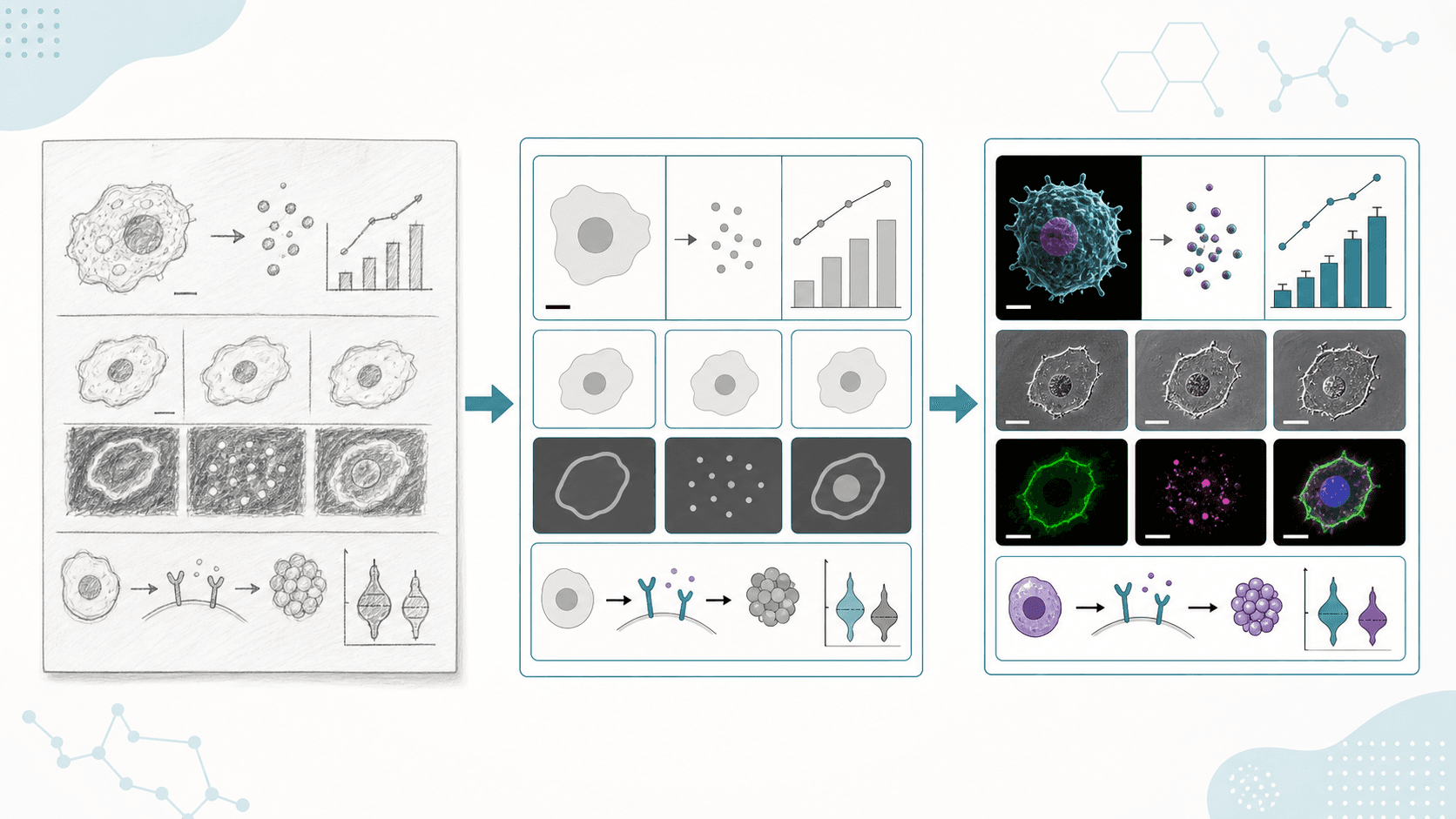
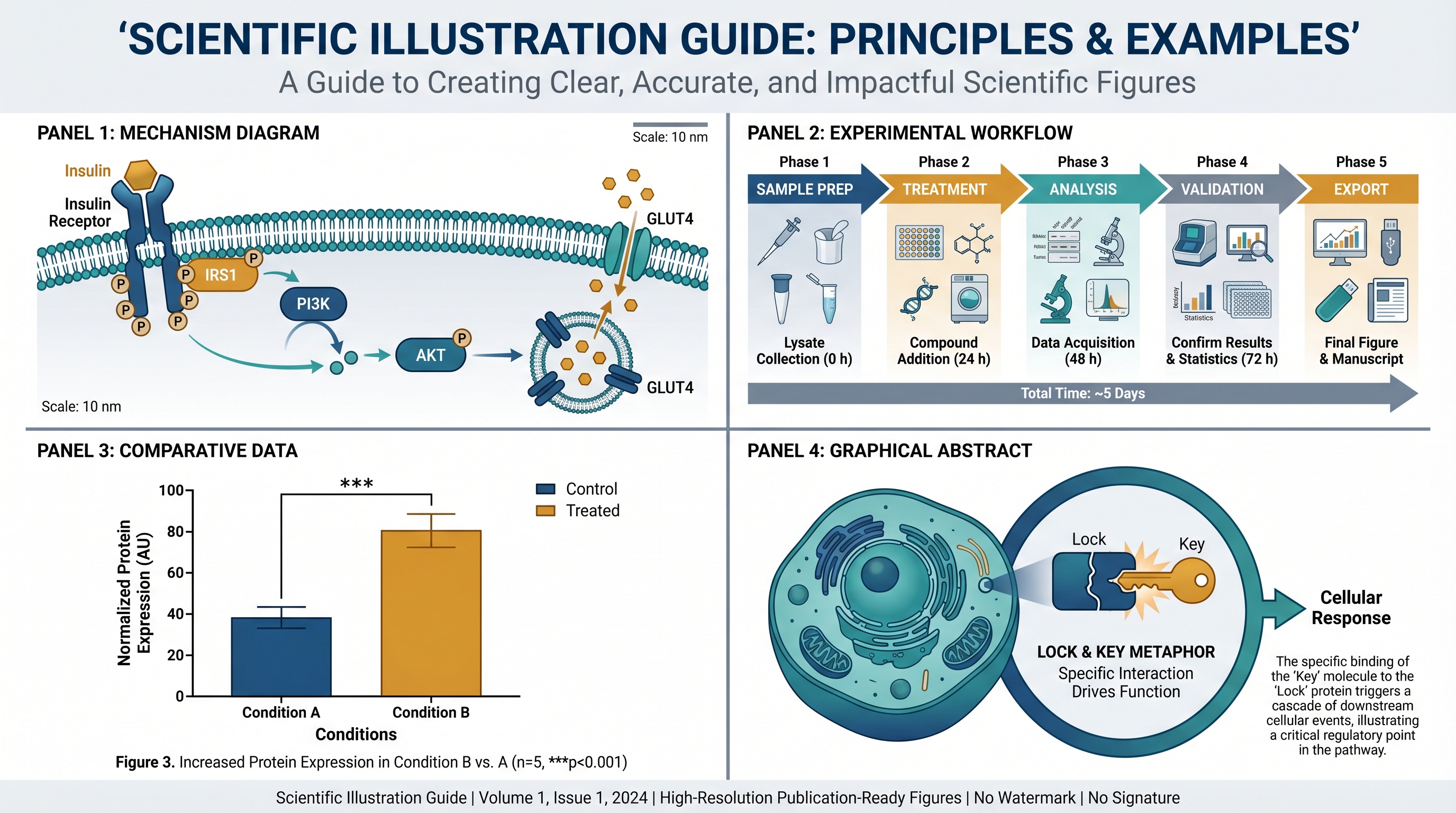
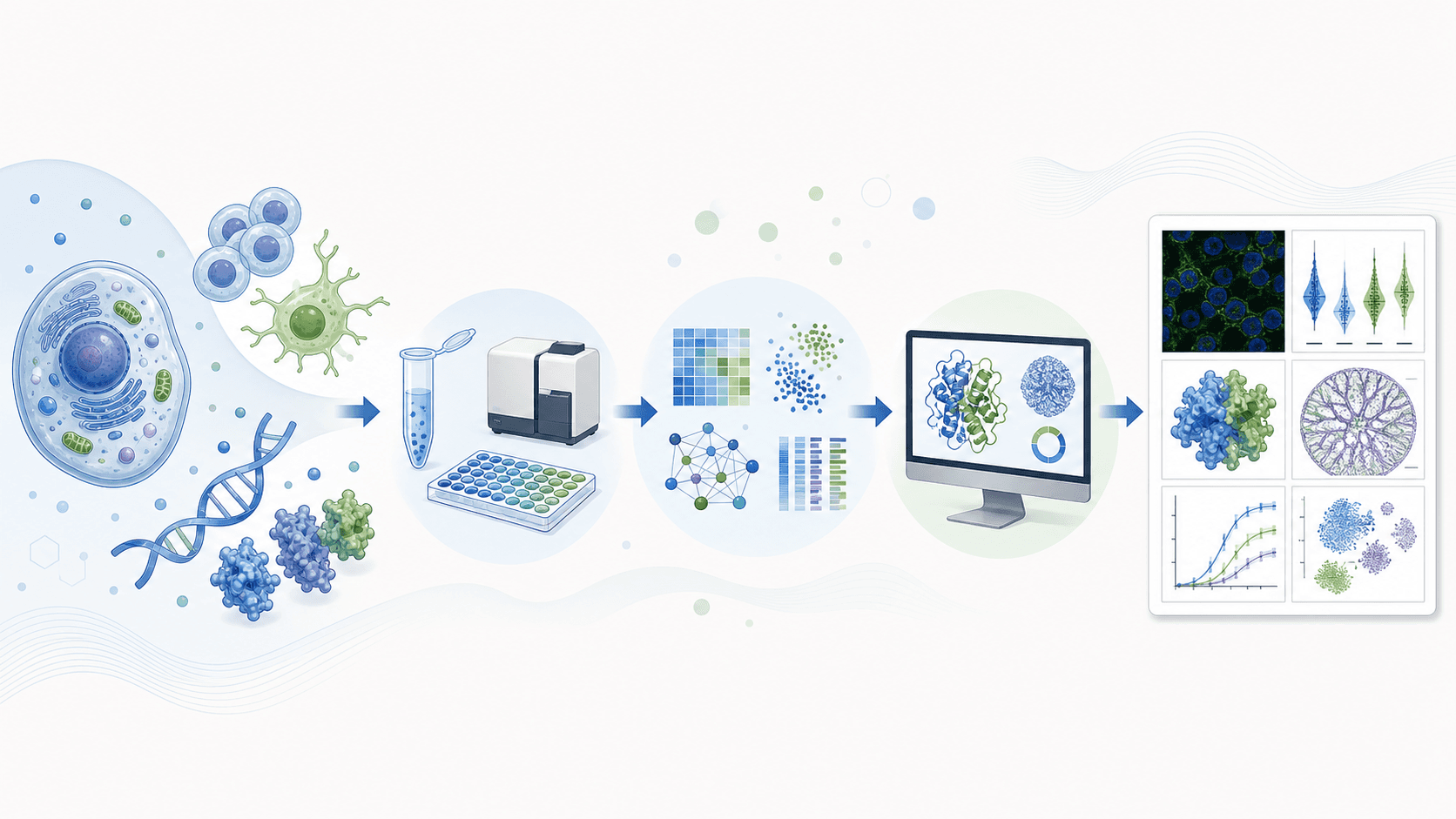
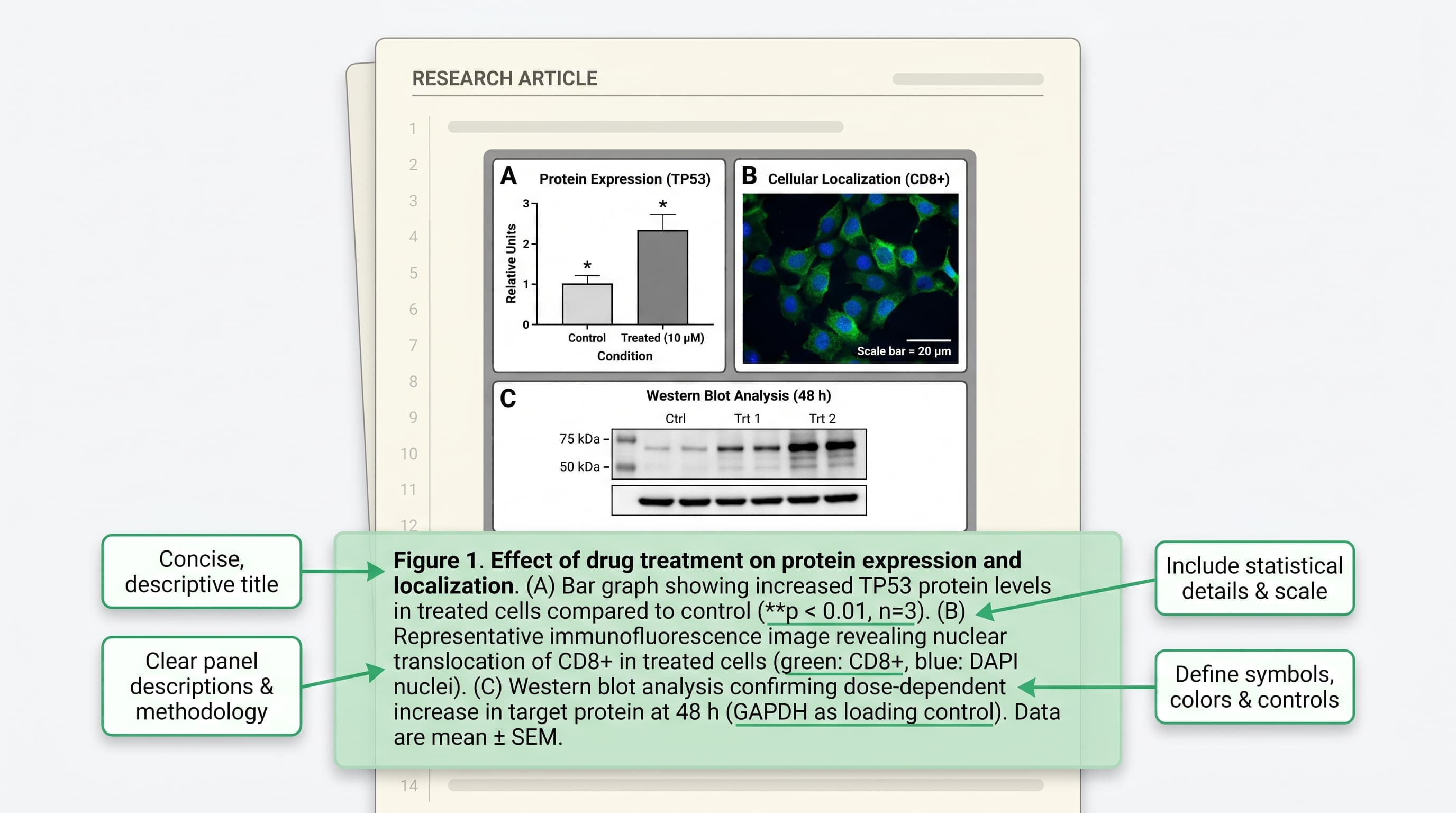
How to Draw a Scientific Figure for Your Paper: A 5-Step AI Workflow from Abstract to Submission
A reusable 5-step workflow for paper figures: define the central message, split into panels, write a structured prompt, then check against submission standards. Includes scientific-figure prompt templates and FAQ.
For many people writing a paper, the hardest part isn't the text — it's the figure. The abstract is done, the results are organized, but the moment you open PowerPoint or Illustrator, you have no idea how to lay out the mechanism diagram, the workflow, or the comparison panel. It usually ends the same way: arrows flying everywhere, more and more labels, and a figure that looks thrown together at the last minute.
If you ask a large language model "how do I draw a scientific figure for my paper," it will usually suggest breaking down your research logic first and then choosing a tool. That's the right instinct. The real problem isn't whether you can draw — it's whether you can turn your paper's content into a clear figure brief.
This article uses SciDraw AI as an example, but the workflow transfers to any tool: define the central message, split into panels, write the prompt, then check against submission standards.
Thousands of researchers use SciDraw AI to make publication-ready figures for papers, grants, and journal submissions — in minutes, with no design skills.
A scientific figure should carry one central message. You can lay out five experiments in the body text, but the figure should let the reader follow one main thread first.
Draw me a scientific figure about the macrophage inflammatory signaling pathway.
This prompt has a topic but no layout, no direction, no elements, no labels, and no style. The AI will happily generate something that "looks like a science figure" — but not necessarily one you can use in a paper.
If you're submitting to an international journal, use English labels from the start. Text length differs a lot across languages, and translating at the end often breaks the layout.
Journals typically specify resolution, font size, line width, single/double-column width, and TIFF/PDF/SVG formats. Checking format only after the figure is done usually means redoing work.
Create a clean 16:9 scientific mechanism figure for a research paper.Show left-to-right flow only.Panel A: macrophage cell membrane with receptor binding.Panel B: downstream signaling cascade NF-kB -> inflammatory cytokines.Panel C: Drug X blocks the pathway before NF-kB nuclear translocation.Use English labels in quotes: "Drug X", "Macrophage", "NF-kB", "Cytokines".Limit colors to blue, orange, gray.White background, publication-ready vector style, no decorative elements.
This prompt carries several key pieces of information:
Specifies 16:9
Specifies a left-to-right reading direction
Specifies the role of each panel
Specifies the label text
Constrains colors and background
In SciDraw AI, this kind of structured prompt is far more likely to yield an editable first draft than a single-sentence description.
Yes — but don't just dump the whole abstract in and call it done.
The better approach is to have the AI convert the abstract into a figure brief first:
Read the following abstract and convert it into a scientific figure brief.Extract:1. Main message2. Figure type3. Panel structure4. Key entities5. Arrows and relationships6. Required English labels7. Elements to excludeAbstract:[paste abstract here]
Once you have the brief, generate the figure with SciDraw AI or another tool. This is far more reliable than "draw a figure directly from the abstract."
Scientific figures usually get messier the more you revise them, because people keep adding things. After the first generation, check these five points first:
Can a reader follow it left-to-right and top-to-bottom?
Does each panel have only one protagonist?
Are any labels too long?
Do arrows mix meanings — activation, inhibition, transport — without distinction?
Is it still readable with the color removed?
You can ask the AI to revise like this:
Reduce label density by 30%.Remove minor pathway branches.Make the inhibitory step more visually prominent.Increase whitespace between panels.Keep all labels horizontal.
These instructions are far more effective than "make it more sophisticated" or "make it look more like a paper."
If you rely mainly on dragging templates and need a large library of ready-made icons, BioRender is still mature.
If your need is "turn a paper abstract, mechanism description, or research plan into a first draft quickly," an AI-native tool saves more time.
SciDraw AI fits these scenarios better:
Generating a scientific figure from a paper abstract
Producing first drafts of mechanism diagrams, workflows, graphical abstracts, and research roadmaps
Continuing to edit in PowerPoint, Illustrator, or other tools after export
AI can produce a first draft quickly, but before submission you still need to check fonts, resolution, line width, labels, grayscale readability, and journal format.
Graduate students, researchers, and educators who need to quickly produce paper figures, mechanism diagrams, research roadmaps, graphical abstracts, defense slides, and conference poster assets.
Davie Chen is a researcher at the Faculty of Animation and Intermedia, University of Arts in Poznan, studying generative AI for scientific figure creation, patent illustration, and manuscript drafting. SciDraw AI is one of the research-to-product tools built from this work.