Free AI Architecture Diagram Generator
From model design to publication-ready architecture figure
SciDraw AI generates professional architecture diagrams — neural network structures, transformer models, system frameworks, cloud architecture visuals, and ML pipeline diagrams — designed for AI/ML papers and technical reports.
Architecture Diagram Examples
Browse architecture diagrams across model families and system designs, or generate your own above.
AI and machine-learning architecture diagram generator
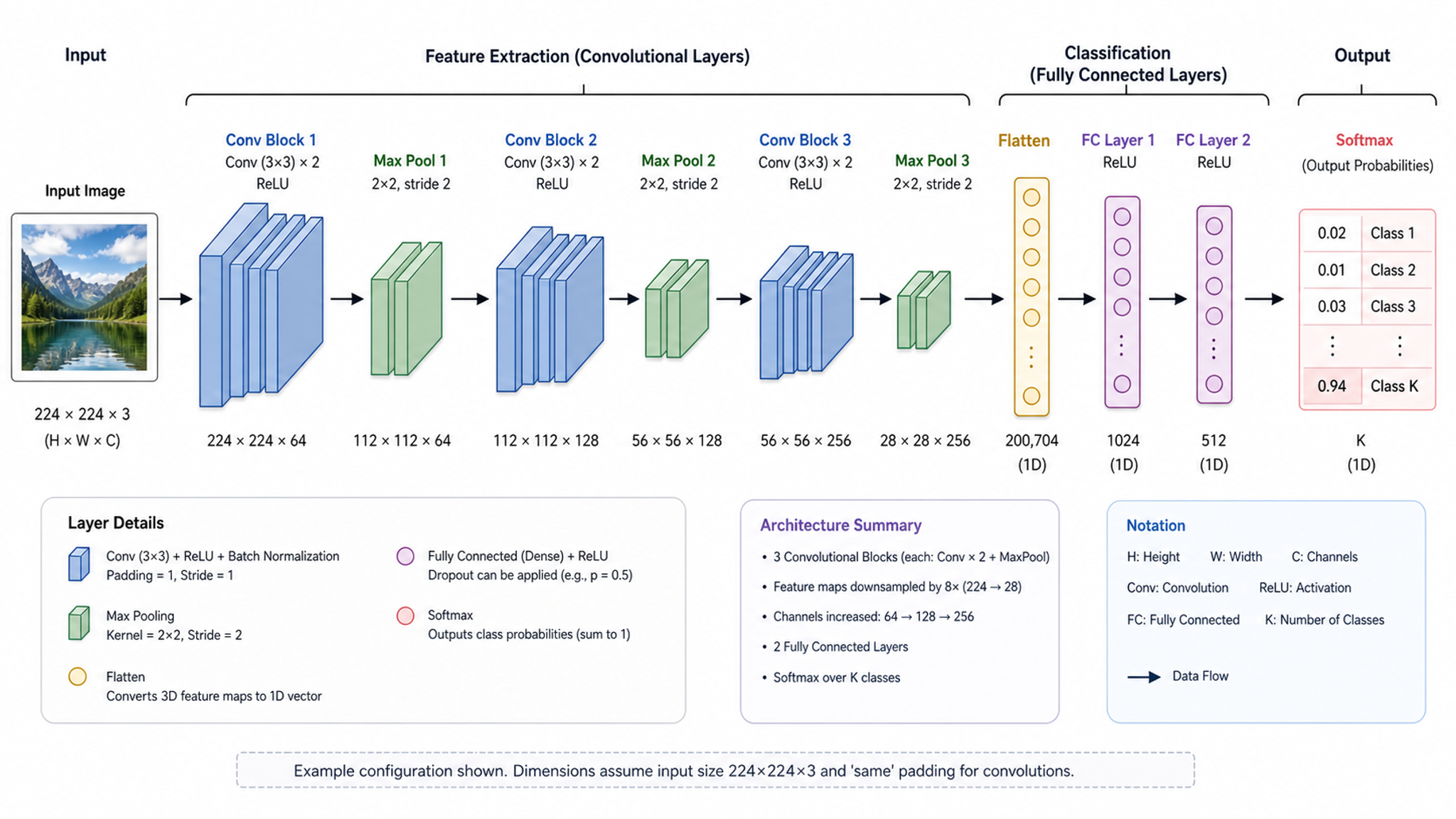
Turn an AI model description, architecture section, or machine-learning system design into a publication-ready figure. Visualize generative AI systems, CNNs, RNNs/LSTMs, Transformers, GANs, encoder-decoder models, ML pipelines, and agentic workflows with labeled blocks, data-flow arrows, and annotated tensor dimensions. To draw layer-by-layer neural network structures such as CNN or ResNet diagrams, use the dedicated Neural Network Diagram Generator; this page focuses on system, software, and AI system architecture.
Why you need clear architecture diagrams
- Help reviewers grasp a novel model structure in seconds
- Communicate layer configuration, data flow, and tensor dimensions precisely
- Meet the figure standards of top AI/ML conferences and journals
- Replace hours of manual work in draw.io, Visio, or PowerPoint
- Make complex ML systems understandable to collaborators and stakeholders
How to create an effective architecture diagram
An effective architecture diagram makes data flow obvious and labels every component clearly. Describe your modules in order — inputs, encoders or backbone blocks, attention or recurrent units, decoders, and output heads — and include tensor dimensions, kernel sizes, and connection types where they matter. Keep a consistent left-to-right or bottom-to-top flow and avoid clutter. SciDraw AI generates conference-ready architecture diagrams that follow these conventions automatically.
Common elements in architecture diagrams
- Labeled layer or module blocks (conv, attention, dense, normalization)
- Data-flow arrows showing the forward pass and connections
- Annotated tensor dimensions, channel counts, and kernel sizes
- Skip connections, residual paths, and recurrent links
- Input and output stages with embeddings and prediction heads
- Repeat notation (Nx) for stacked layers and module groups
Frequently Asked Questions
What types of AI architecture diagrams can I create?
You can create neural network layer diagrams (CNN, RNN, Transformer, GAN), system framework overviews, ML pipeline visualizations, multi-agent architecture diagrams, training/inference flow figures, and ablation study comparison diagrams. Both detailed and high-level views are supported.
Can I show tensor dimensions and layer parameters?
Yes. Specify input/output dimensions, kernel sizes, channel counts, sequence lengths, and other parameters. SciDraw AI will annotate your architecture diagram with the exact specifications, matching the style commonly seen in top AI conference papers.
Does SciDraw AI understand Transformer and attention architectures?
Yes. SciDraw AI recognizes multi-head attention, self-attention, cross-attention, feed-forward networks, layer normalization, positional encoding, and other Transformer components. It can generate both the classic Vaswani-style Transformer figure and custom variations.
Are diagrams suitable for top AI conference submissions?
Absolutely. The output meets the figure requirements of NeurIPS, ICML, ICLR, CVPR, ACL, AAAI, and other top venues. High-resolution exports with clean vector graphics ensure your architecture figures look professional in both single and double-column formats.
Can I visualize a multi-model or agentic system?
Yes. Describe the components — LLM modules, retrieval systems, tool-use interfaces, memory stores, planner agents, cloud services, and deployment layers — and SciDraw AI will generate a system architecture figure showing data flow, API calls, and component interactions.
Can I generate an architecture diagram from my paper text?
Yes. Paste your model description or architecture section, and SciDraw AI will parse the components, connections, and data flow to generate a visual architecture diagram. You can then adjust layout, colors, and annotations. For structured engineering handoff, use the exported SVG/PDF rather than expecting draw.io, Visio, PlantUML, or Terraform output.
How do I draw a Transformer architecture diagram for my paper?
Describe the model in plain language: encoder/decoder stack count, multi-head attention dimensions, feed-forward width, residual connections, layer norms, positional encoding, and any custom modules. The AI generates a labeled architecture diagram with the standard block conventions used in NeurIPS, ICML, ACL, and CVPR submissions. Edit annotations as SVG in Illustrator or Inkscape afterward.
What is the best AI tool to draw a CNN or neural network structure diagram?
For neural network structure diagrams, the right tool needs to understand layer types (conv, pool, batch-norm, activation), tensor shapes, skip connections, and standard visual conventions. SciDraw AI's AI Architecture Diagram Generator covers CNN, ResNet, U-Net, Transformer, GAN, VAE, GNN, and custom hybrid architectures, with publication-ready SVG / PDF / 300 DPI PNG export. For dedicated layer-by-layer network structure diagrams, the Neural Network Diagram Generator is the more specialized option.
Can I generate a system architecture diagram for an LLM application?
Yes. List the system components — LLM endpoint, vector store, retriever, tool-use interface, memory layer, prompt templates, evaluation harness — and the AI assembles them into a system architecture diagram showing data flow, API calls, and dependency direction. Output style matches the architecture-diagram conventions used in technical blogs and academic systems papers.
Create your architecture diagram now
Join thousands of AI researchers who use SciDraw AI to visualize neural network architectures, system frameworks, and ML pipelines.