Skin Diagram Generator
Labeled, unlabeled and blank skin anatomy in seconds
Describe the skin anatomy you need and generate a labeled cross-section, an unlabeled diagram for students to complete, or a blank skin worksheet for biology and health science lessons.
Labeled and Blank Skin Diagram Examples
Start from a ready-made example or describe your own — from a fully labeled cross-section to a blank skin worksheet students can fill in.
What is a skin diagram?
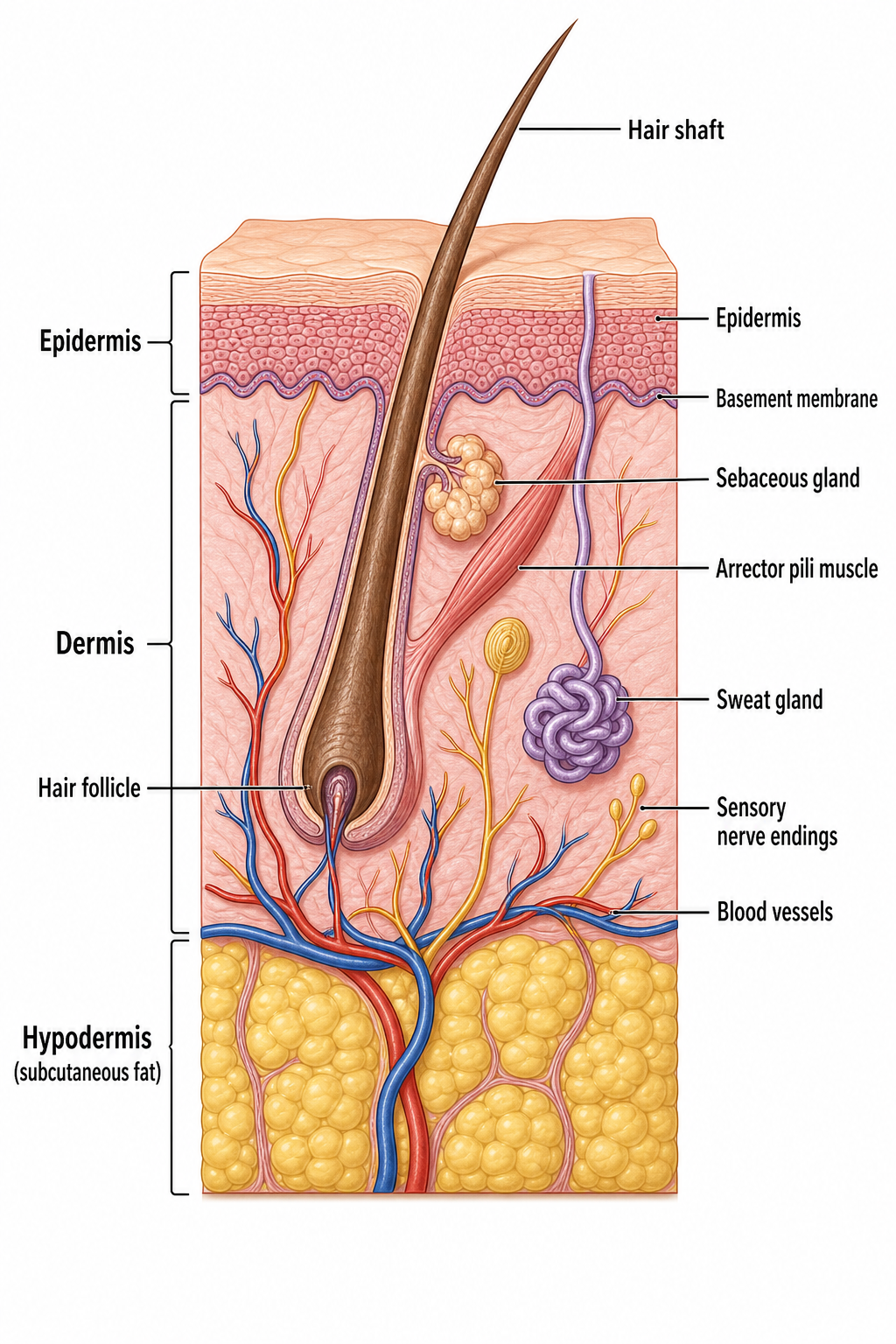
A skin diagram is a labeled cross-section of the integumentary system showing the epidermis, dermis and hypodermis together with the structures embedded in them: hair follicles, sebaceous and sweat glands, the arrector pili muscle, blood vessels and sensory receptors. It is one of the first figures students meet in human biology because a single cut-away view explains how a layered organ works. SciDraw AI renders these structures at their correct depths from a short description, so you can teach or revise skin anatomy without redrawing a textbook figure. The same description also gives you the classroom version: ask for an unlabeled section with empty leader lines and you get a printable worksheet students can label themselves, then generate the labeled version to hand out as the answer key.
Why you need a skin diagram
- Learn the three skin layers and what sits in each one.
- Show how hair follicles, glands and receptors relate to the layers.
- Create figures for worksheets, slides, lab reports and exams.
- Support health science and nursing study with accurate integumentary anatomy.
- Replace tracing or clip-art with custom, print-ready diagrams in minutes.
How to make a skin diagram
Describe the view and the structures you want drawn — the three layers, a hair follicle, the glands, the receptors — and say whether you want every structure named or an unlabeled version with blank leader lines for students to complete. Add "clean white background, print-friendly" when the diagram is going onto a worksheet. SciDraw AI generates an anatomically accurate skin cross-section at 2K resolution that you can download and drop straight into your slides or handouts, and you can refine the wording and regenerate until the labels and layout match your lesson.
Parts of the skin
- Epidermis, with its five strata from corneum to basale.
- Dermis, holding the glands, vessels and receptors.
- Hypodermis, the subcutaneous fat layer beneath.
- Hair follicle, shaft, bulb and dermal papilla.
- Sebaceous gland, sweat gland and arrector pili muscle.
- Sensory receptors from free nerve endings to Pacinian corpuscles.
Frequently Asked Questions
What are the three layers of the skin?
From the surface inward the skin has the epidermis, the dermis and the hypodermis. The epidermis is the thin outer barrier built from five strata of keratinocytes. The dermis is the thicker connective layer holding hair follicles, sebaceous and sweat glands, blood vessels and most sensory receptors. The hypodermis, also called the subcutaneous layer, is mostly fat and anchors the skin to the tissue beneath.
How do I make a labeled skin diagram online?
Open the generator above, describe the cross-section you need and name the structures you want labeled. SciDraw AI produces an accurate layered diagram in seconds that you can download in 2K and use anywhere. No drawing skills or design software required.
Which sensory receptors are in the skin?
Free nerve endings sit highest and carry pain, temperature and itch. Merkel discs sit at the base of the epidermis for sustained pressure and texture. Meissner corpuscles sit in the dermal papillae for light touch, Ruffini endings deeper in the dermis for skin stretch, and Pacinian corpuscles in the hypodermis for deep pressure and vibration.
Are the skin diagrams anatomically accurate?
Yes. Diagrams are generated with the layers in the correct order and thickness, the follicle rooted in the dermis, the glands in their proper positions, and the sensory receptors at their true depths. You can request a specific focus, such as the epidermal strata or the follicle and its glands, and refine the prompt until the figure is right for your needs.
Is the skin diagram generator free to use?
You can start generating skin diagrams for free. New accounts get 10 credits on signup and 5 more each day, and a standard 2K diagram costs 5 credits. Paid plans add a monthly credit allowance if you produce many figures.
Can I use these skin diagrams in class or coursework?
Yes. The diagrams are designed for biology, health science and nursing education. Use them in lecture slides, worksheets, lab reports, study guides and exam materials, and download in high resolution so labels stay sharp when printed or projected.
Can I generate an unlabeled or blank skin diagram?
Yes. Describe the layers and structures you want drawn and ask SciDraw AI to leave the labels off, or to use numbered leader lines pointing to empty boxes. You get the same accurate cross-section with no text on it, which is what you need for a diagram students have to label themselves.
Can I use the generated skin diagram as a worksheet and answer key?
Yes. Generate the blank cross-section first with empty numbered leader lines and print it as the labeling worksheet, then generate a fully labeled version to use as the answer key. Ask for the same view and the same numbering in both prompts so the two sheets line up for your students.
Explore More Tools
Create your skin diagram now
Generate a labeled skin cross-section, an unlabeled version to label, or a blank skin worksheet in seconds. Perfect for biology and health science.