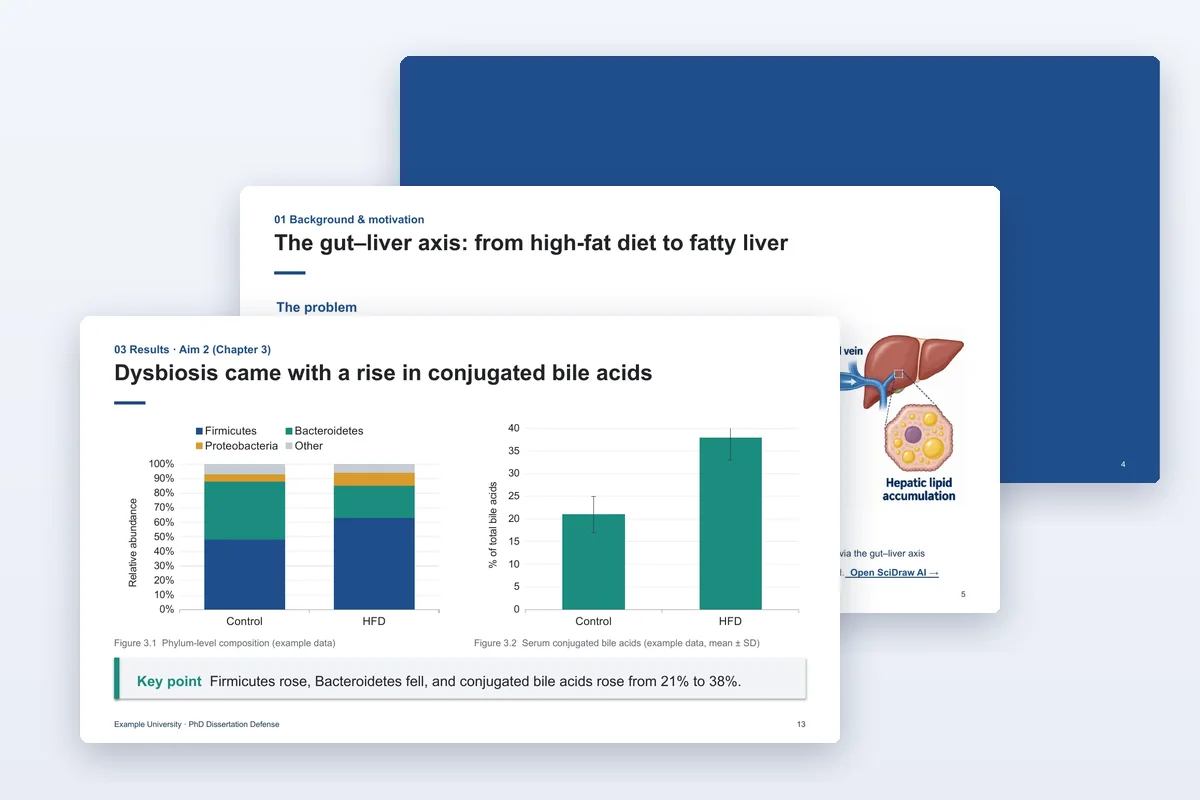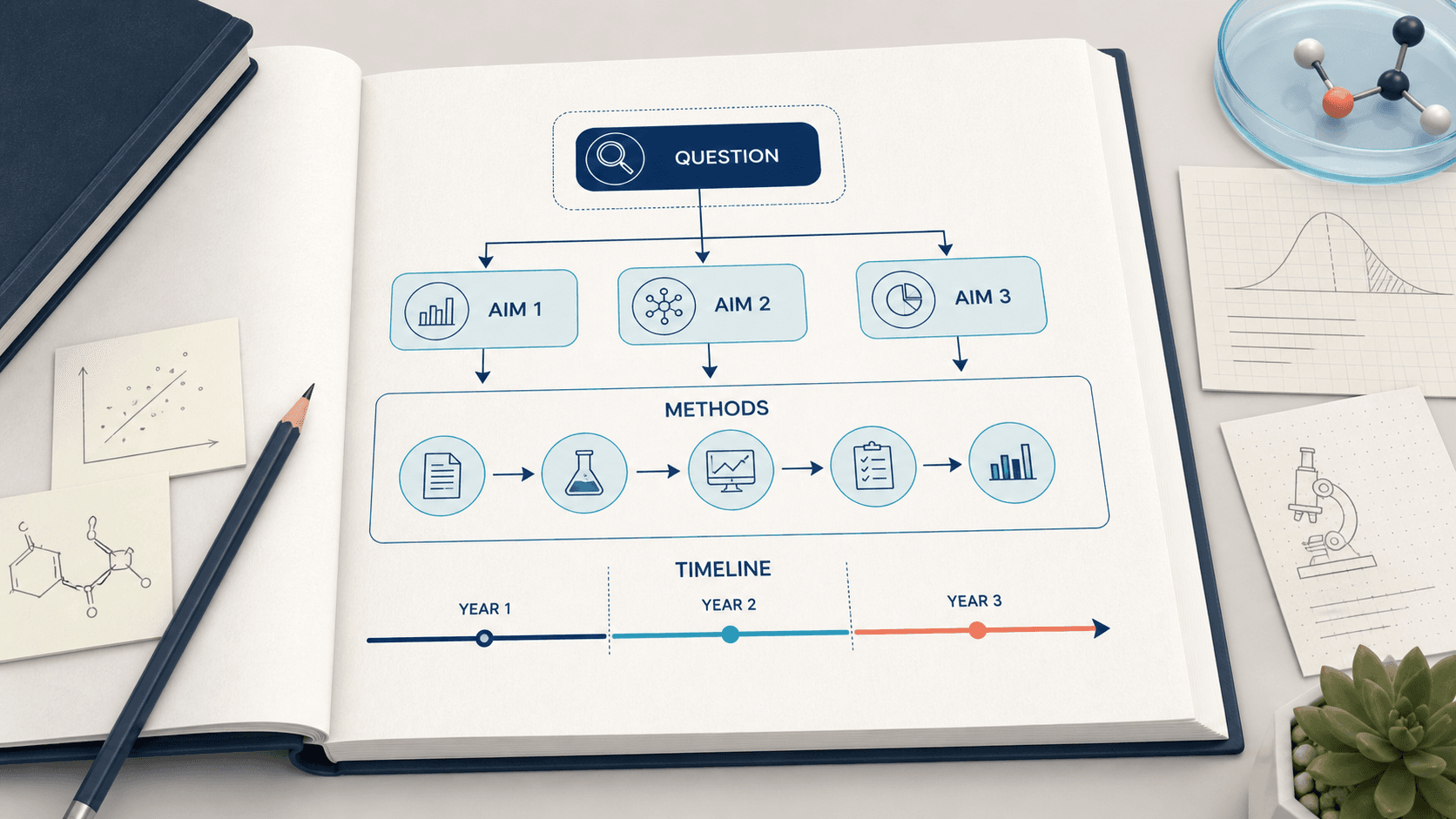
An applicant can have a promising question, strong grades, and relevant research experience—and still submit a proposal that feels impossible to evaluate. The problem is often not the idea. It is that the reader cannot quickly see the chain from research gap to question, method, evidence, and contribution.
A professional figure can make that chain visible. It cannot rescue a vague project, and it should never be added just to make the document look expensive. Used well, however, a research framework, method workflow, or timeline lets a supervisor or admissions panel inspect your reasoning without decoding five dense pages first.
This guide applies broadly to doctoral applications: university and research-institute admissions, application-and-assessment routes, structured doctoral programmes, and applications built around a self-proposed project. Requirements vary sharply, so use the structure below as a thinking tool—not as a substitute for the instructions of the programme you are applying to.
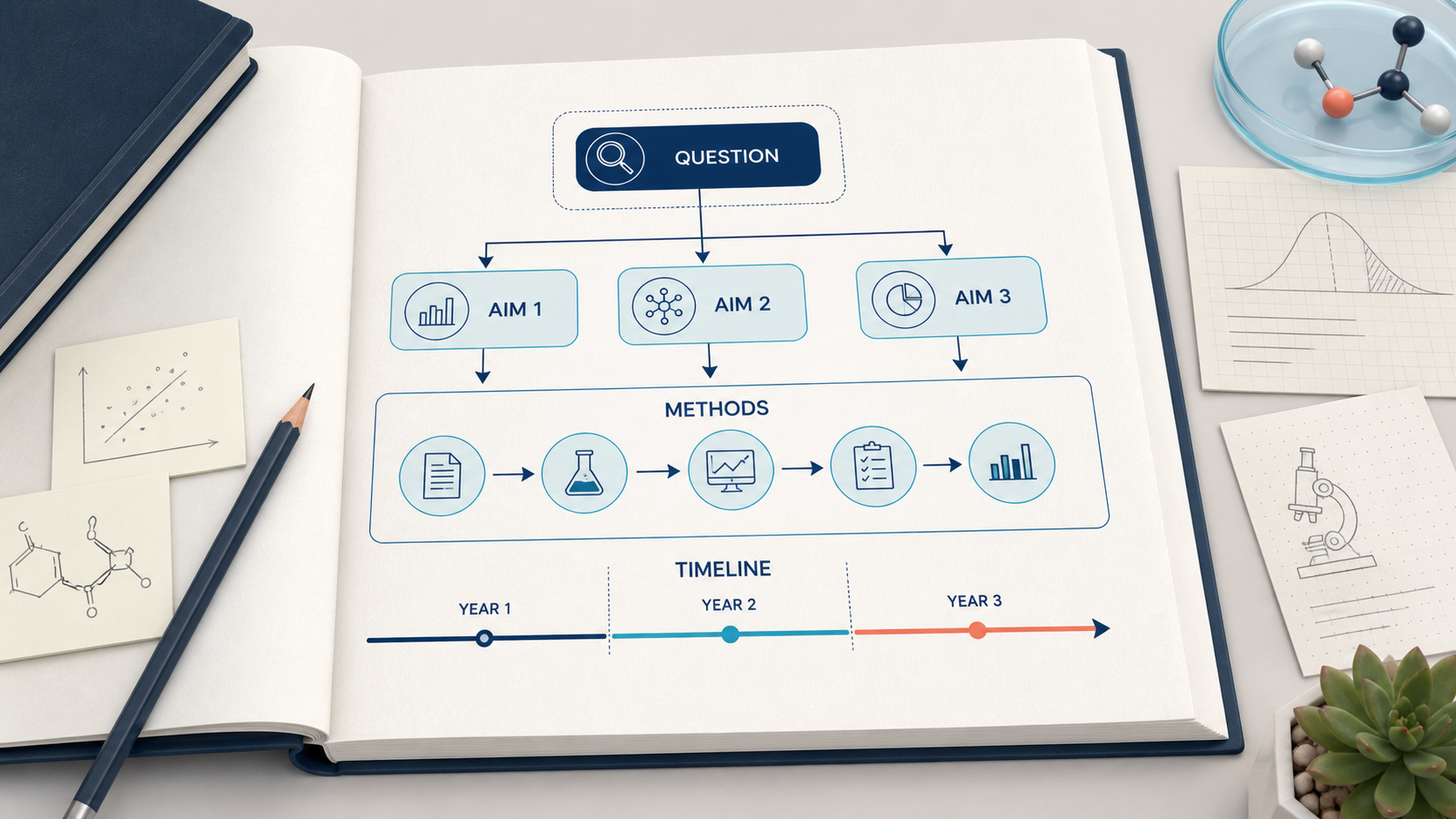
Before writing: check whether a proposal is required
Start with the programme, department, or institute page. Do not start from a generic online template.
The differences are real:
- Oxford notes that not every research course requires a full proposal; some advertised or laboratory-based projects ask for research interests or preferred supervisors instead.
- The University of Southampton gives a 1,500-word example structure, excluding the bibliography.
- A 2026 doctoral admissions outline from the Institute of Zoology, Chinese Academy of Sciences asks for a research plan of about 3,000 Chinese characters, including rationale, key scientific questions, methods, innovation, and an annual plan.
- A 2026 application-and-assessment route at Renmin University of China allows up to 10,000 Chinese characters and does not prescribe one fixed template.
- Charité's 2026 PhD/MD-PhD exposé format is capped at three pages and permits an optional appendix with up to two figures.
Before drafting, record five constraints: required sections, word or page limit, citation style, whether figures count toward the limit, and whether you must name or contact a prospective supervisor.
Common mistakes that weaken a doctoral proposal
1. Treating a topic as a research question
“AI in medical education” is a field. “How does AI-assisted feedback affect diagnostic calibration among first-year radiology trainees?” is a question that can drive a study.
2. Summarising literature without locating a gap
A proposal is not a miniature textbook. A useful literature section moves through three steps: what is established, what remains uncertain, and why that uncertainty matters.
3. Naming methods without designing a study
“Interviews, surveys, and machine learning” is a shopping list. Explain who or what will be studied, how access or sampling works, what will be measured, how the evidence will be analysed, and why the method answers the question.
4. Promising results instead of planning evidence
You are not expected to know the findings in advance. State the evidence you expect to generate, the outcomes that would support or challenge the hypothesis, and what you will do if a critical step fails.
5. Ignoring supervisor and institutional fit
Panels assess not only whether the project is interesting, but whether the institution has the expertise, data access, equipment, archives, participants, or collaborations needed to support it. Cambridge's guidance explicitly frames value, achievability, and supervisory fit as central questions.
6. Adding decorative figures
A colourful diagram with vague arrows consumes space and creates new questions. A figure deserves inclusion only if it shows a relationship, sequence, comparison, or decision more clearly than prose.
7. Letting AI invent the academic argument
The research question, literature judgement, citations, and methodological choices must remain yours. The University of Manchester warns that proposals relying heavily on descriptive AI-produced text and showing limited independent thought are unlikely to succeed.
What reviewers are trying to learn
A strong proposal lets a reader answer six questions:
- What exactly will you investigate?
- What is missing from current knowledge or practice?
- Why is the gap significant?
- What evidence and methods will answer the question?
- Can the project be completed with the time, skills, and resources available?
- Why are you and this research environment a credible match?
The order matters. Do not begin polishing sentences until you can connect those six answers in one page of notes.
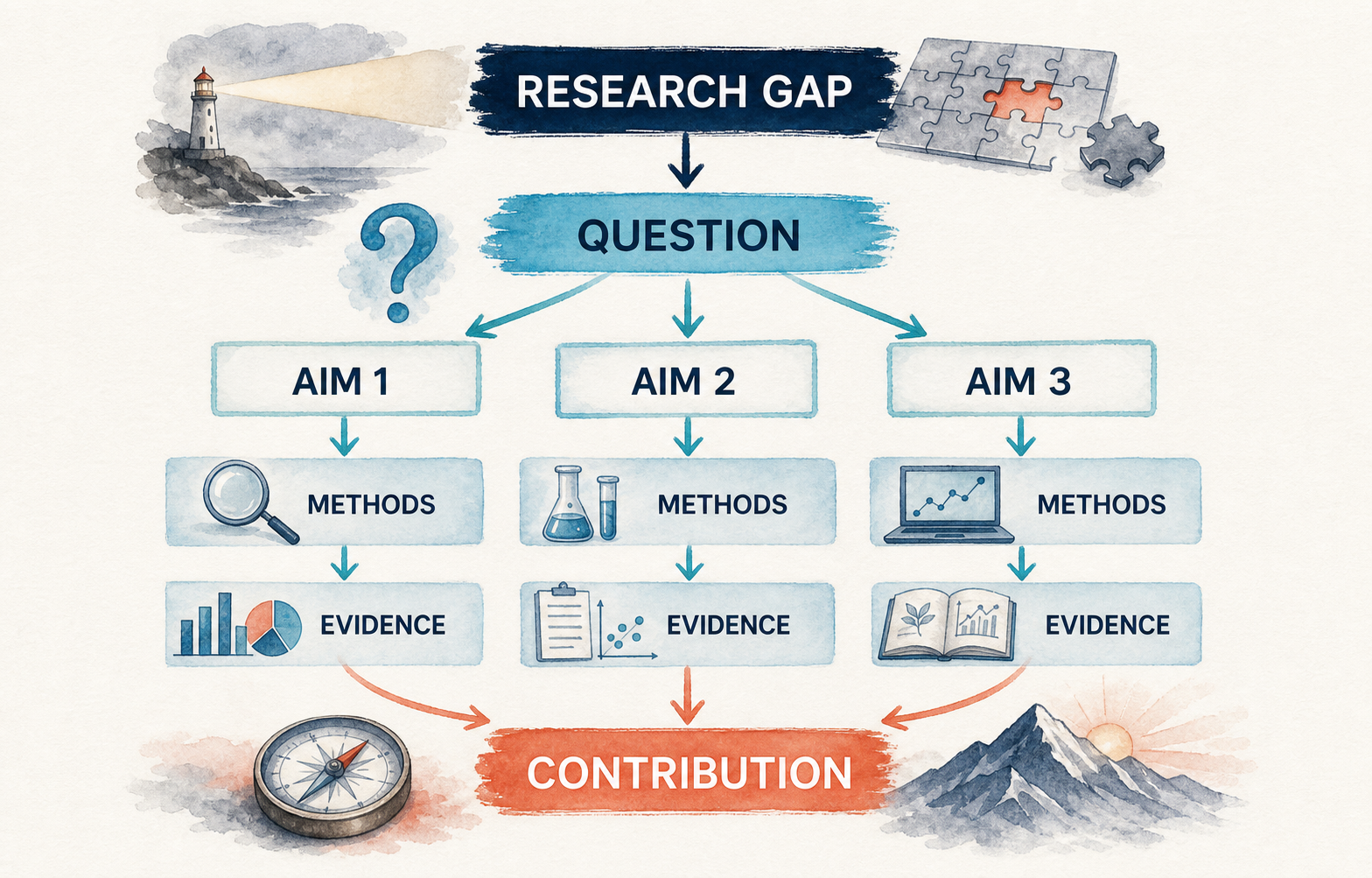 A proposal should read as one connected argument, not a collection of independently impressive sections.
A reusable PhD research proposal structure
Always follow the requested template first. When no detailed template is supplied, this structure is a reliable starting point.
1. Working title
Name the object, relationship, population or context, and—when useful—the approach. Avoid titles that claim a result before the study exists.
Too broad: AI and higher education Better: How AI-assisted formative feedback shapes diagnostic calibration in postgraduate radiology training
2. Project overview or abstract
In one compact paragraph, state the problem, gap, main question, proposed approach, and expected contribution. Write this after the rest of the proposal even if it appears first.
3. Background and research gap
Select the literature needed to establish the problem. End with a precise gap statement:
Existing studies establish A and suggest B, but they have not explained or tested C in context D. This project will address that gap by E.
4. Research question, hypothesis, and aims
Use one central question and a small number of supporting aims. Every aim should produce evidence that helps answer the central question. If an aim could disappear without affecting the main argument, it may be a separate project.
5. Research design and methods
For each aim, specify:
- evidence or data required;
- source, population, corpus, sample, or materials;
- collection or experimental procedure;
- analysis method and why it is suitable;
- access, ethics, validity, or reproducibility considerations;
- a realistic alternative if the preferred route fails.
For a visual first draft, turn this sequence into a method workflow. Keep the diagram at the level of research decisions; a laboratory protocol or software command list is usually too detailed for the main proposal.
6. Original contribution and significance
Separate the two:
- Contribution: the new explanation, evidence, dataset, method, model, interpretation, or design your project may add.
- Significance: why that contribution matters to a field, practice, community, or policy question.
7. Feasibility, fit, and preparation
Show that you understand what the project requires. Briefly connect your previous research or training to the proposed work, identify skills you still need to acquire, and explain why the prospective supervisor, department, laboratory, archive, dataset, or facility is relevant.
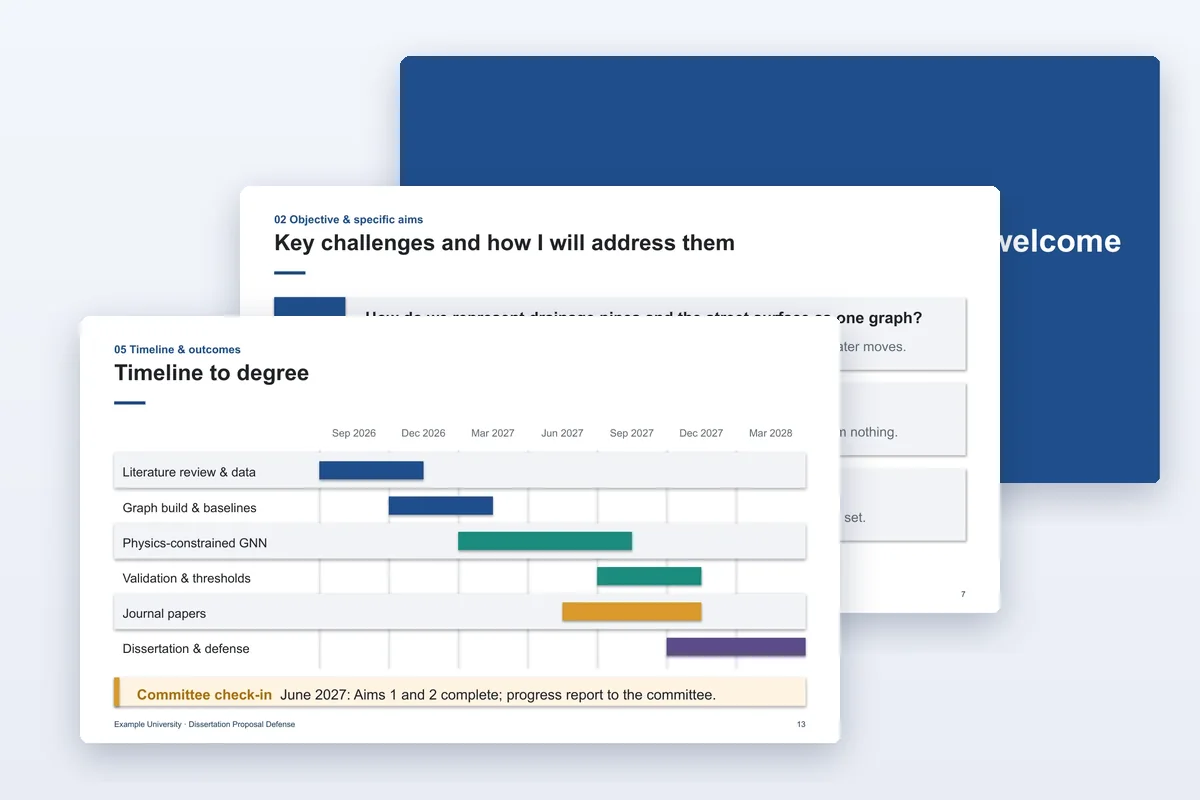
8. Timeline and milestones
A timeline should show decisions and deliverables, not just dates. Depending on programme length and discipline, milestones might include ethics approval, pilot work, data access, fieldwork, analysis, chapter drafts, papers, prototypes, or validation studies.
Use the Research Roadmap Maker to draft a phase-based plan, then edit it to match the programme's actual duration. Do not recycle a three-year template for a four- or five-year programme without changing the logic.
9. Ethics, risks, and contingency plans
Address consent, privacy, vulnerable participants, data security, dual-use concerns, fieldwork safety, cultural permissions, or conflicts of interest when relevant. Pair important risks with specific alternatives rather than writing “no major risks are anticipated.”
10. References
Use a focused bibliography that supports the decisions in the proposal. Verify every reference against the original source. Do not include papers simply to make the list look long.
How to allocate a limited word count
There is no universal ratio, but this is a useful planning range when the programme supplies a total limit without section limits:
| Section | Approximate share |
|---|---|
| Overview and problem | 10–15% |
| Literature and gap | 20–25% |
| Questions and aims | 10% |
| Design and methods | 30–35% |
| Contribution, feasibility, ethics, and risks | 15–20% |
| Timeline and fit | 10–15% |
References may or may not count. Check the instructions rather than assuming.
Which figures belong in a PhD proposal?
If figures are allowed, one or two strong visuals are often more useful than a gallery. Each must answer a different question.
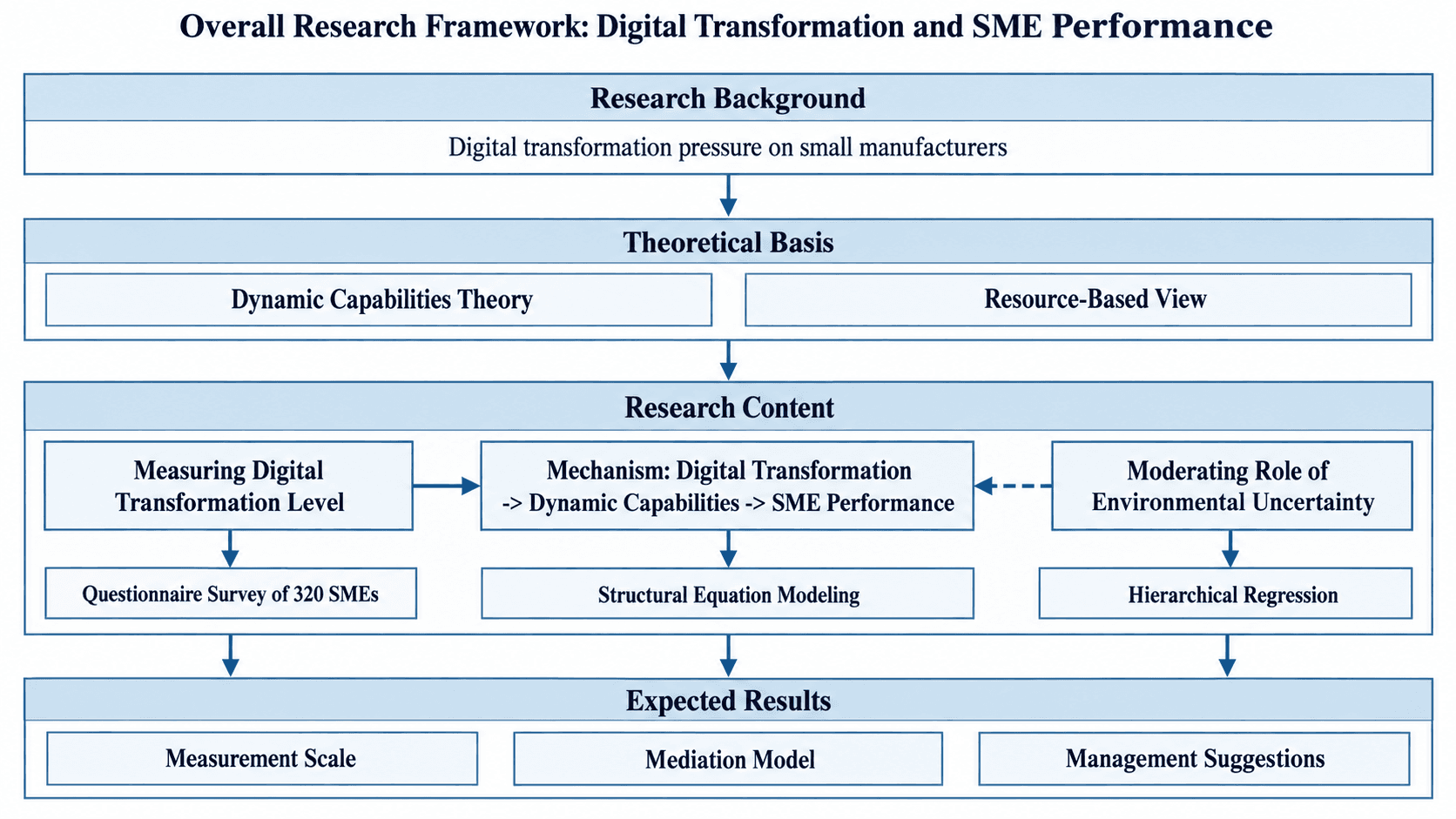
Research framework: What is the logic?
Use a Conceptual Framework Maker for relationships among concepts, variables, mechanisms, or research aims. Label arrows with their meaning; an unlabeled arrow can hide the very claim the figure is meant to clarify.
Method workflow: How will the evidence be produced?
Use a Workflow Diagram Generator for sampling, data collection, experiment stages, analysis, validation, and contingency routes.
Roadmap or timeline: Can it be completed?
Use a Research Roadmap Maker for phases, milestones, dependencies, and outputs. A roadmap explains research logic; a Gantt chart mainly explains scheduling. Use the one the instructions and your project actually need.
Scientific or mechanism figure: What system is being studied?
When the project depends on a biological mechanism, material process, system architecture, device, intervention, or spatial relationship, a Scientific Figure Maker can make the object of study concrete.
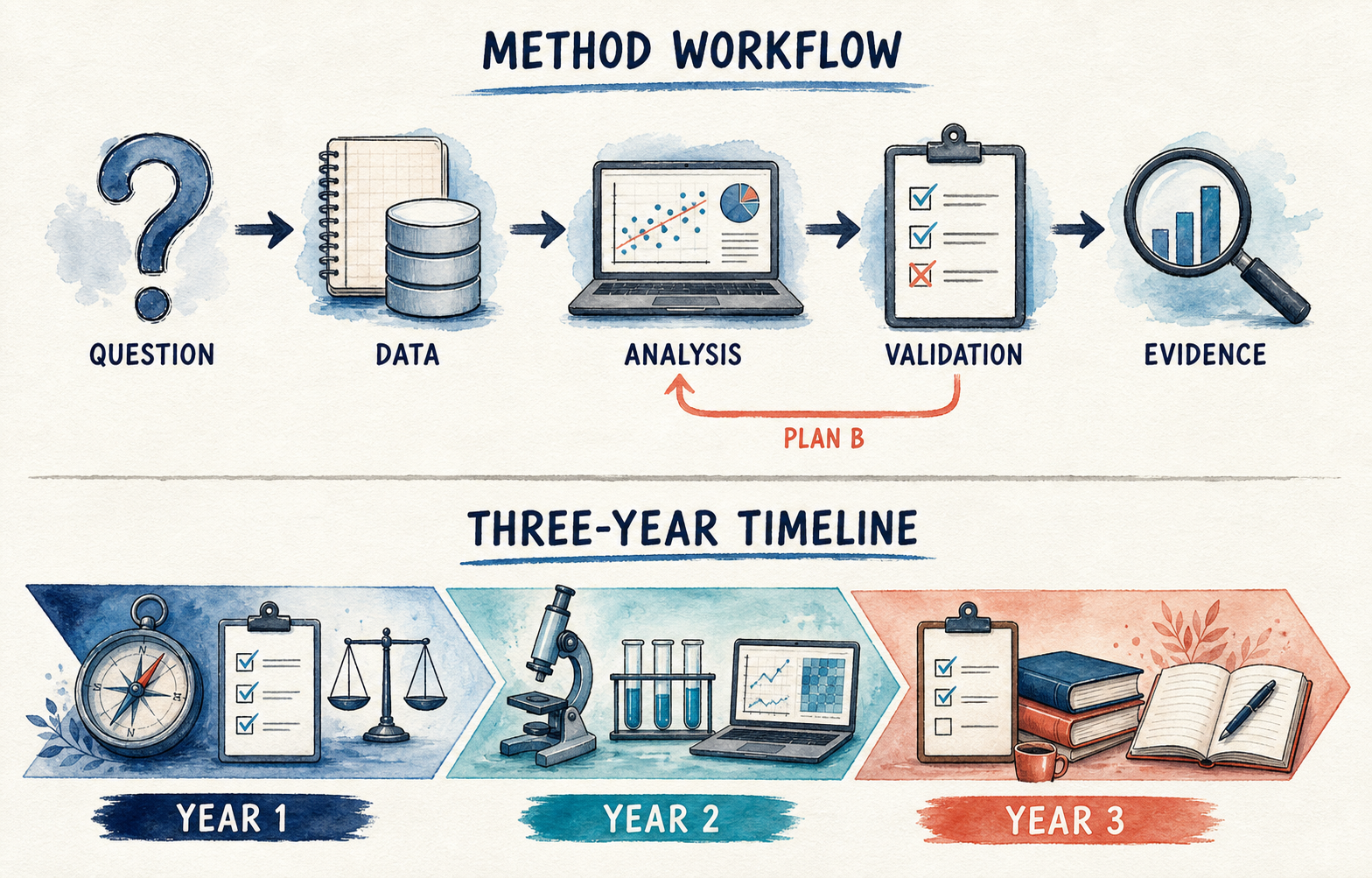 Methods explain how evidence will be produced; a timeline shows when decisions and milestones occur.
Three concrete figures that could go into a proposal
The following are not diagrams about diagram-making. They are hypothetical case figures of the kind an applicant could place in the proposal itself. The scientific claims, variables, and methods are examples only: replace them with your own project and verify every relationship before submission.
Biomedical case: a proposed mechanism and intervention
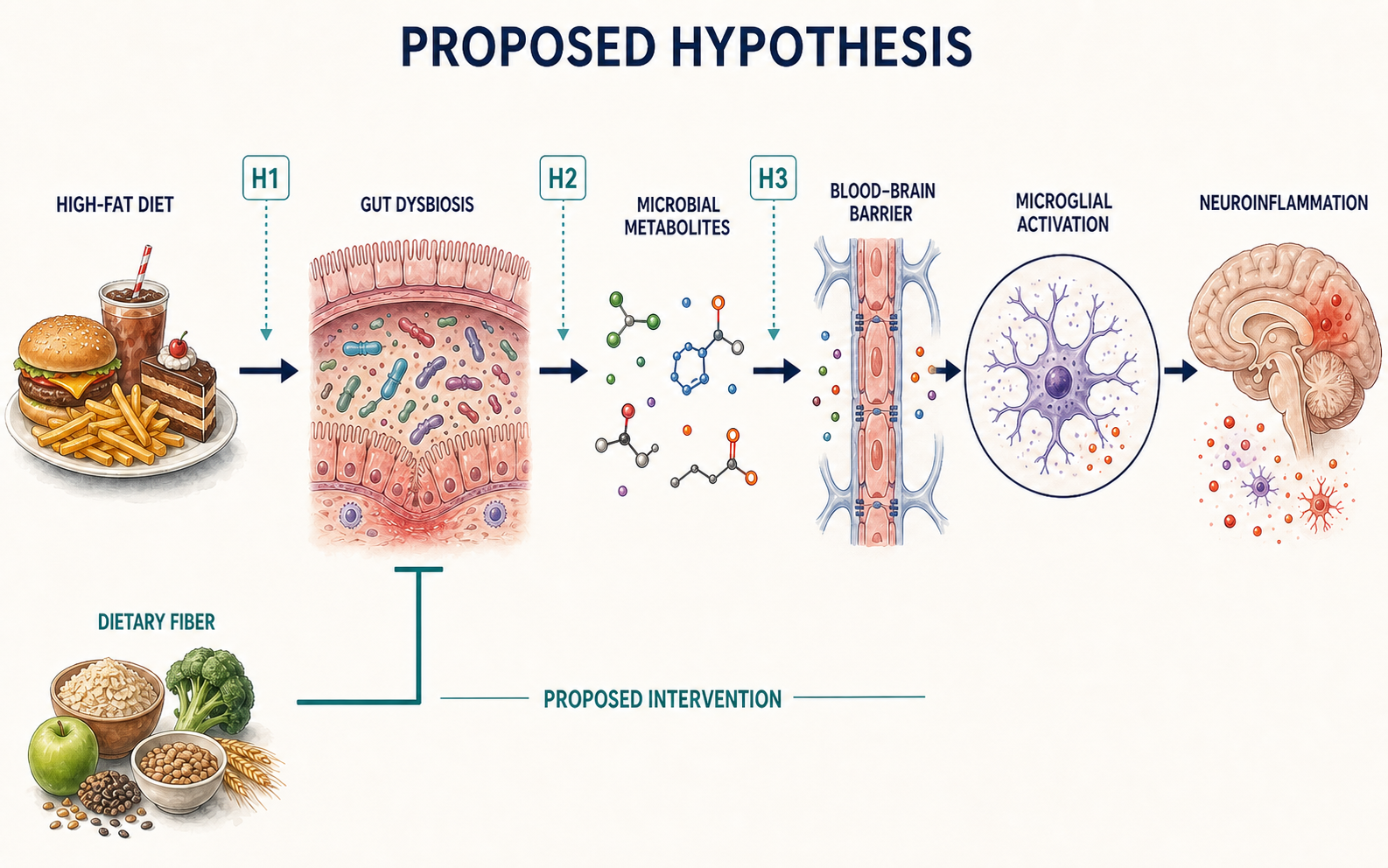 A mechanism figure turns a broad topic into testable links and makes the intervention point explicit.
This belongs after the background or hypotheses. Replace the exposure, biological compartments, mediators, outcome, and intervention with the elements of your study. Each arrow must be supported by literature or clearly marked as a proposed hypothesis; the T-bar must mean inhibition consistently. A first draft can be prepared with the Scientific Figure Maker, but the applicant remains responsible for biological accuracy.
Social-science case: mediation, moderation, and controls
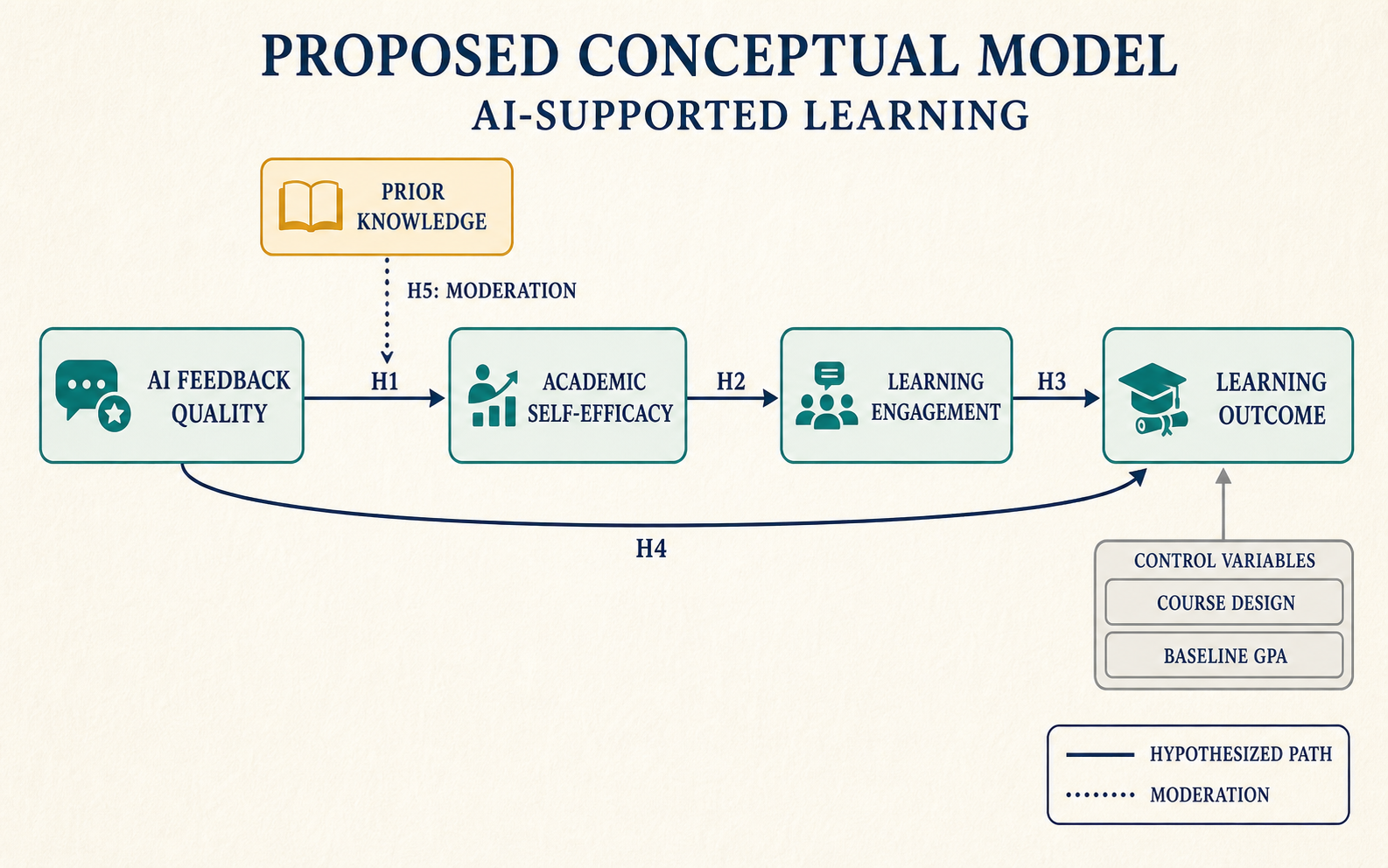 The figure separates the main pathway, a moderator, a direct effect, and control variables.
Place this beside the conceptual framework or research hypotheses. Replace the constructs and H-labels, then define every variable in the text. Do not draw a causal arrow if an observational design can establish only association, and do not add a mediator or moderator merely to make the model look sophisticated. The Conceptual Framework Maker is useful for testing alternative structures before choosing one.
Engineering and AI case: development versus external validation
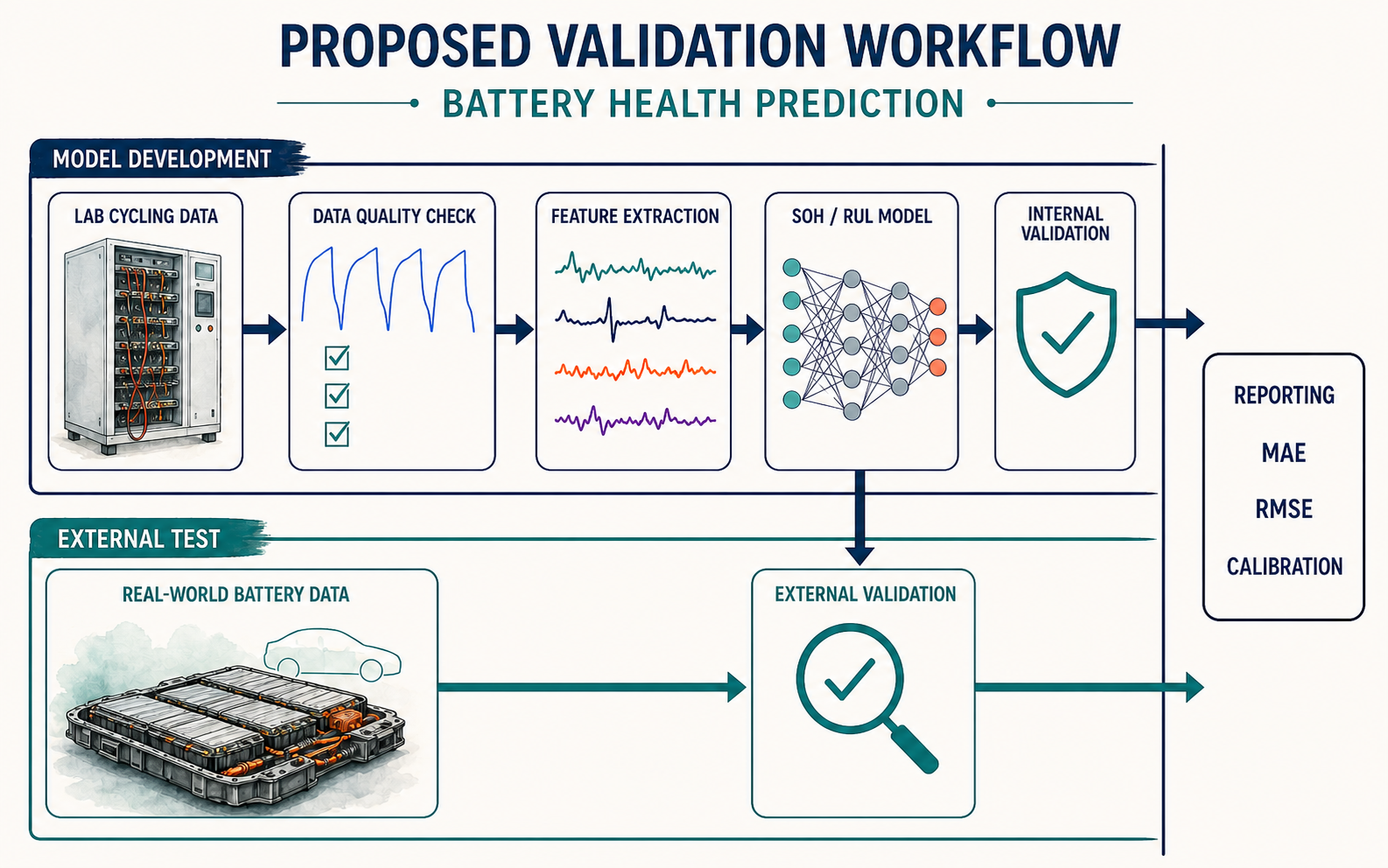 A methods figure should reveal data provenance, processing, model development, validation boundaries, and planned reporting without inventing results.
This fits in the methods section. Replace the data sources, quality checks, features, model, validation sets, and metrics with your actual design. Keep training, internal testing, and external validation visually separate. A proposal may name planned metrics, but it must not contain fabricated performance plots or scores. Use the Workflow Diagram Generator to make the sequence auditable.
Professional does not mean decorative
A proposal figure should have:
- one reading direction;
- labels that match the proposal word for word;
- short noun phrases instead of paragraphs inside boxes;
- consistent fonts, arrow styles, and colour meanings;
- enough contrast for grayscale printing;
- a caption that states what the reader should learn;
- editable output for supervisor feedback.
The NIH figure guidance recommends self-explanatory, relevant visuals, consistent typography and colour, and a grayscale check. Those principles transfer well to doctoral proposals even when the application is not a grant.
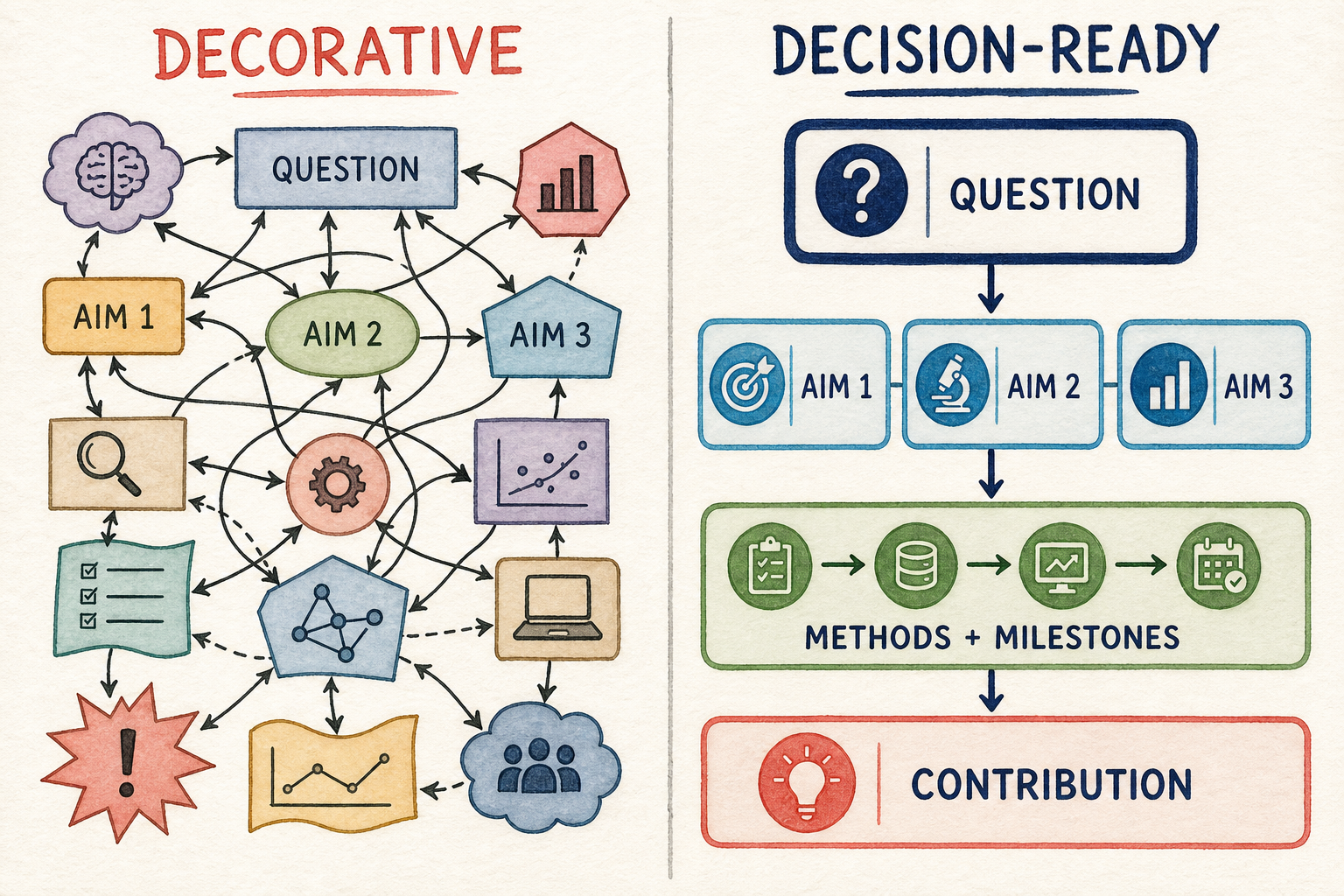 A figure is professional when it reduces the reader's work, not when it contains more effects.
A poor prompt and a better prompt
Poor prompt
Make a beautiful illustration for my PhD proposal.This provides no scientific content, relationship, or acceptance criterion. The result will usually be generic decoration.
Better prompt
Create a clean research framework diagram for a doctoral application.
Top: research gap — [one sentence].
Center: central research question — [one sentence].
Below: three aims arranged in [parallel / sequential] order.
Under each aim, show the required data, core method, and expected evidence.
Bottom: the original contribution.
Use one top-to-bottom reading direction, short noun-phrase labels,
a white background, deep navy and cyan with one coral accent,
and no university logos, decorative icons, or fabricated results.
Generate a first draft, then verify every arrow and label yourself. If you need to keep revising in PowerPoint or Illustrator, convert the selected figure to an editable vector rather than rebuilding it from a flattened screenshot.
A responsible AI workflow
Use AI for visual drafting, not intellectual substitution:
- Write the gap, question, aims, methods, and expected evidence yourself.
- Ask a supervisor or knowledgeable reader to challenge the logic.
- Use SciDraw to explore two or three visual structures.
- Select one and manually correct terminology, arrows, and emphasis.
- Check the programme's AI-disclosure and authorship rules.
- Submit only claims and references you can defend.
Final submission checklist
- The file follows the programme's requested format and length.
- The central question can be found within seconds.
- The literature review ends in a defensible gap.
- Each aim has evidence, a method, and a feasible outcome.
- Data access, ethics, risks, and alternatives are addressed.
- The timeline matches the programme duration and available resources.
- Supervisor and institutional fit are specific, not flattering boilerplate.
- Every citation has been checked against the original source.
- Every figure is permitted, legible at page size, cited in the text, and useful.
- Figure labels match the proposal terminology exactly.
- The PDF has been opened on another device and test-printed or checked in grayscale.
For a deeper visual workflow, continue with the thesis proposal roadmap guide, the research proposal figures guide, or the field-specific humanities and social-science proposal diagram guide.
FAQ
Does every PhD application need a research proposal?
No. Some programmes require a detailed self-proposed project, while others recruit into an advertised project or ask only for research interests. Follow the current programme page.
Should a proposal include figures?
Only when permitted and useful. A framework, workflow, or timeline is worth the space when it makes a relationship or sequence easier to evaluate. Decoration is not.
Is a research proposal the same as a personal statement?
No. A proposal argues for the value and feasibility of a project. A personal statement explains your preparation, motivation, and fit. Some applications ask for both in one file, but the functions remain different.
Must I follow the proposal exactly after admission?
Often not. Doctoral projects normally evolve after deeper literature review, training, data access, and supervisor feedback. The application proposal still needs to be coherent and feasible at the time you submit it.
Where should I start drawing?
Start with the central question and aims. Build the framework in the Conceptual Framework Maker, the method sequence in the Workflow Diagram Generator, or the phases in the Research Roadmap Maker. The PhD student tools page brings the wider workflow together.