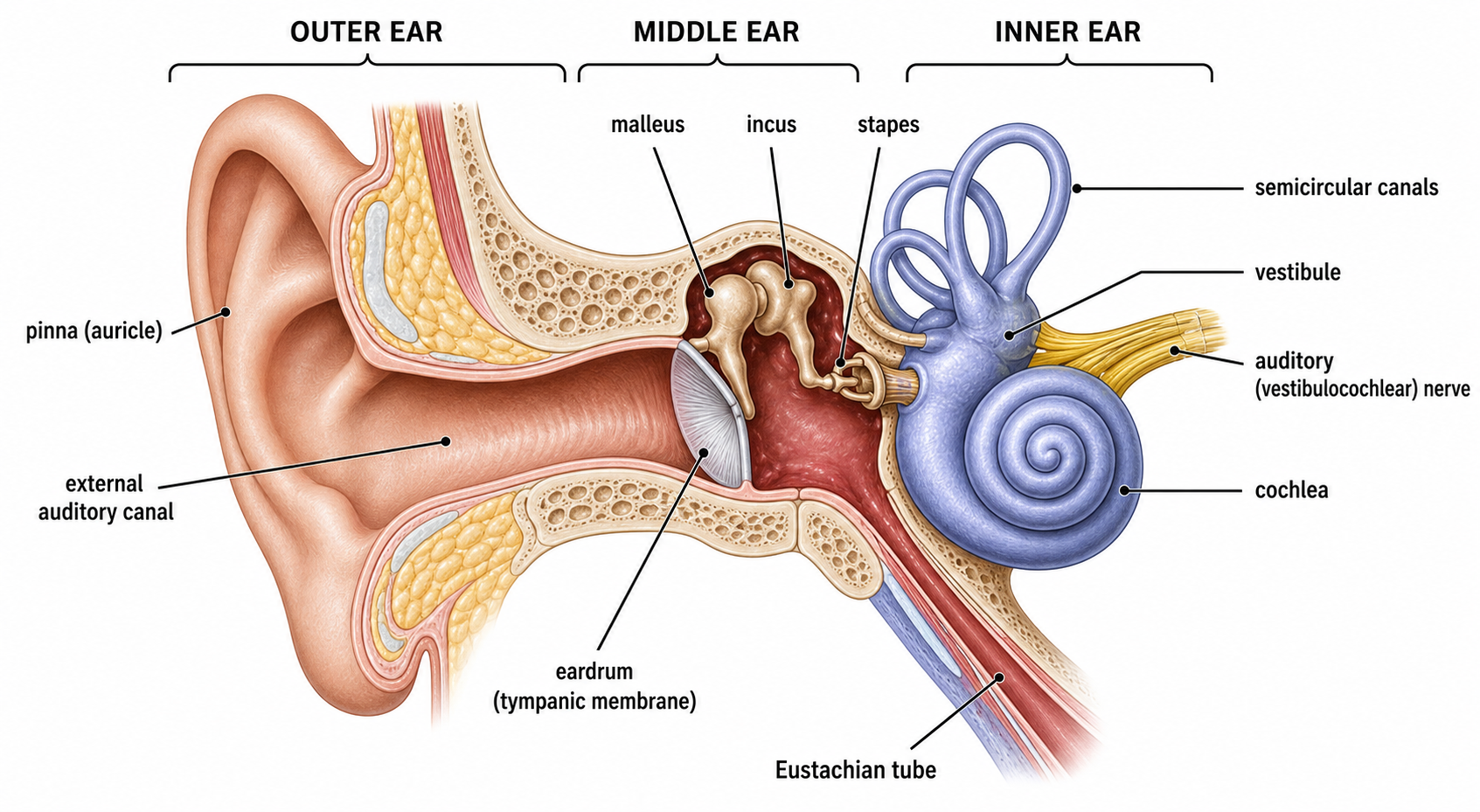
Ear Diagram: Labeled and Blank Ear Anatomy
Outer, middle, and inner ear anatomy for study and teaching
Create a complete ear cross-section or focus on the ossicles, cochlea, and semicircular canals. Use labeled, blank, or answer-key examples as a starting point.
Labeled and Blank Ear Diagram Examples
Start from a ready-made example or describe your own — from a fully labeled cross-section to a blank ear worksheet students can fill in.
What is an ear anatomy diagram?
An ear anatomy diagram is a labeled drawing of the human ear that shows how it is built and how it hears. This generator turns your description into one. You say which view you want — a full labeled ear, the outer, middle, and inner regions, a cochlea close-up, the ossicles, a cross-section, or the hearing pathway — and the AI draws the pinna and ear canal, the eardrum, the malleus, incus, and stapes, the cochlea and semicircular canals, and the auditory nerve, then adds leader lines and labels for each part. You get a tidy, accurate figure without drawing the ear or positioning labels by hand. The same description also gives you the classroom version: ask for an unlabeled ear with empty leader lines and you get a printable worksheet students can label themselves, then generate the labeled version to hand out as the answer key.
Why use an ear anatomy diagram generator
- A labeled ear diagram is one of the most-used figures in biology, audiology, and nursing courses.
- Drawing an accurate ear with the tiny ossicles and the coiled cochlea by hand takes real time.
- Clear labels for the outer, middle, and inner ear make the figure self-explanatory.
- Teachers, students, and clinicians need presentable diagrams for worksheets, slides, and notes quickly.
- Regenerating from a description is faster than redrawing whenever you need a different view or label set.
How to make an ear anatomy diagram
Describe the ear diagram you need — for example a full labeled cross-section, the three regions side by side, a close-up of the cochlea, or the pathway of hearing. List the parts to label (pinna, ear canal, eardrum, malleus, incus, stapes, Eustachian tube, cochlea, semicircular canals, vestibule, auditory nerve) and say whether you want the outer, middle, and inner ear grouped. Generate the diagram, then check that each part is correctly placed and labeled, and refine until it matches what you are teaching or studying. Say whether you want every structure named or an unlabeled version with blank leader lines for students to complete, and add "clean white background, print-friendly" when the diagram is going onto a worksheet.
Parts of the ear
- Outer ear — the pinna (auricle) and ear canal that funnel sound waves inward.
- Eardrum (tympanic membrane) — the thin membrane that vibrates when sound waves reach it.
- Middle ear — the air-filled cavity holding the three ossicles, the malleus, incus, and stapes, plus the Eustachian tube.
- Cochlea — the spiral, fluid-filled organ of the inner ear that converts vibrations into nerve signals.
- Semicircular canals — three looped tubes of the inner ear that sense head movement and balance.
- Auditory nerve — the vestibulocochlear nerve that carries hearing and balance signals to the brain.
Ear Anatomy Diagram Generator FAQ
What are the parts of the ear?
The ear has three regions. The outer ear is the pinna (auricle) and ear canal. The middle ear is the eardrum (tympanic membrane), the three ossicles — malleus, incus, and stapes — and the Eustachian tube. The inner ear is the cochlea (for hearing) and the semicircular canals and vestibule (for balance), connected to the brain by the auditory (vestibulocochlear) nerve.
How do I make a labeled ear diagram online?
Describe the ear diagram you want — for example a labeled cross-section showing the pinna, ear canal, eardrum, ossicles, cochlea, and semicircular canals — and the generator draws a clean figure with a leader line and label for each part. You can name the exact structures to label and regenerate until it looks right.
What is the difference between the outer, middle, and inner ear?
The outer ear (pinna and ear canal) collects and funnels sound waves to the eardrum. The middle ear amplifies them: the eardrum vibrates the malleus, incus, and stapes, which pass the vibration on through the oval window. The inner ear converts it into nerve signals — the cochlea handles hearing while the semicircular canals and vestibule handle balance.
Can I label specific parts of the ear?
Yes. Name the parts you want labeled — such as the pinna, ear canal, eardrum, malleus, incus, stapes, cochlea, semicircular canals, and auditory nerve — and the generator draws leader lines and labels for each. You can also ask for a clean, unlabeled version to label yourself for a quiz or worksheet.
Is the ear anatomy diagram generator free?
You can start generating ear diagrams for free. Sign up to receive starter credits, and each diagram uses a small number of credits. It is a quick way to get labeled ear figures for lessons, revision, and study notes without drawing them by hand.
Can I use the ear diagrams in class?
Yes. The diagrams are designed to be clear and accurate for worksheets, slides, textbooks, and revision notes, with readable labels for each part. They suit biology, audiology, and nursing teaching. Always review the figure against your syllabus or an authoritative source before using it.
Can I generate an unlabeled or blank ear diagram?
Yes. Describe the structures you want shown and ask SciDraw AI to leave the labels off, or to use numbered leader lines pointing to empty boxes. You get the same accurate cross-section through the outer, middle and inner ear with no text on it, ready for students to label.
Can I use the generated ear diagram as a worksheet and answer key?
Yes. Generate the blank cross-section first with empty numbered leader lines and print it as the labeling worksheet, then generate a fully labeled ear diagram to use as the answer key. Ask for the same view and the same numbering in both prompts so the two sheets line up.
Writing a paper, thesis or grant?
SciDraw AI also makes publication-ready research figures: graphical abstracts, mechanism figures, workflows and conceptual frameworks.
Explore More Tools

Need other science diagrams?
Generate a labeled ear diagram, an unlabeled version to label, or a blank ear worksheet in seconds. Perfect for biology, audiology and anatomy teaching.