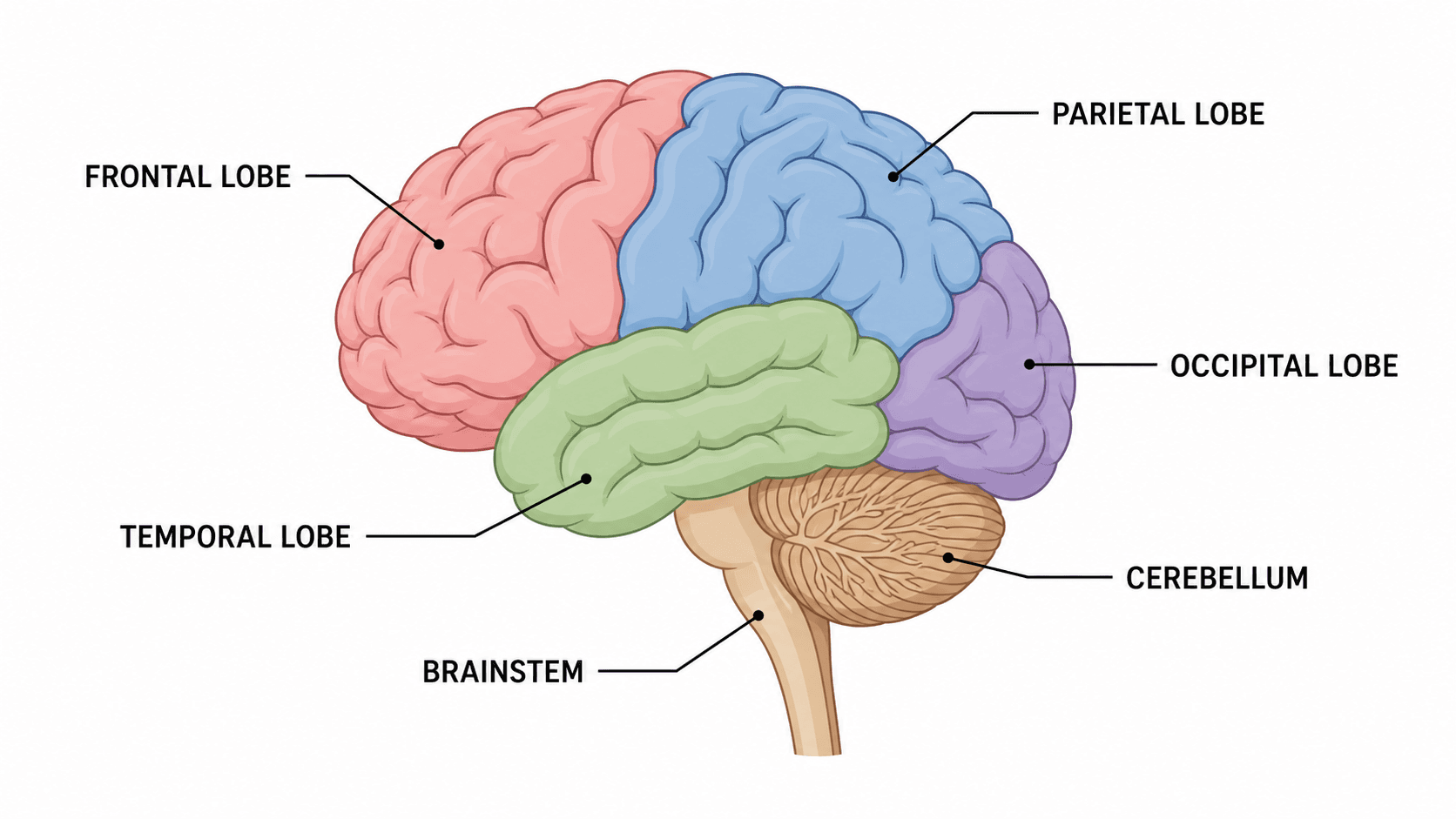
Environmental science spans everything from soil microbiology to global climate modeling, and every sub-field demands clear, compelling illustrations. Whether you are submitting to Environmental Science & Technology, Soil Biology and Biochemistry, or Nature Climate Change, your figures need to communicate complex ecological processes at a glance.
With over 300 environment-themed illustrations generated on SciDraw AI, the data reveals clear trends: soil processes, biogeochemical cycling, water treatment systems, and climate impact diagrams are what researchers need most. This guide shows you how to create each type using real examples and refined prompts.
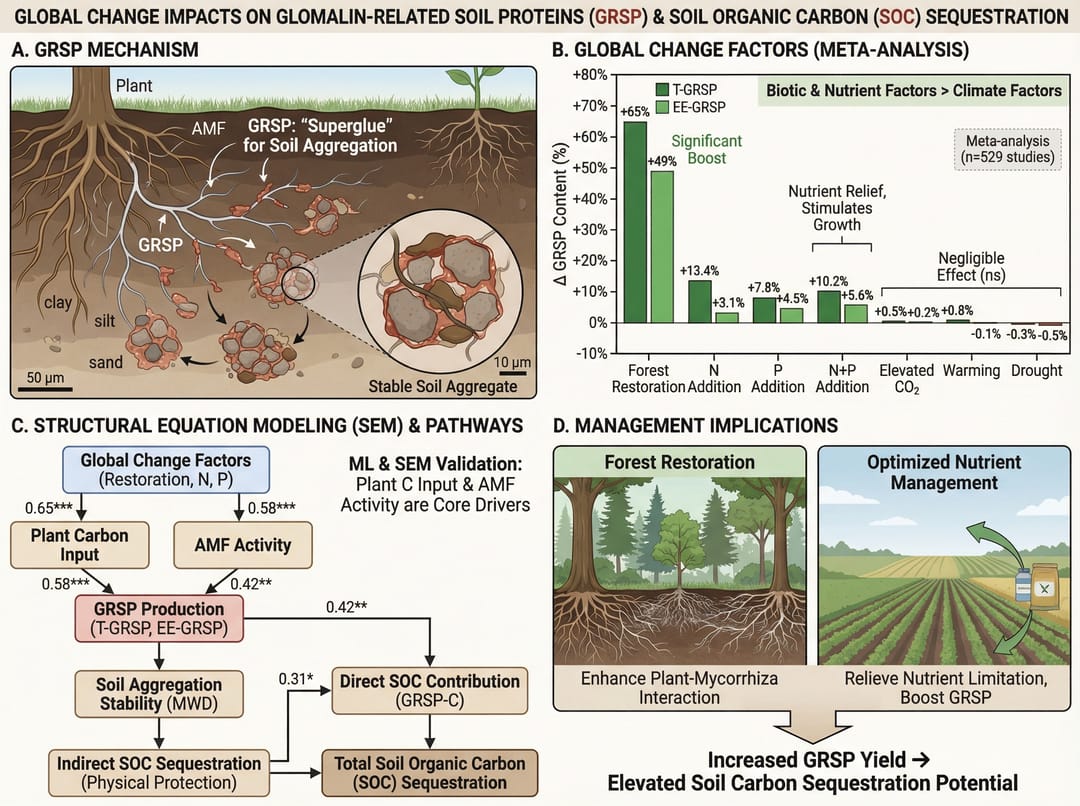 Glomalin-related soil protein and organic carbon stability mechanism — a real researcher-created illustration
What Environmental Researchers Are Drawing
Based on keyword analysis of 302 real environment-themed prompts, the top topics are:
- Soil science (22% mention "soil", with "microbial" at 10%)
- Water systems (23% mention "water")
- Carbon cycling (13% mention "carbon")
- Environmental mechanisms (14% mention "mechanism")
- Plant-soil interactions (10% mention "plant")
- Pollution and remediation (frequent terms: "pollutants", "contamination", "treatment")
Soil Science Illustrations
Soil science is the single largest topic in environmental illustrations, covering everything from mycorrhizal networks to biochar amendments.
Soil Organic Carbon Stabilization
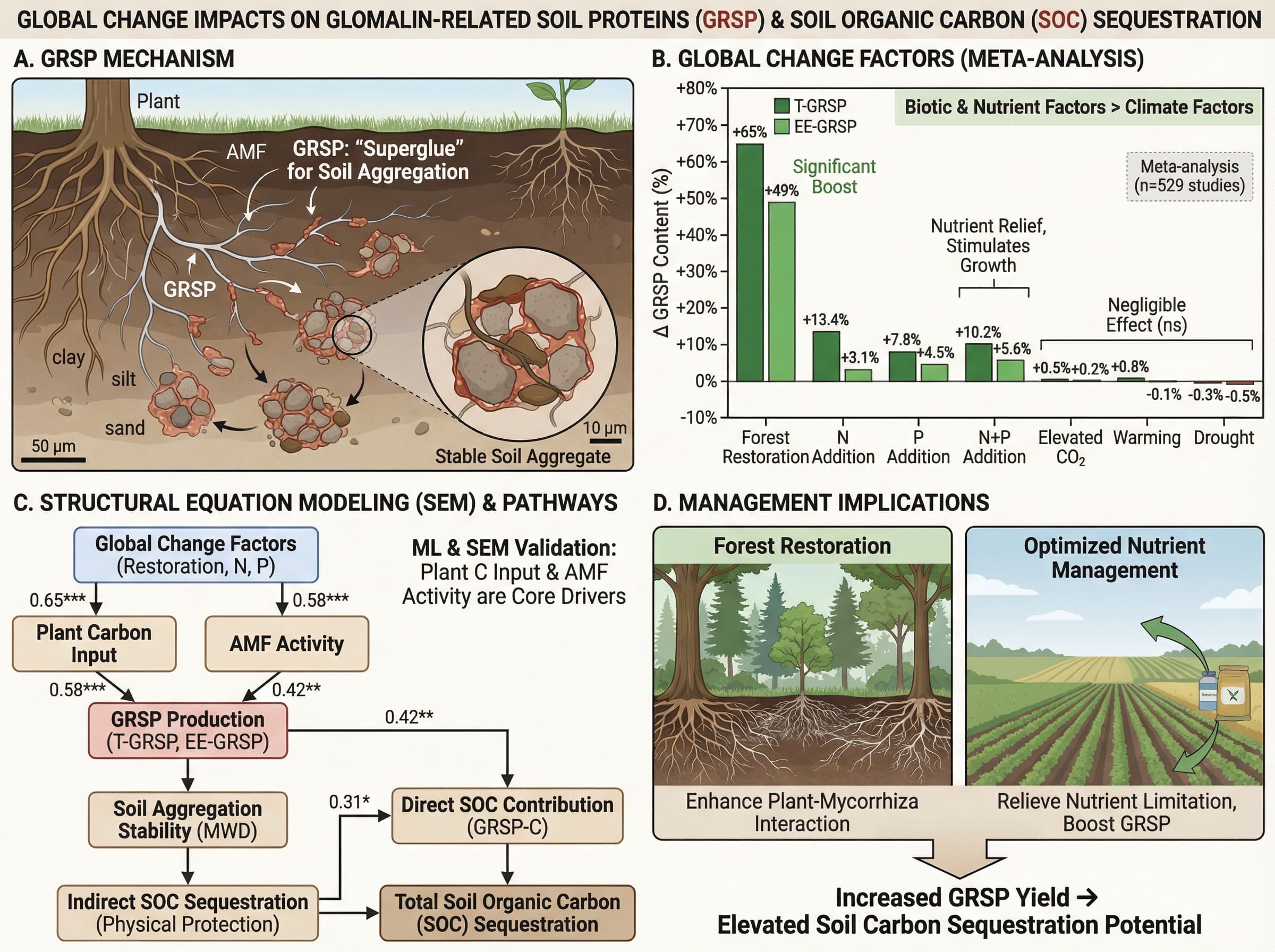
Glomalin-related soil protein (GRSP) mechanism illustration.
GRSP as a key metabolite secreted by arbuscular mycorrhizal fungi,
known as "super glue" for maintaining soil organic carbon stability.
Show: mycorrhizal hyphae in rhizosphere →
GRSP secretion onto soil particle surfaces →
formation of soil aggregates (micro and macro) →
physical protection of organic carbon within aggregates.
Under climate change: elevated CO₂ and temperature effects
on GRSP production rates and aggregate stability.
Soil biology journal style, cross-sectional soil view.
Soil Color Analysis with Modern Sensors
Research illustration for soil property analysis
using Nix Pro color sensor as modern alternative
to conventional manual methods.
Study design: 150 soil samples analyzed.
Show: field sampling → sensor measurement (RGB/L*a*b*) →
machine learning models (Random Forest, SVM) →
predicted soil properties (organic matter, moisture, pH).
Comparison panel: traditional lab methods vs. sensor-based.
Precision agriculture journal style.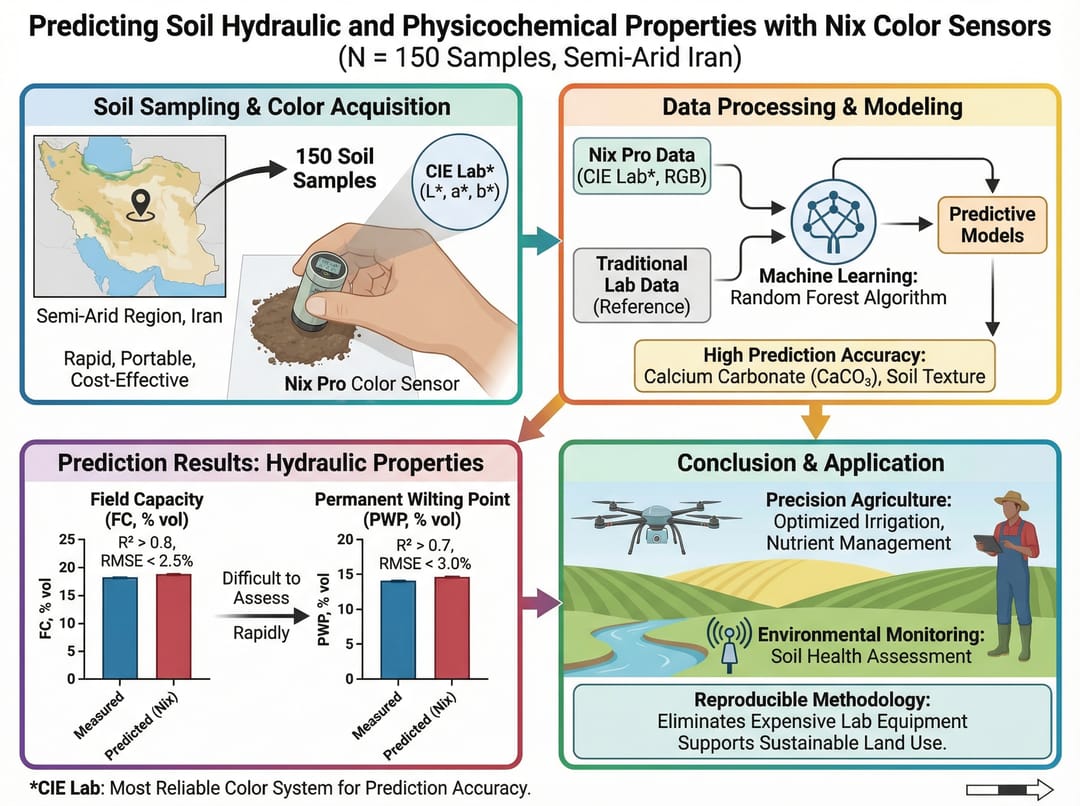 Nix Pro color sensor for soil property analysis — methodology framework
Biochar in Soil Systems
Biochar layer structure illustration.
Show gray, undulating biochar structure
embedded within soil profile.
Porous carbon matrix with micropores labeled,
nutrient adsorption sites (NH₄⁺, PO₄³⁻) indicated,
water retention capacity in pore spaces,
microbial colonization on biochar surfaces.
Soil amendment cross-sectional view,
environmental engineering journal style.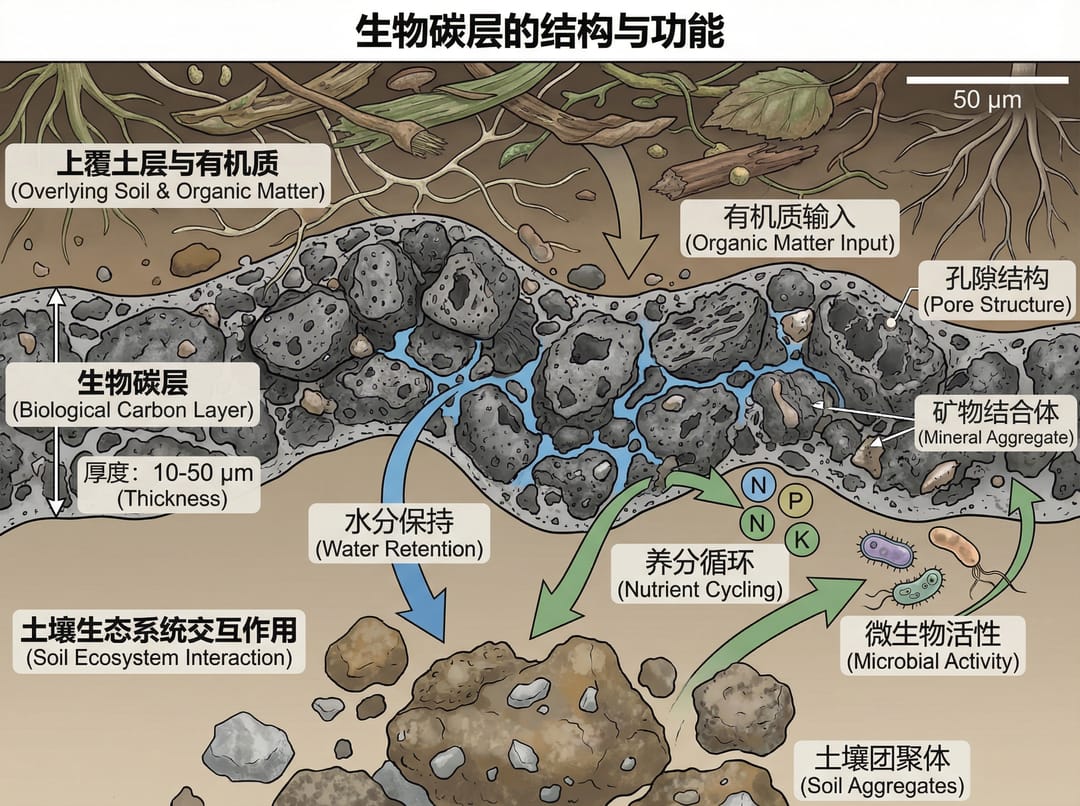 Biochar layer characteristics in soil profile
Biogeochemical Cycles
Carbon and nitrogen cycles are fundamental to environmental science education and research publications alike.
Carbon Cycle Ecosystem Diagram
High-contrast, black and white diagram of the carbon cycle
suitable for photocopying.
Depict a moose, balsam fir, and aquatic plants in a lake,
alongside a volcano.
Illustrate: photosynthesis (CO₂ uptake by plants),
respiration (CO₂ release by animals),
decomposition in soil,
volcanic outgassing,
ocean-atmosphere CO₂ exchange,
fossil fuel formation pathways.
Arrows with labels for flux rates.
Ecology textbook illustration style.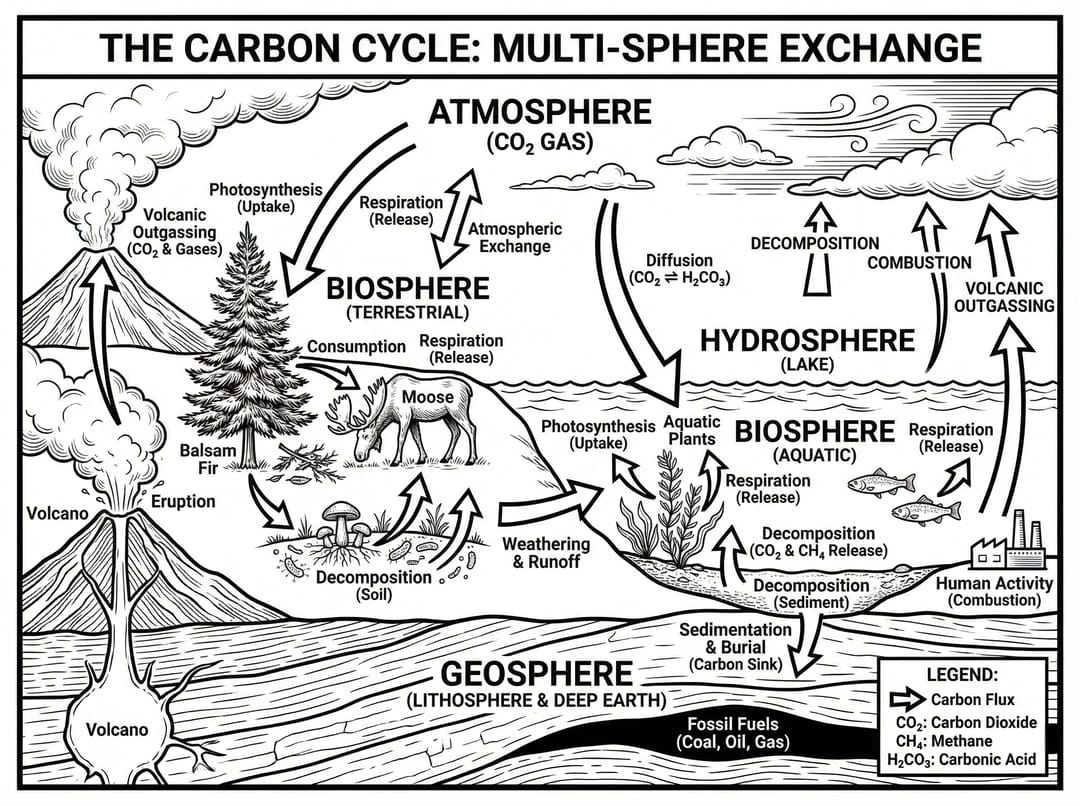 Carbon cycle ecosystem diagram with boreal forest components
Nitrogen Cycle
Nitrogen cycle diagram incorporating
a moose and balsam fir as biotic components.
Show: atmospheric N₂ fixation (biological and lightning),
nitrification (NH₄⁺ → NO₂⁻ → NO₃⁻),
denitrification (NO₃⁻ → N₂O → N₂),
ammonification of organic N,
plant uptake and animal consumption,
leaching to groundwater.
Bacterial species labeled at key transformation steps.
Black and white suitable for photocopying.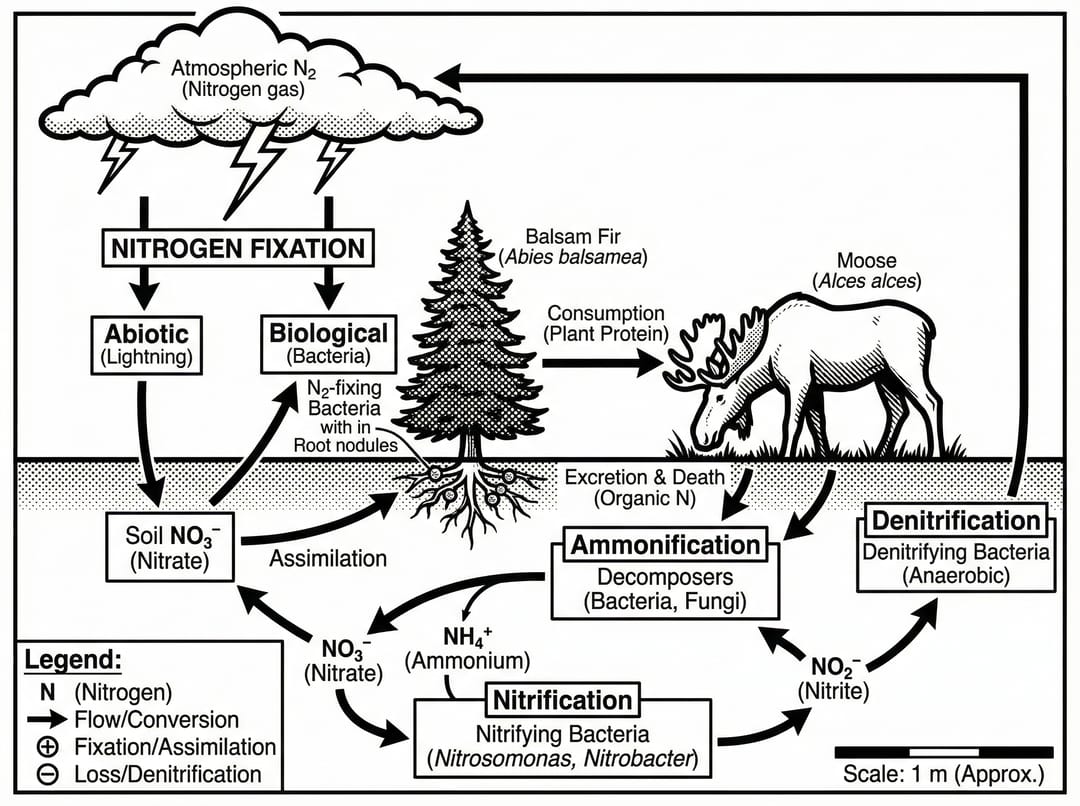 Nitrogen cycle with boreal ecosystem components
Water Treatment and Pollution
Plastic Removal from Water Sources
Flowchart illustrating process for plastic removal
from water sources (white background, line images):
1. Site Selection: major drainage outlets,
wastewater discharge points, stormwater drains
2. Sampling and Analysis: microplastic quantification
3. Treatment System Design: filtration stages
4. Implementation: boom barriers, filtration units
5. Monitoring: before/after comparison metrics
Sequential flowchart with icons at each step.
Environmental engineering journal style.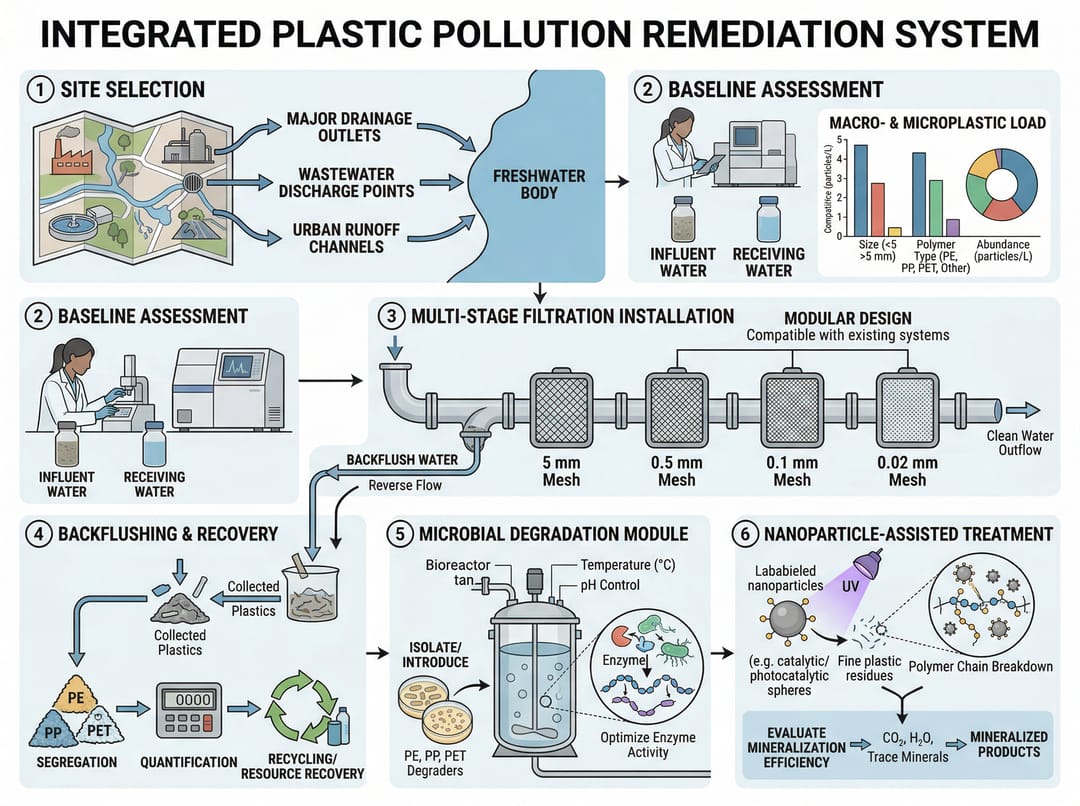 Plastic removal process from water sources — sequential workflow
Coal Power Plant Pollutant Pathways
Operation of coal-fired power plants and pollutant pathways
into river ecosystems.
Show: wastewater discharge from coal combustion facilities,
waste landfill leachate pathways,
atmospheric deposition of particulates,
pollutant transport through soil to groundwater,
bioaccumulation in aquatic food chain.
Multiple entry points converging on river system.
Environmental impact assessment style,
suitable for Environmental Science & Technology journal.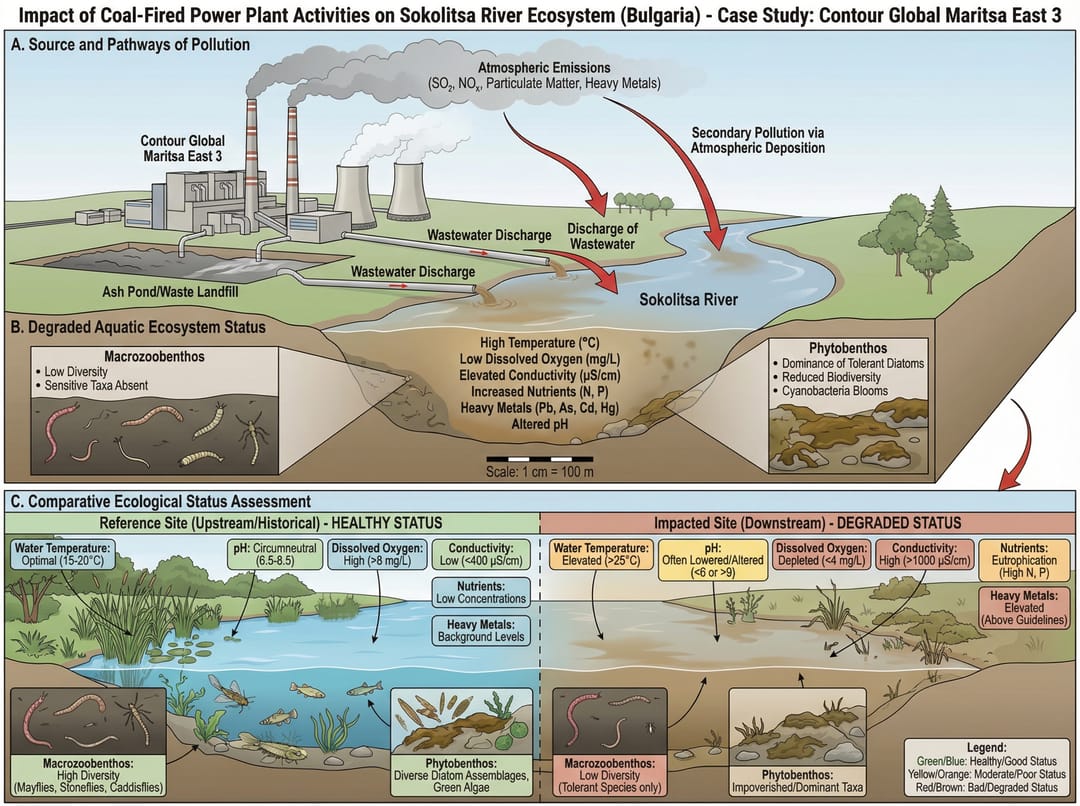 Coal-fired power plant pollutant pathways into river ecosystems
Climate and Ecosystem Impact
Climate Change and Food Security
Highlights visualization for climate change
and food security research in Africa.
Key threats: increasing temperatures,
inconsistent rainfall patterns, extreme weather events.
Show: climate drivers (top) →
agricultural impacts (crop yield decline, livestock stress) →
food security outcomes (malnutrition, economic loss) →
adaptation strategies (drought-resistant crops, irrigation).
Vulnerable populations highlighted.
Infographic style for policy communication.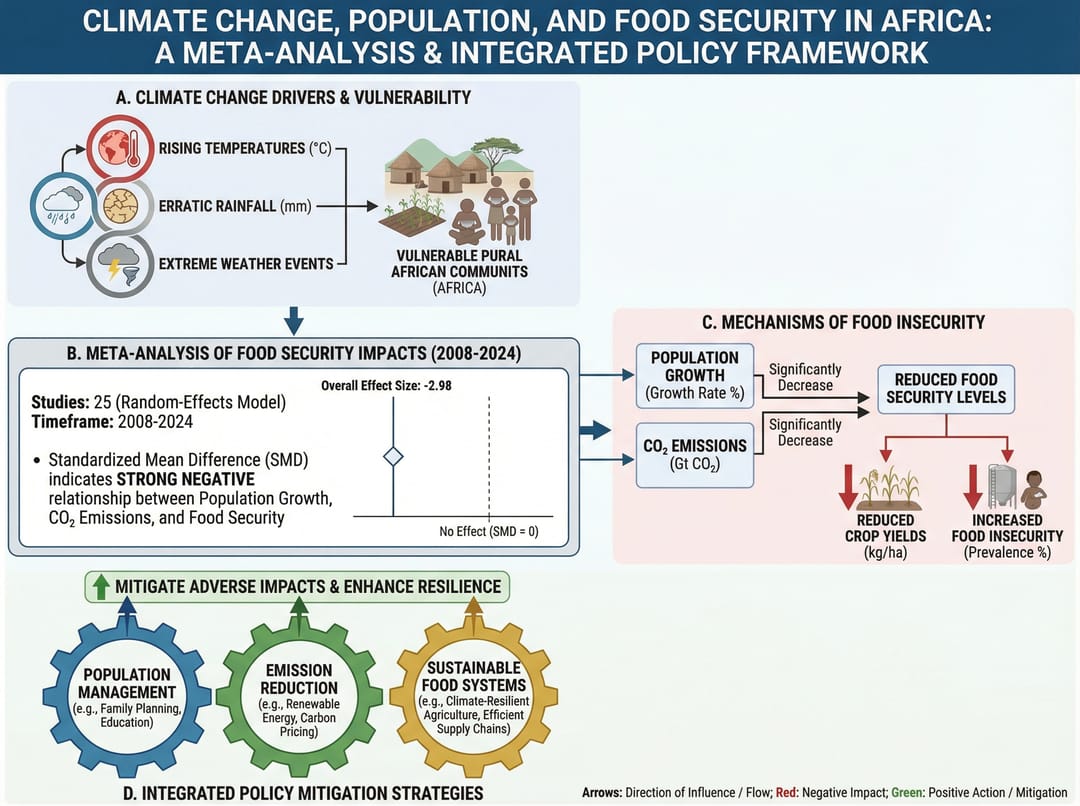 Climate change impacts on food security in Africa
CO₂ Injection and Geomechanics
Illustration depicting the damage mechanism
of high-temperature CO₂ injection into coal rock.
Show: injection well and CO₂ flow pathway,
thermomechanical stress on coal matrix,
fracture propagation patterns,
mineral dissolution and pore structure changes,
permeability enhancement zones.
Cross-sectional geological view with depth indicators.
Energy geoscience journal style.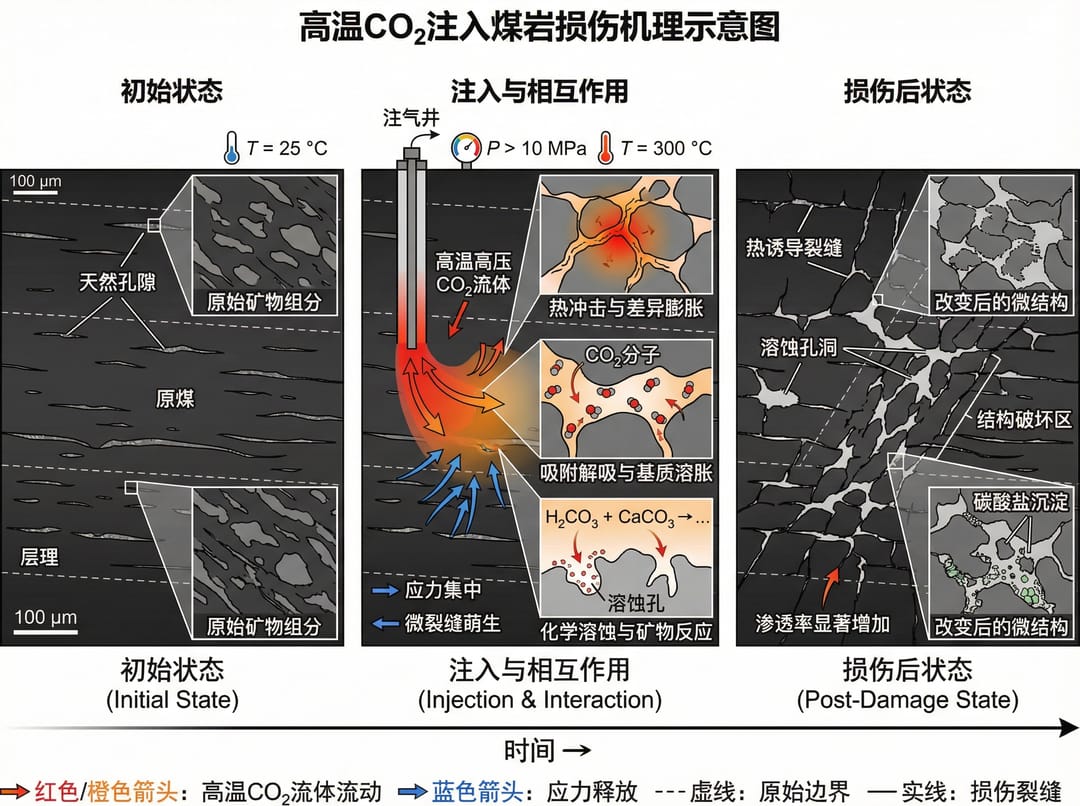 Damage mechanism of high-temperature CO₂ injection into coal rock
Research Framework Diagrams
Multi-Layer Research Roadmap
Environmental research often requires multi-tier framework diagrams that connect theory to methodology to outcomes:
Three-layer logical research framework,
landscape orientation, technical roadmap style.
Blue-green color scheme.
Logic flow: "Background Analysis" →
"Methodology Development" → "Application & Validation."
Layer 1: Problem identification and literature review
Layer 2: Experimental design and data collection
Layer 3: Model development and prediction
Each layer with 3-4 sub-components connected by arrows.
SCI paper technical roadmap style.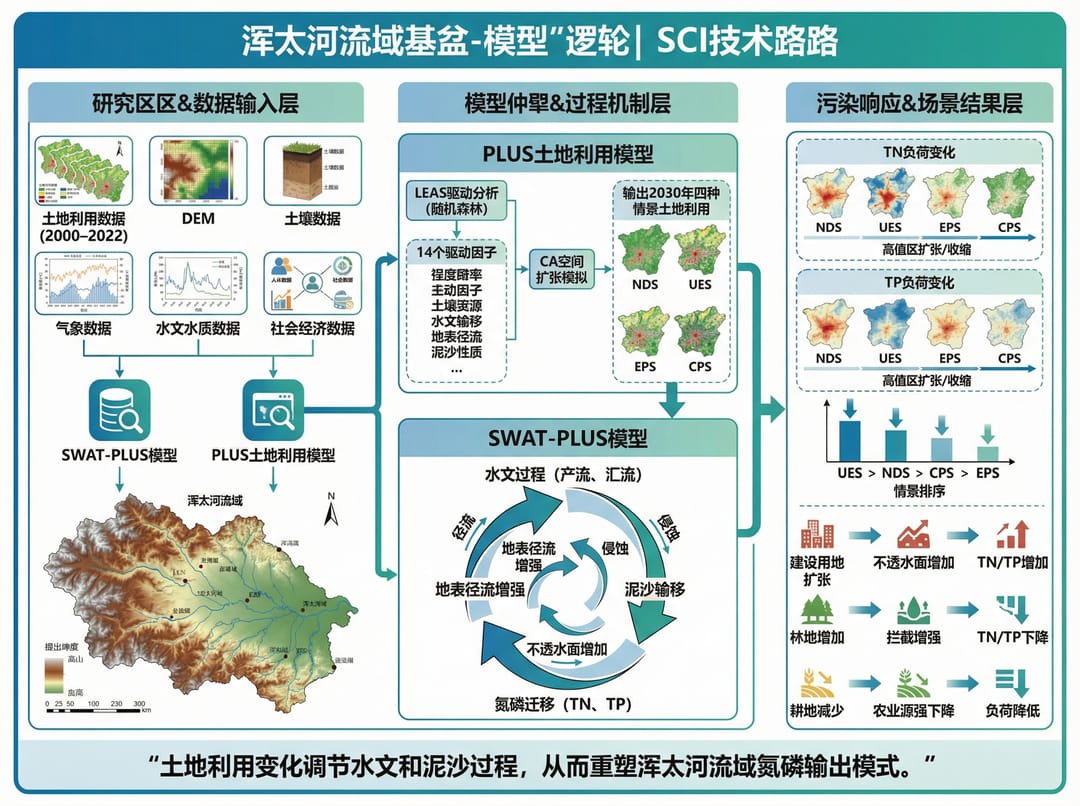 Three-layer research framework with blue-green color scheme
Systematic Review Protocol
Systematic Review Protocol using SPICE Framework.
Research objectives for Knowledge Management
in Subtropical Forestry.
Portrait or square layout.
Show: Setting → Perspective → Intervention →
Comparison → Evaluation.
Search strategy: databases (Web of Science, Scopus, CNKI),
inclusion/exclusion criteria flowchart,
PRISMA flow diagram integration.
Forestry and environmental management journal style.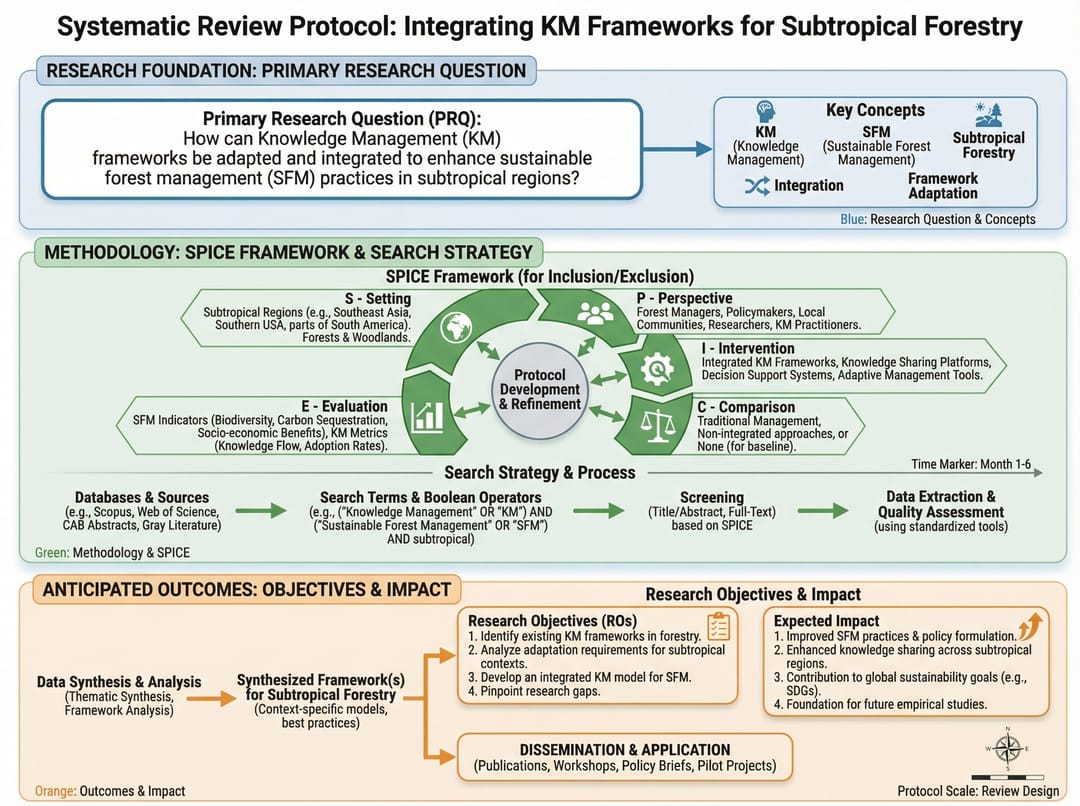 SPICE framework systematic review protocol for subtropical forestry research
Prompt Writing Tips for Environmental Science
What Makes Environmental Prompts Effective
Based on analysis of 302 environment prompts, the most successful ones include:
| Element | Frequency | Example |
|---|---|---|
| Compartment labels | 22% | "soil", "water", "atmosphere" |
| Process names | 17% | "nitrification", "photosynthesis" |
| Scale indicators | 12% | "ecosystem level", "molecular scale" |
| Flux directions | 14% | arrows, "leading to", "resulting in" |
| Species/organisms | 10% | "mycorrhizal fungi", "moose", "balsam fir" |
Common Patterns in Successful Prompts
- "Schematic diagram illustrating" — the most common opening phrase (20+ occurrences)
- "This study" — connecting the illustration to specific research (37 occurrences)
- Cross-compartment connections — showing atmosphere-soil-water interactions
- Before/after comparisons — treatment effects, seasonal changes
- Machine learning integration — increasingly common for environmental modeling
What to Avoid
- Missing spatial context: Always indicate above-ground vs. below-ground
- Oversimplified cycles: Include at least the major transformation steps
- No scale reference: Readers need to understand if you are showing molecular, field, or global scale
- Forgetting feedback loops: Environmental systems are inherently interconnected
Start Creating Environmental Science Illustrations
Transform your environmental research visualization:
- Visit SciDraw AI Drawing
- Select Mechanism Illustration or Experimental Workflow template
- Describe your environmental system, processes, and compartments
- Generate publication-ready diagrams for your paper
From soil carbon dynamics to climate impact assessments, AI helps you communicate the complexity of environmental systems with clarity and precision.
Related Guides
- Environmental Science Diagram Prompts — 30 prompts for environmental visuals
- Scientific Figure Generator — AI-powered figure creation
- 8 AI Prompt Rules for Scientific Figures — prompt techniques for diagrams
- Scientific Figure Maker Tool — create figures online