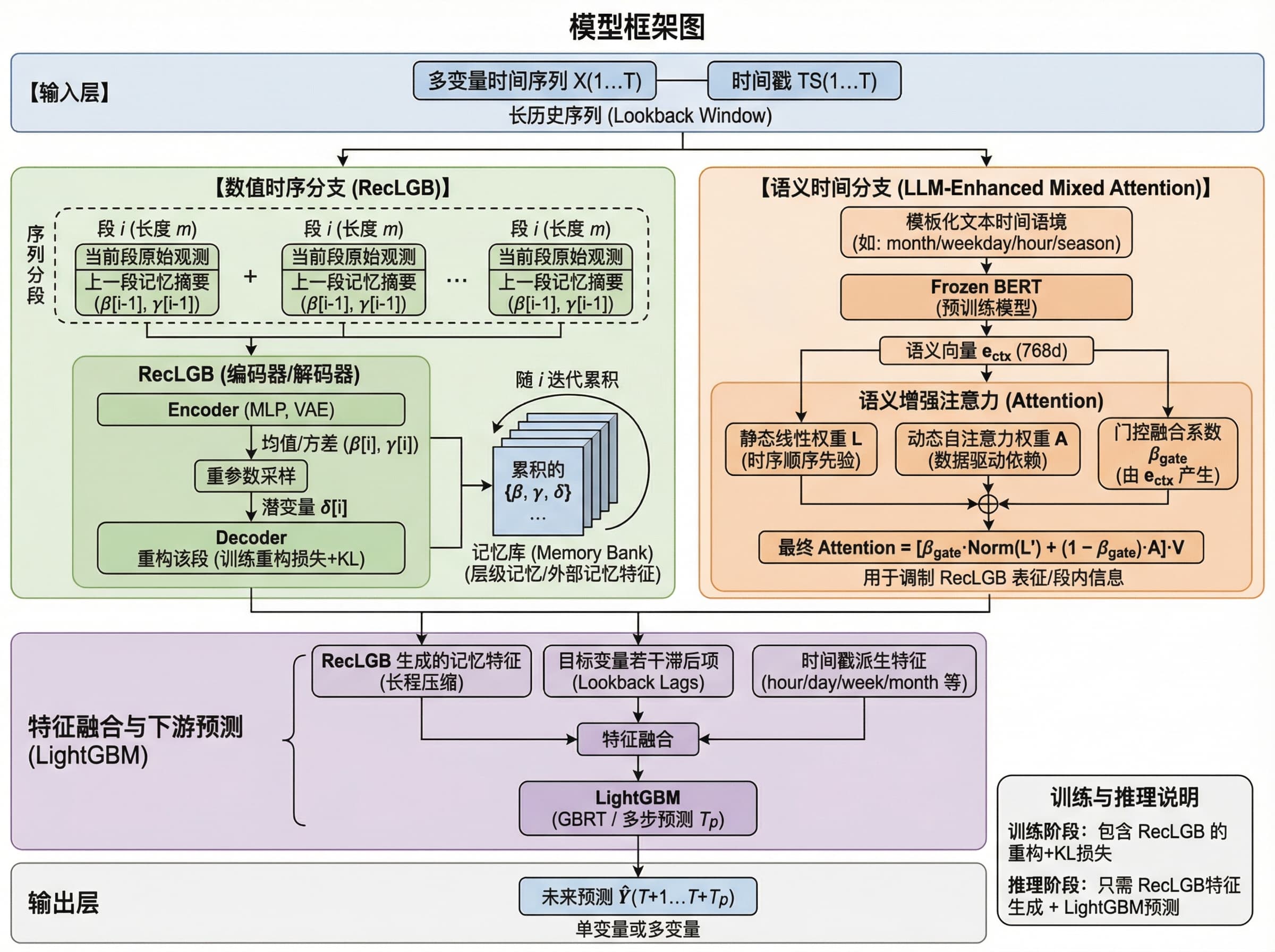
AI and deep learning research papers demand clear, visually compelling architecture diagrams. From multi-layer neural network frameworks to UAV collaborative scheduling protocols, these figures are the centerpiece of any methods section. Yet creating them with tools like draw.io or PowerPoint is painfully slow.
With over 360 AI system architecture diagrams generated on SciDraw AI, we have analyzed what researchers actually need. The data reveals a strong focus on model framework diagrams, feature extraction pipelines, data flow architectures, and optimization algorithm flowcharts. This guide shows you how to create each type using real examples.
When your model description is ready, use the AI Architecture Diagram Generator for the first visual draft, then apply the layout and labeling checks in this guide.
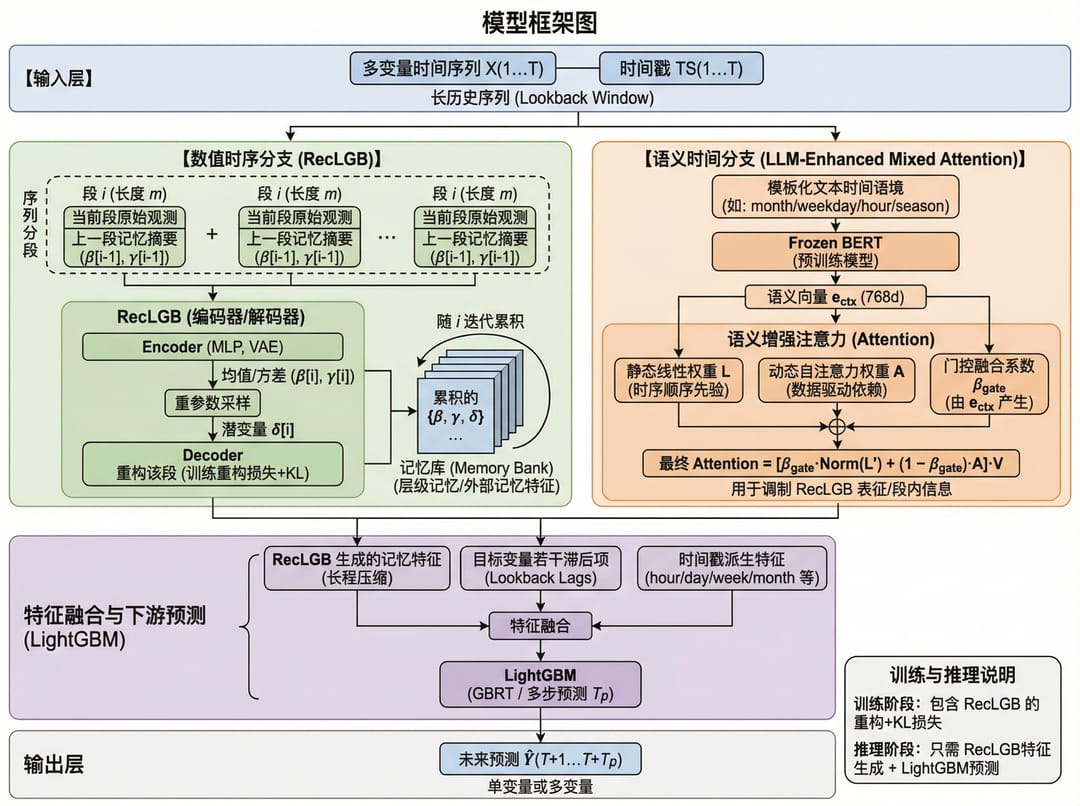 AI-generated model framework diagram with input layer, temporal encoding, and prediction modules
What AI Researchers Are Drawing
Based on keyword analysis of 368 real AI system prompts, the top themes are:
- Data flow and pipelines (49% mention "data", 34% "data flow")
- Neural network architectures (26% "network", 25% "architecture")
- Module-based frameworks (28% "module", 21% "modules")
- Feature extraction (27% "feature", 26 occurrences of "feature extraction")
- Optimization algorithms (19% "optimization")
- Prediction models (16% "prediction")
The most frequent bigrams tell a clear story: "architecture diagram" (37 occurrences), "neural network" (34), "data flow" (34), and "feature extraction" (26) dominate the landscape.
Neural Network Architecture Diagrams
If your figure is a model's layer stack — a CNN, an LSTM, or a Transformer encoder — the neural network diagram generator is tuned for labeled layers, tensor shapes, and left-to-right data flow.
Time Series Prediction Model
One of the most detailed architecture diagrams from our community shows a complete multivariate time series prediction framework:
Model Framework Diagram:
1) Input Layer:
- Input consists of multivariate time series X(1…T)
  and corresponding timestamps TS(1…T)
  (labeled as "lookback window/long historical sequence")
2) Temporal Encoding Module:
- Timestamps processed through positional encoding
- Learnable temporal embeddings
3) Feature Extraction:
- Multi-head self-attention mechanism
- Convolutional feature maps
4) Prediction Head:
- Output: forecasted values Y(T+1…T+H)
Academic paper style, vector illustration,
soft color scheme with blue-green palette.
XGBoost Algorithm Improvement Roadmap
Roadmap for improving XGBoost algorithm,
focusing on leaf fine-tuning
(Newton-BCD for post-optimization).
Show: original XGBoost tree structure →
leaf value initialization →
Newton-BCD optimization iterations →
convergence criteria check →
pruned and fine-tuned tree output.
Include performance comparison metrics.
Algorithm design academic paper style.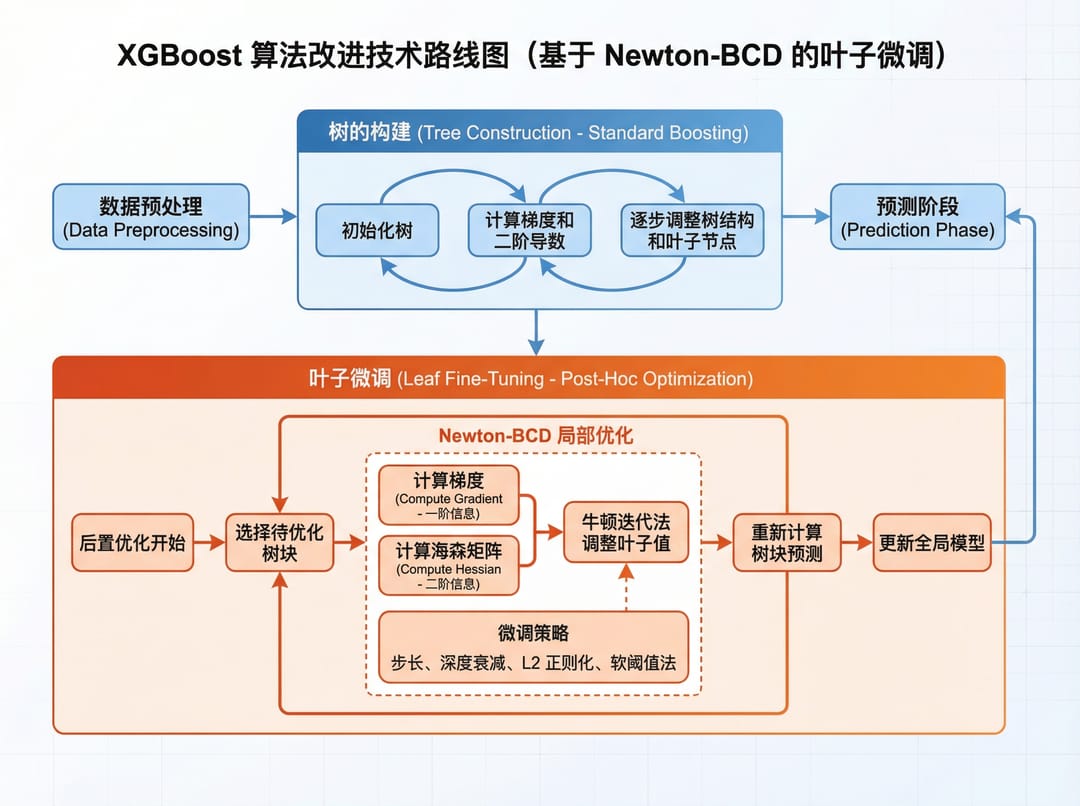 XGBoost leaf fine-tuning algorithm improvement roadmap
Algorithm Flowcharts
Flowcharts are the bread and butter of AI papers. Researchers need them for methods sections, and they must conform to academic standards.
CRF-Based Boundary Optimization
Flowchart conforming to academic paper standards,
focusing on process logic with extremely concise text.
Theme: "CRF-based Broiler Instance Mask
Boundary Optimization Process."
Steps: Input segmentation mask →
Edge detection → CRF energy function construction →
Unary potential (appearance model) +
Pairwise potential (spatial smoothness) →
Mean-field inference iterations →
Refined boundary output.
Clean academic flowchart, minimal text labels.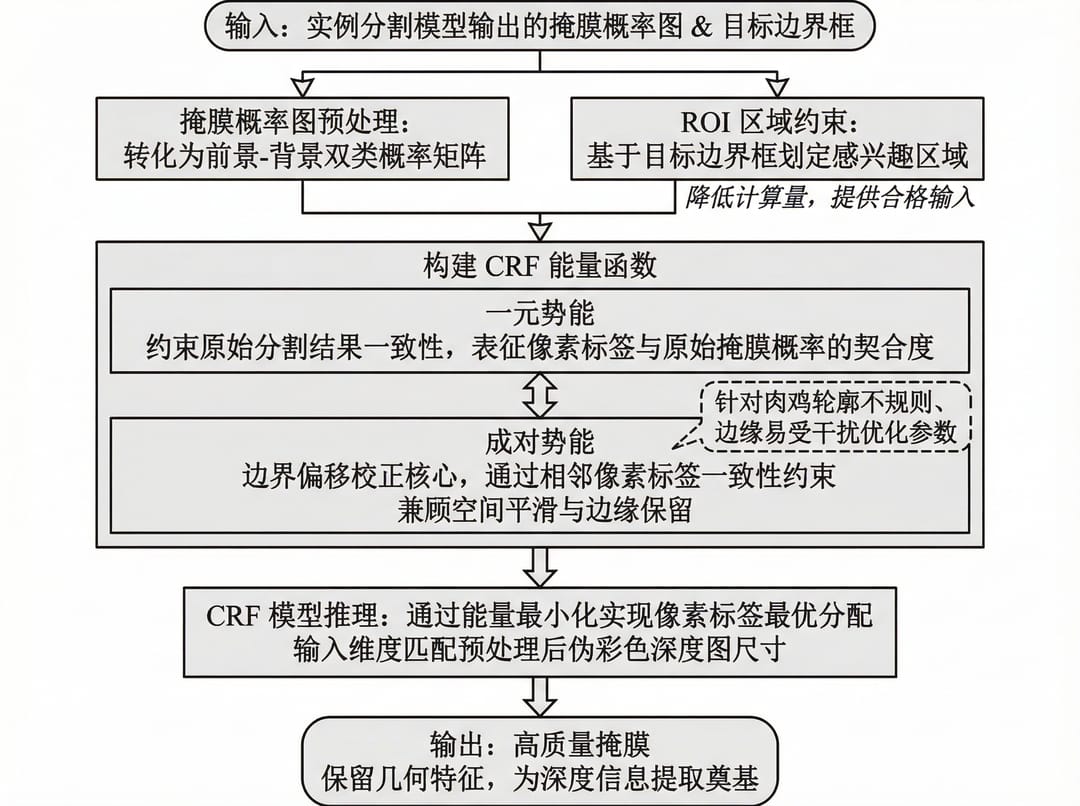 CRF-based instance mask boundary optimization flowchart
Diffusion Model for Robotic Control
Algorithm flowchart for robotic arm control.
Input: trajectory of robotic arm motion
and corresponding torque data.
Processing: hierarchical diffusion model
with noise injection schedule,
denoising steps with conditional guidance.
Output: executed trajectory matching expert demonstrations.
Evaluation: trajectory error metrics, torque smoothness.
Robotics + deep learning paper style.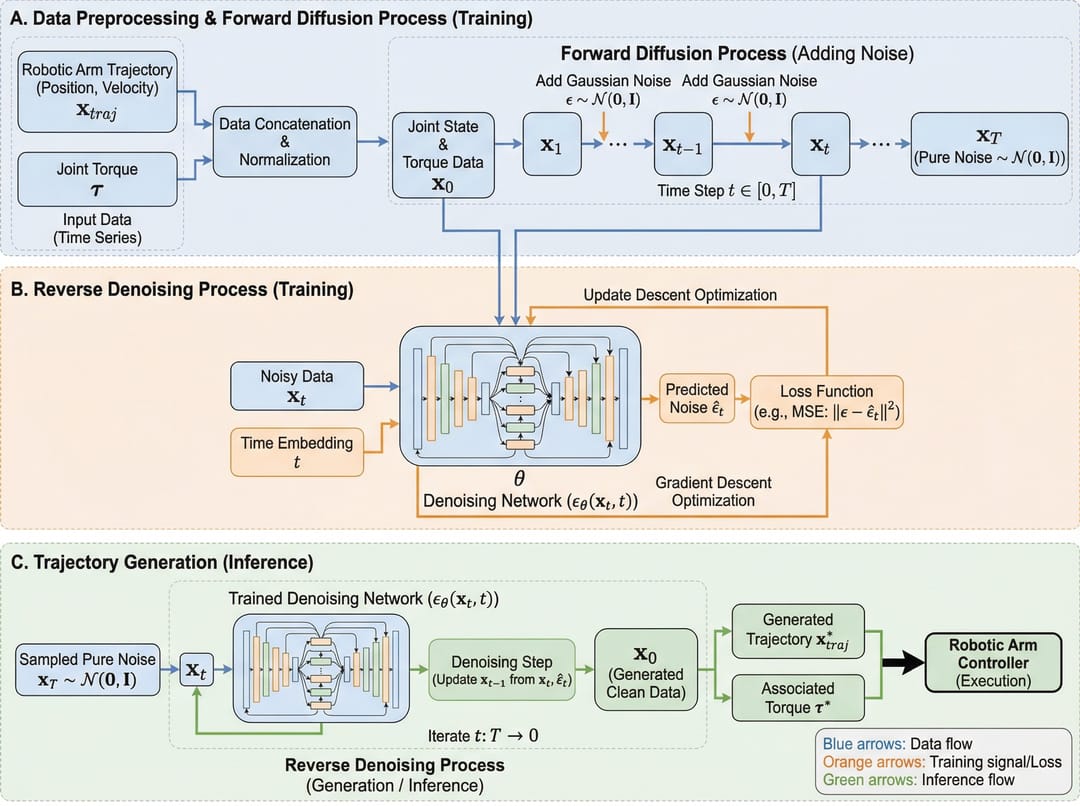 Hierarchical diffusion model for robotic arm trajectory generation
Multi-Module System Architectures
UAV Collaborative Scheduling
UAV edge-cloud collaboration is a hot research area with complex multi-module architectures:
Collaborative scheduling protocol for large-scale
unmanned aerial vehicle (UAV) clusters.
Integrate UAV image input size selection
and task offloading path planning.
Three-tiered architecture:
- UAV layer: trajectory planning + image capture
- Edge layer: local inference + task queue
- Cloud layer: heavy model + global optimization
Data flow arrows between tiers,
latency and energy consumption constraints labeled.
Technical architecture diagram, IEEE style.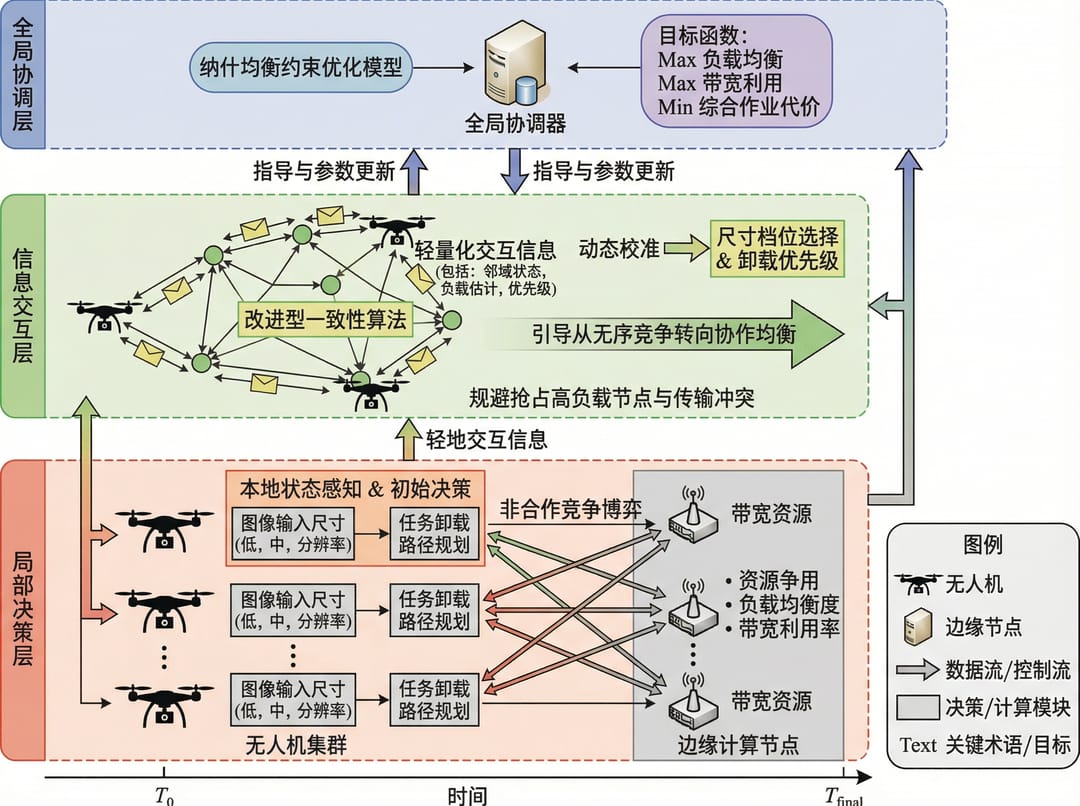 UAV-edge-cloud collaborative scheduling protocol architecture
Multi-Agent Optimization Framework
Co-evolutionary Multi-Agent Optimization Architecture (MAT-EMO).
Agent Role Allocation table:
- Architect: structure optimization
- Explorer: search space expansion
- Exploiter: local refinement
- Evaluator: fitness assessment
Show agent communication topology,
shared memory pool for population exchange,
co-evolutionary cycles with performance feedback.
Academic paper figure, optimization conference style.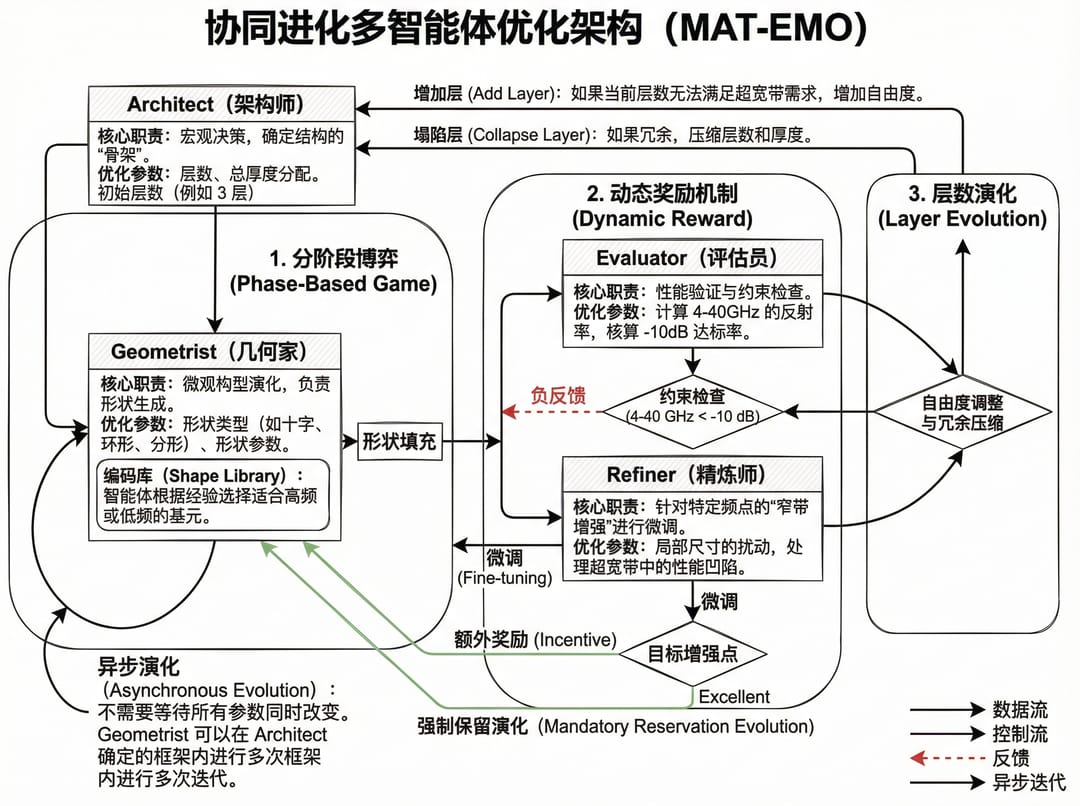 Co-evolutionary multi-agent optimization architecture
Research Framework Diagrams
Three-Section Module Layout
A popular layout pattern divides the diagram into three distinct sections:
Diagram divided into three sections from left to right,
distinguished by light-colored rounded rectangle backgrounds.
Title text centered at the top.
Color scheme: soft, mainly light blue, light green,
light purple pastel tones.
Section 1: Data preprocessing and input
Section 2: Core model architecture with sub-modules
Section 3: Output and evaluation metrics
Connecting arrows showing data flow between sections.
Academic paper style, clean vector illustration.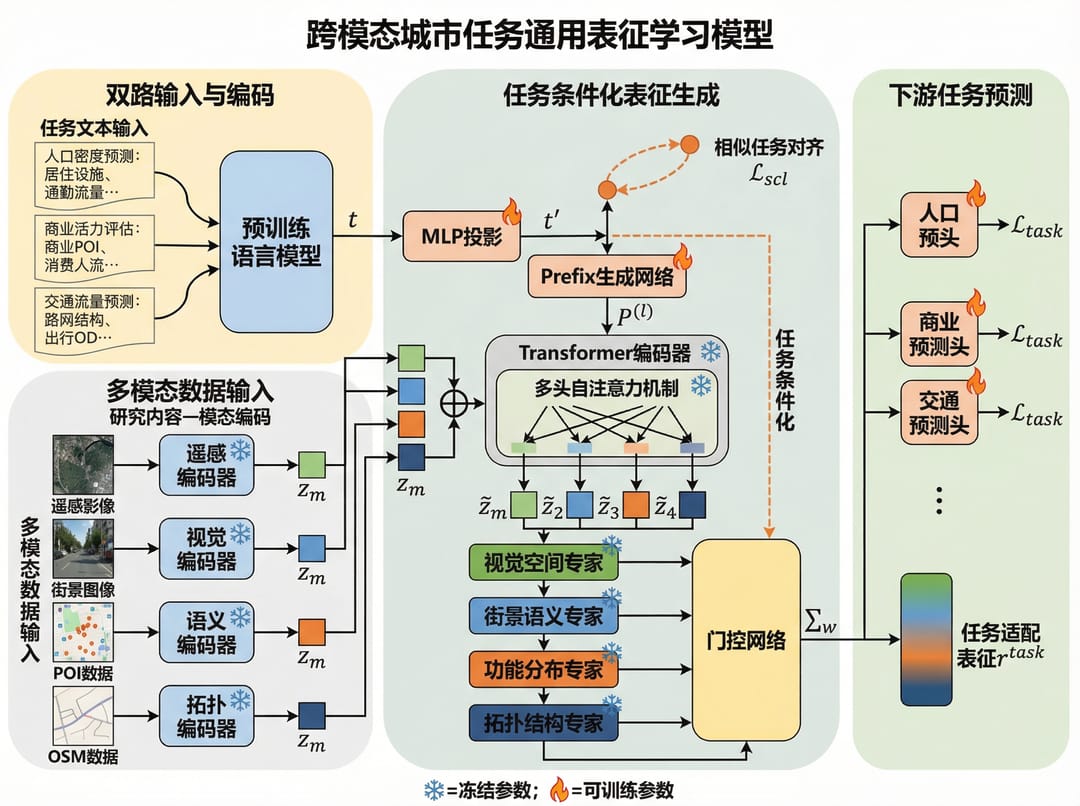 Three-section research framework with pastel color scheme
Methodological Framework
Methodological framework diagram.
Approach: hierarchical diffusion model.
Inputs: expert trajectories and corresponding torques.
Output: executed trajectory.
Evaluation metrics: trajectory tracking error,
torque smoothness score, success rate.
Show training phase (top) and inference phase (bottom).
Loss function components labeled.
Machine learning paper methods section style.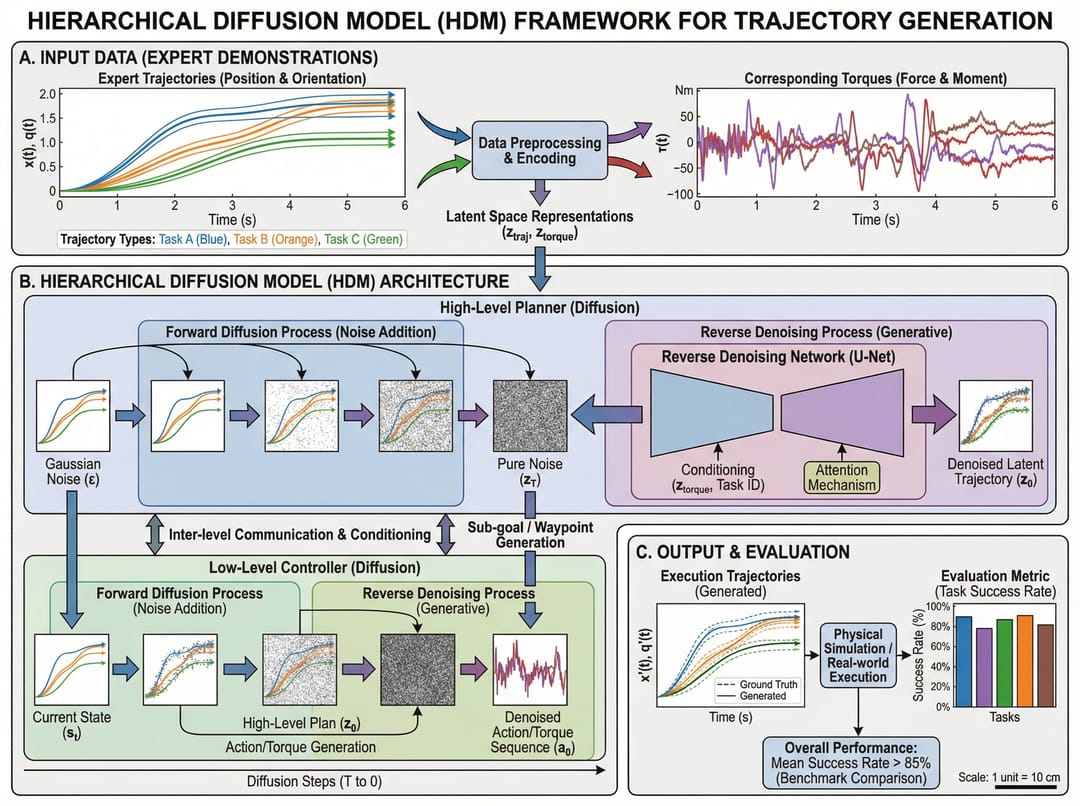 Hierarchical diffusion model methodological framework
Prompt Writing Tips for AI Architecture Diagrams
Structural Elements That Work
Based on analysis of 368 AI system prompts, successful diagrams share these structural patterns:
| Pattern | Frequency | Purpose |
|---|---|---|
| "Divided into sections" | 47 occurrences | Creates clear visual hierarchy |
| "Input → Output" flow | 33% of prompts | Establishes data pipeline |
| "Color scheme" specified | 55 occurrences | Ensures visual consistency |
| Module naming | 28% | Clarifies component roles |
| "Academic paper" style | 20% | Sets professional tone |
Key Components to Specify
- Input format: "multivariate time series X(1…T)" not just "data input"
- Module names: Use your paper's actual module names
- Data flow direction: "left to right" or "top to bottom"
- Color scheme: "soft pastel" or "blue-green palette" for readability
- Layout type: "three-column", "hierarchical", "circular"
What to Avoid
- Too many modules: Limit to 5-7 main components for clarity
- Missing connections: Every module should have clear input/output arrows
- Inconsistent granularity: Don't mix high-level blocks with detailed sub-components
- No legend: Include a color/symbol legend when using multiple visual codes
Start Creating AI Architecture Diagrams
Transform your AI research visualization:
- Visit SciDraw AI Drawing
- Select System Architecture template
- Describe your model's modules, data flow, and connections
- Generate a publication-ready architecture diagram
Join hundreds of AI researchers who are already using SciDraw AI to create their neural network architectures, algorithm flowcharts, and model framework illustrations.
Related Guides
- AI Architecture Diagram Generator — create neural network and system architecture diagrams with AI
- AI Architecture Diagram Prompts — 30 prompts for system architecture
- AI Data Visualization — CSV/Excel to publication-ready charts
- Experimental Workflow Diagrams — create clear methods figures
- Scientific Figure Maker Tool — create AI diagrams online