NeurIPSやCVPR、あるいはトップジャーナルに投稿するとき、手法セクションのモデルアーキテクチャ図は何度も描き直すことになりがちです。draw.ioやPowerPointで四角形と矢印を一つずつ並べていくと、Transformerのマルチヘッドアテンションを描き終える前に締め切りが来る——AI分野の研究者なら、この苦しさはおなじみでしょう。
SciDraw AIで生成された360枚以上のAIシステムアーキテクチャ図から、みんなが実際に何を描いているかを集計しました。多いのはこの4種類——モデルフレームワーク図、特徴抽出パイプライン、データフローアーキテクチャ、最適化アルゴリズムのフローチャート。この記事では、この4種類を実例つきで、それぞれどう手早く描くかを解説します。ツールは AIアーキテクチャ図ジェネレーター をそのまま使えます。
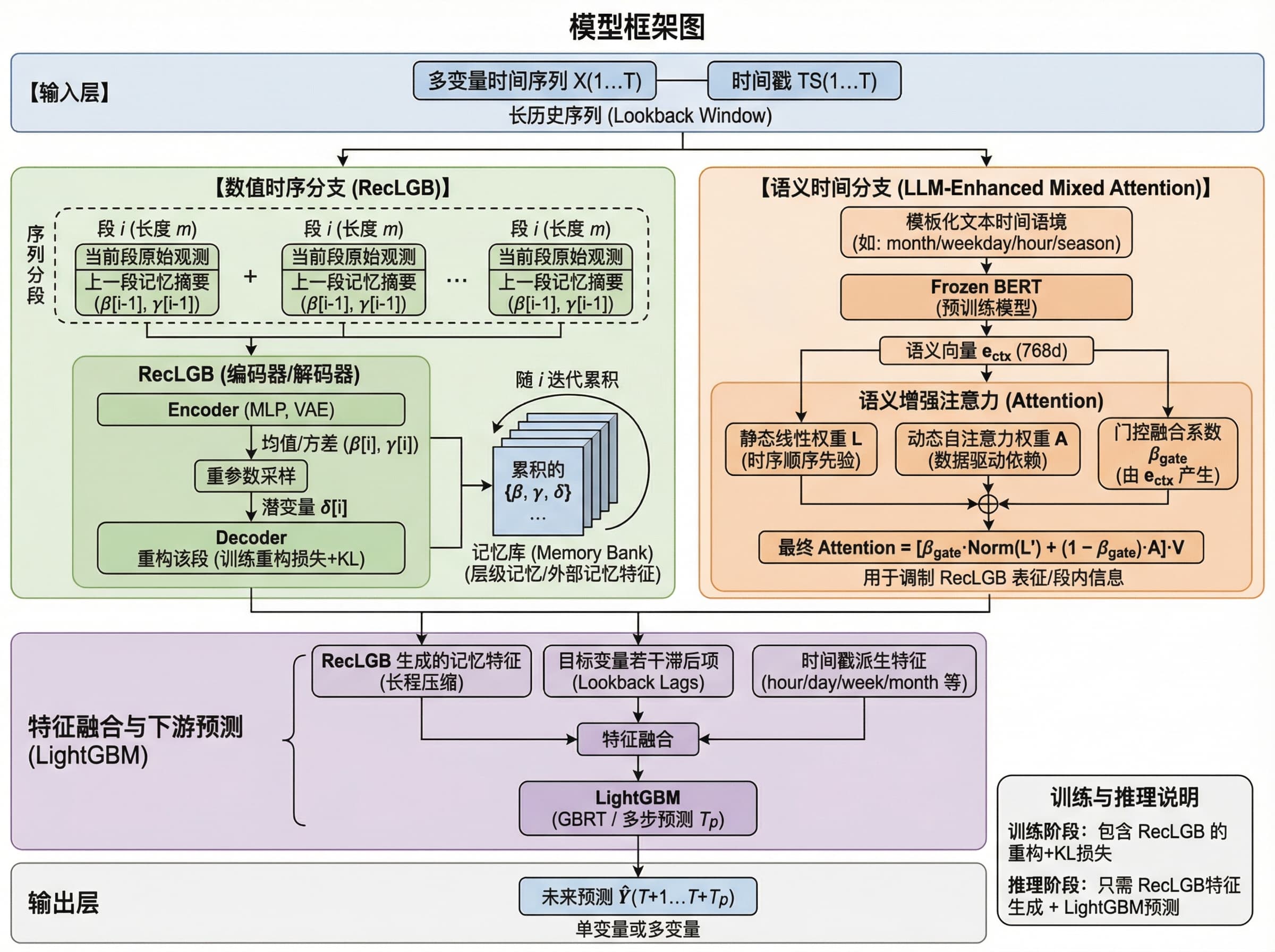
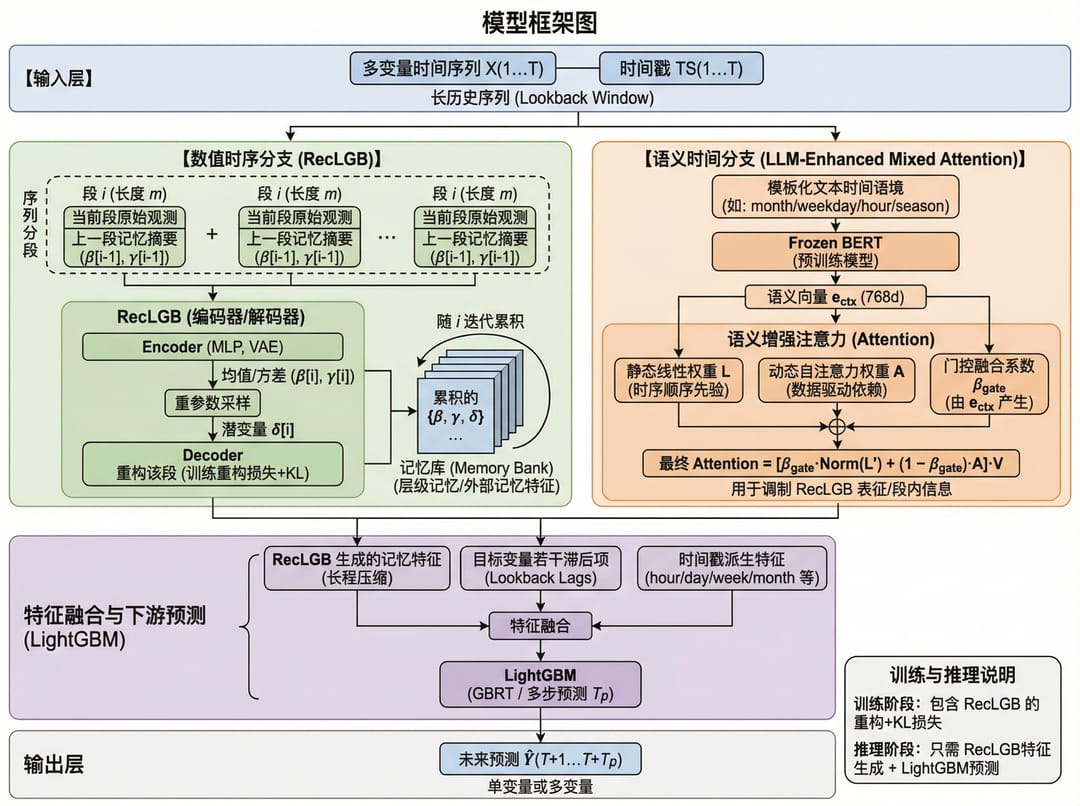 入力層、時間エンコーディング、予測モジュールを備えたAI生成のモデルフレームワーク図
AI研究者が描いているもの
368件の実際のAIシステムプロンプトのキーワード分析に基づくと、主なテーマは以下の通りです。
- データフローとパイプライン(49%が「data」、34%が「data flow」と言及)
- ニューラルネットワークアーキテクチャ(26%が「network」、25%が「architecture」)
- モジュールベースのフレームワーク(28%が「module」、21%が「modules」)
- 特徴抽出(27%が「feature」、26回「feature extraction」が登場)
- 最適化アルゴリズム(19%が「optimization」)
- 予測モデル(16%が「prediction」)
最も頻繁に登場するバイグラム(2語の連なり)は明確な傾向を示しています。「architecture diagram」(37回)、「neural network」(34回)、「data flow」(34回)、「feature extraction」(26回)が主流を占めています。
ニューラルネットワークアーキテクチャ図
時系列予測モデル
私たちのコミュニティで最も詳細なアーキテクチャ図の一つは、完全な多変量時系列予測フレームワークを示しています。
Model Framework Diagram:
1) Input Layer:
- Input consists of multivariate time series X(1…T)
  and corresponding timestamps TS(1…T)
  (labeled as "lookback window/long historical sequence")
2) Temporal Encoding Module:
- Timestamps processed through positional encoding
- Learnable temporal embeddings
3) Feature Extraction:
- Multi-head self-attention mechanism
- Convolutional feature maps
4) Prediction Head:
- Output: forecasted values Y(T+1…T+H)
Academic paper style, vector illustration,
soft color scheme with blue-green palette.
XGBoostアルゴリズム改善ロードマップ
Roadmap for improving XGBoost algorithm,
focusing on leaf fine-tuning
(Newton-BCD for post-optimization).
Show: original XGBoost tree structure →
leaf value initialization →
Newton-BCD optimization iterations →
convergence criteria check →
pruned and fine-tuned tree output.
Include performance comparison metrics.
Algorithm design academic paper style.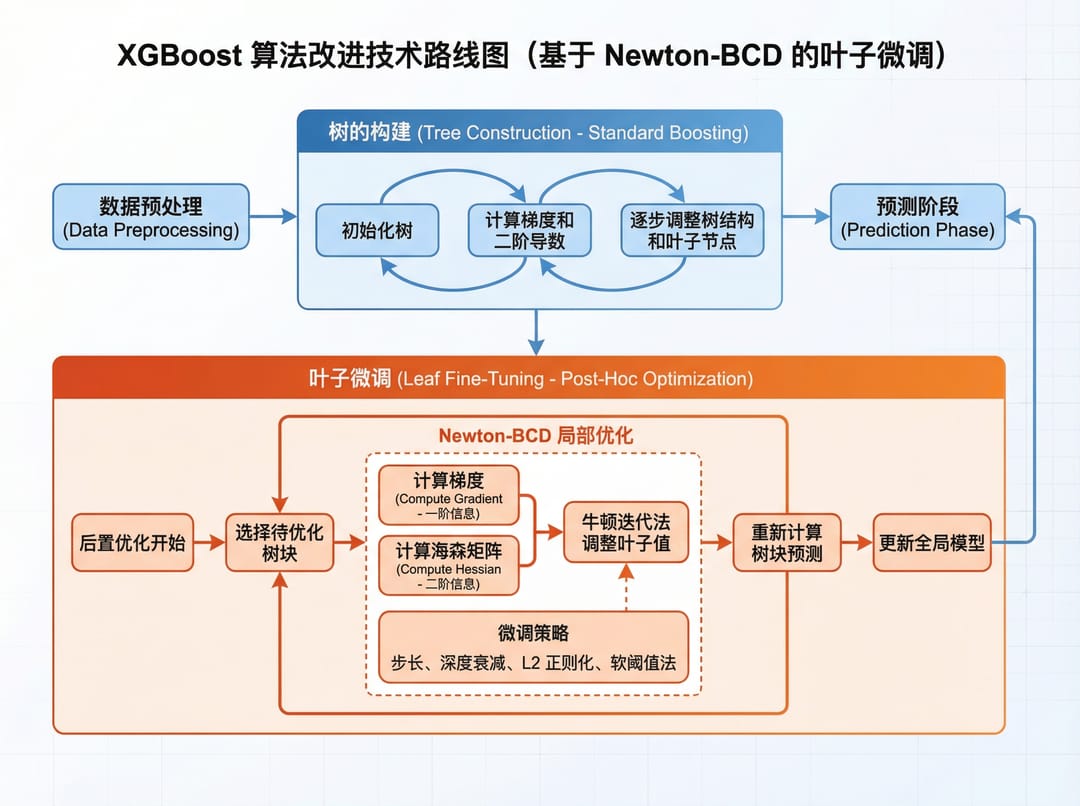 XGBoostのリーフ微調整アルゴリズム改善ロードマップ
アルゴリズムフローチャート
フローチャートはAI論文の基本です。研究者はメソッドセクションのためにこれらを必要としており、学術的な基準に準拠している必要があります。
CRFベースの境界最適化
Flowchart conforming to academic paper standards,
focusing on process logic with extremely concise text.
Theme: "CRF-based Broiler Instance Mask
Boundary Optimization Process."
Steps: Input segmentation mask →
Edge detection → CRF energy function construction →
Unary potential (appearance model) +
Pairwise potential (spatial smoothness) →
Mean-field inference iterations →
Refined boundary output.
Clean academic flowchart, minimal text labels.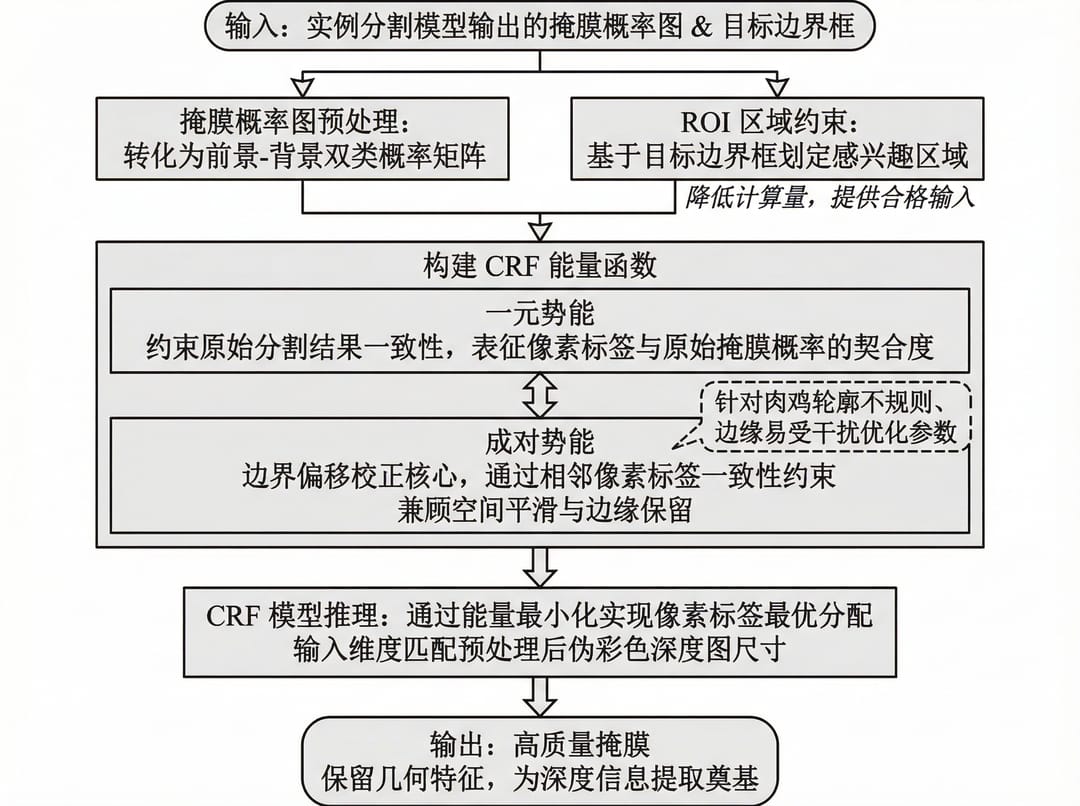 CRFベースのインスタンスマスク境界最適化フローチャート
ロボット制御のための拡散モデル
Algorithm flowchart for robotic arm control.
Input: trajectory of robotic arm motion
and corresponding torque data.
Processing: hierarchical diffusion model
with noise injection schedule,
denoising steps with conditional guidance.
Output: executed trajectory matching expert demonstrations.
Evaluation: trajectory error metrics, torque smoothness.
Robotics + deep learning paper style.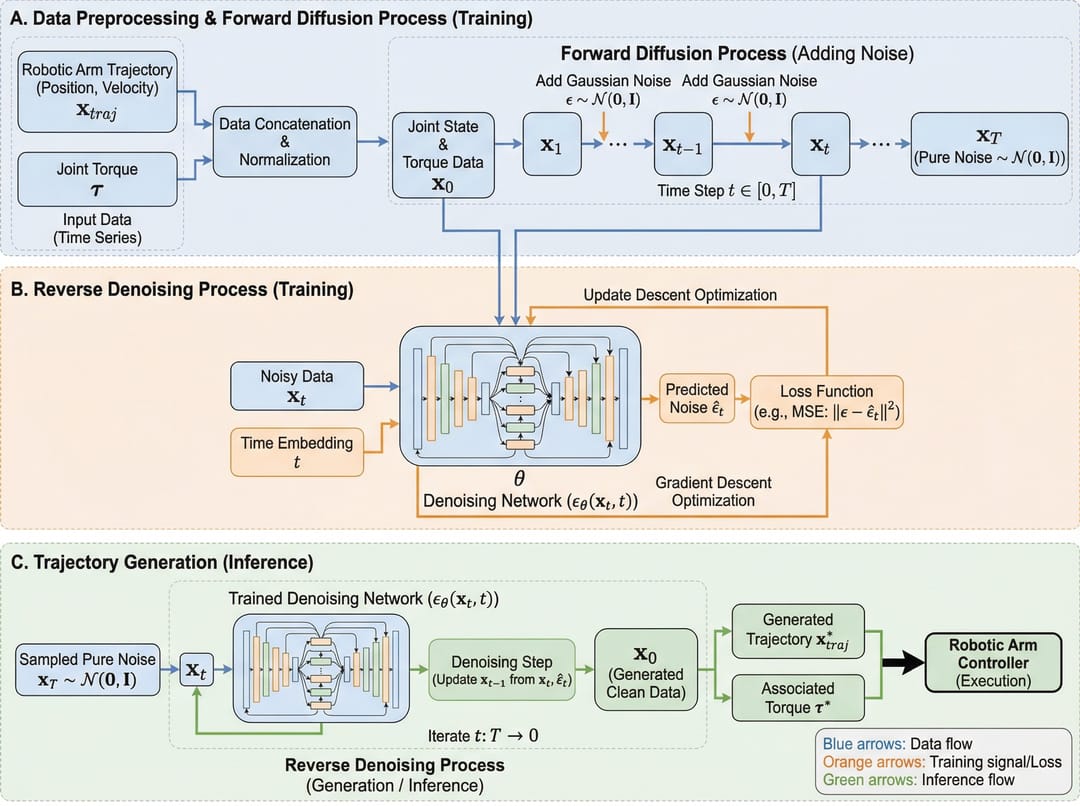 ロボットアームの軌道生成のための階層的拡散モデルのフローチャート
マルチモジュールシステムアーキテクチャ
UAV協調スケジューリング
UAVのエッジ・クラウド協調は、複雑なマルチモジュールアーキテクチャを伴う注目の研究分野です。
Collaborative scheduling protocol for large-scale
unmanned aerial vehicle (UAV) clusters.
Integrate UAV image input size selection
and task offloading path planning.
Three-tiered architecture:
- UAV layer: trajectory planning + image capture
- Edge layer: local inference + task queue
- Cloud layer: heavy model + global optimization
Data flow arrows between tiers,
latency and energy consumption constraints labeled.
Technical architecture diagram, IEEE style.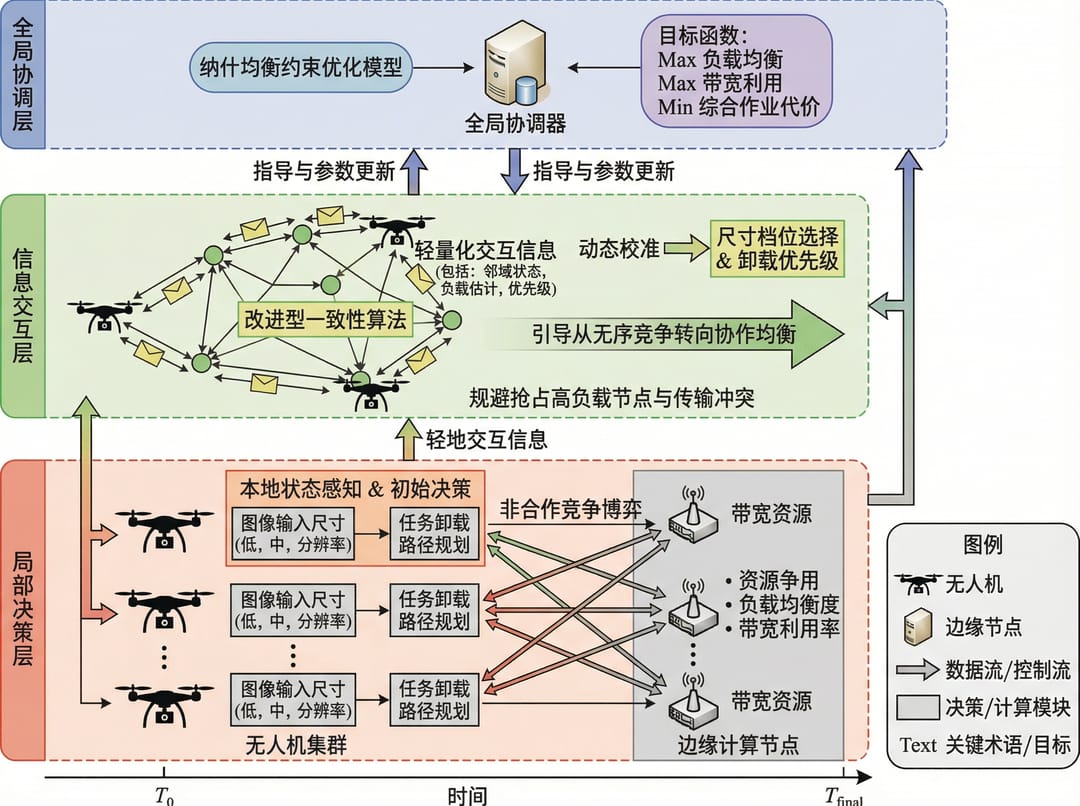 UAV-エッジ-クラウド協調スケジューリングプロトコルのアーキテクチャ
マルチエージェント最適化フレームワーク
Co-evolutionary Multi-Agent Optimization Architecture (MAT-EMO).
Agent Role Allocation table:
- Architect: structure optimization
- Explorer: search space expansion
- Exploiter: local refinement
- Evaluator: fitness assessment
Show agent communication topology,
shared memory pool for population exchange,
co-evolutionary cycles with performance feedback.
Academic paper figure, optimization conference style.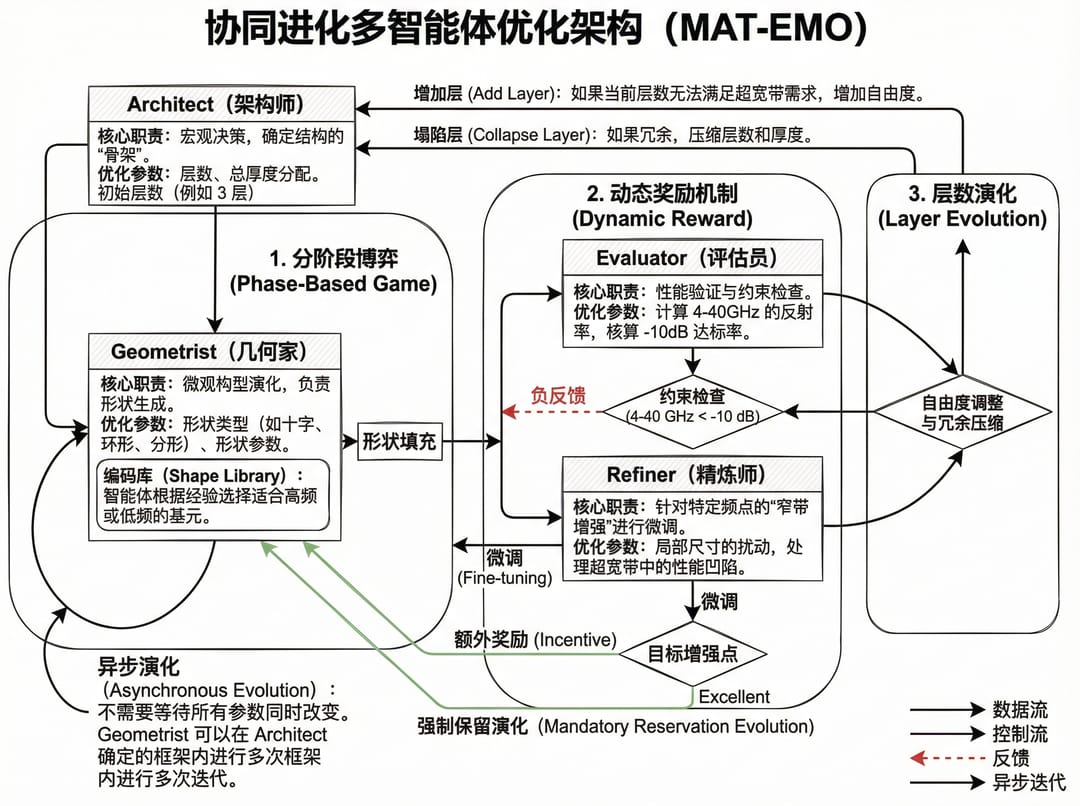 共進化マルチエージェント最適化アーキテクチャ
研究フレームワーク図
3セクションモジュールレイアウト
一般的なレイアウトパターンとして、図を3つの明確なセクションに分割するものがあります。
Diagram divided into three sections from left to right,
distinguished by light-colored rounded rectangle backgrounds.
Title text centered at the top.
Color scheme: soft, mainly light blue, light green,
light purple pastel tones.
Section 1: Data preprocessing and input
Section 2: Core model architecture with sub-modules
Section 3: Output and evaluation metrics
Connecting arrows showing data flow between sections.
Academic paper style, clean vector illustration.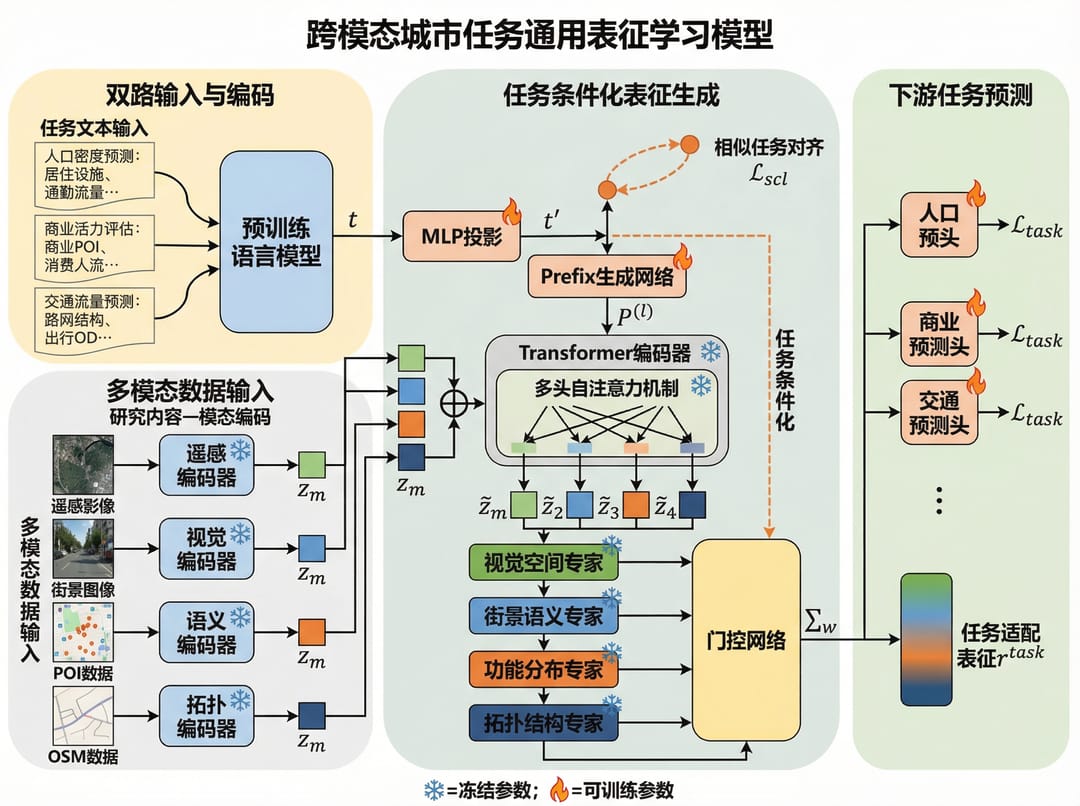 パステルカラーを採用した3セクション構成の研究フレームワーク
手法フレームワーク
Methodological framework diagram.
Approach: hierarchical diffusion model.
Inputs: expert trajectories and corresponding torques.
Output: executed trajectory.
Evaluation metrics: trajectory tracking error,
torque smoothness score, success rate.
Show training phase (top) and inference phase (bottom).
Loss function components labeled.
Machine learning paper methods section style.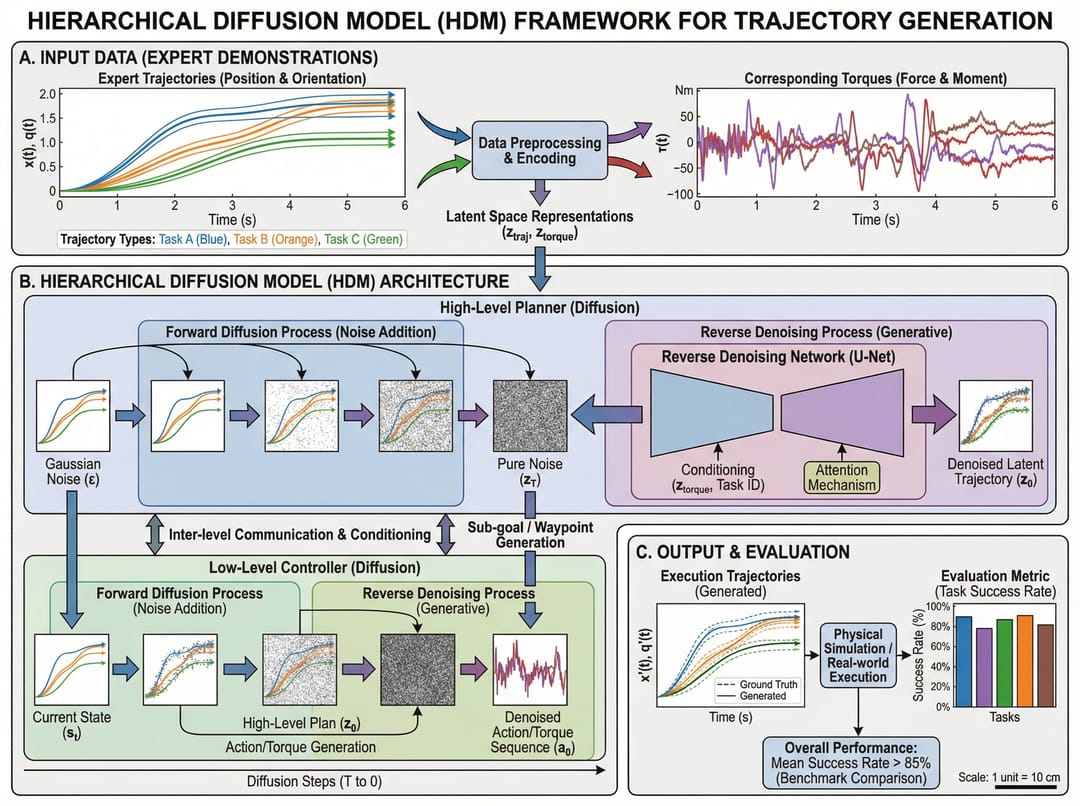 階層的拡散モデルの手法フレームワーク
AIアーキテクチャ図のためのプロンプト作成のヒント
効果的な構造要素
368件のAIシステムプロンプトの分析に基づくと、成功している図には以下の構造的パターンが見られます。
| パターン | 頻度 | 目的 |
|---|---|---|
| 「セクションに分割(Divided into sections)」 | 47回 | 明確な視覚的階層を作成する |
| 「入力 → 出力(Input → Output)」フロー | プロンプトの33% | データパイプラインを確立する |
| 「配色(Color scheme)」の指定 | 55回 | 視覚的な一貫性を確保する |
| モジュールの命名 | 28% | コンポーネントの役割を明確にする |
| 「学術論文(Academic paper)」スタイル | 20% | 専門的なトーンを設定する |
指定すべき主要なコンポーネント
- 入力形式: 単なる「データ入力」ではなく、「多変量時系列 X(1…T)」のように指定します。
- モジュール名: 論文で実際に使用しているモジュール名を使用します。
- データフローの方向: 「左から右」または「上から下」など。
- 配色: 読みやすさのために「ソフトパステル」や「青緑系のパレット」などを指定します。
- レイアウトタイプ: 「3カラム」、「階層型」、「円形」など。
避けるべきこと
- モジュールが多すぎる: 明確さを保つため、主要なコンポーネントは5〜7個に制限します。
- 接続の欠落: すべてのモジュールには明確な入力/出力の矢印が必要です。
- 粒度の不一致: 高レベルのブロックと詳細なサブコンポーネントを混在させないでください。
- 凡例がない: 複数の視覚的コード(色や記号)を使用する場合は、凡例を含めます。
AIアーキテクチャ図の作成を始める
AI研究の可視化を一新しましょう。
- SciDraw AI Drawing にアクセス
- System Architecture テンプレートを選択
- モデルのモジュール、データフロー、接続について記述
- 論文掲載レベルのアーキテクチャ図を生成
ニューラルネットワークアーキテクチャ、アルゴリズムフローチャート、モデルフレームワークの図解作成に、すでに何百人ものAI研究者が SciDraw AI を活用しています。
関連記事: