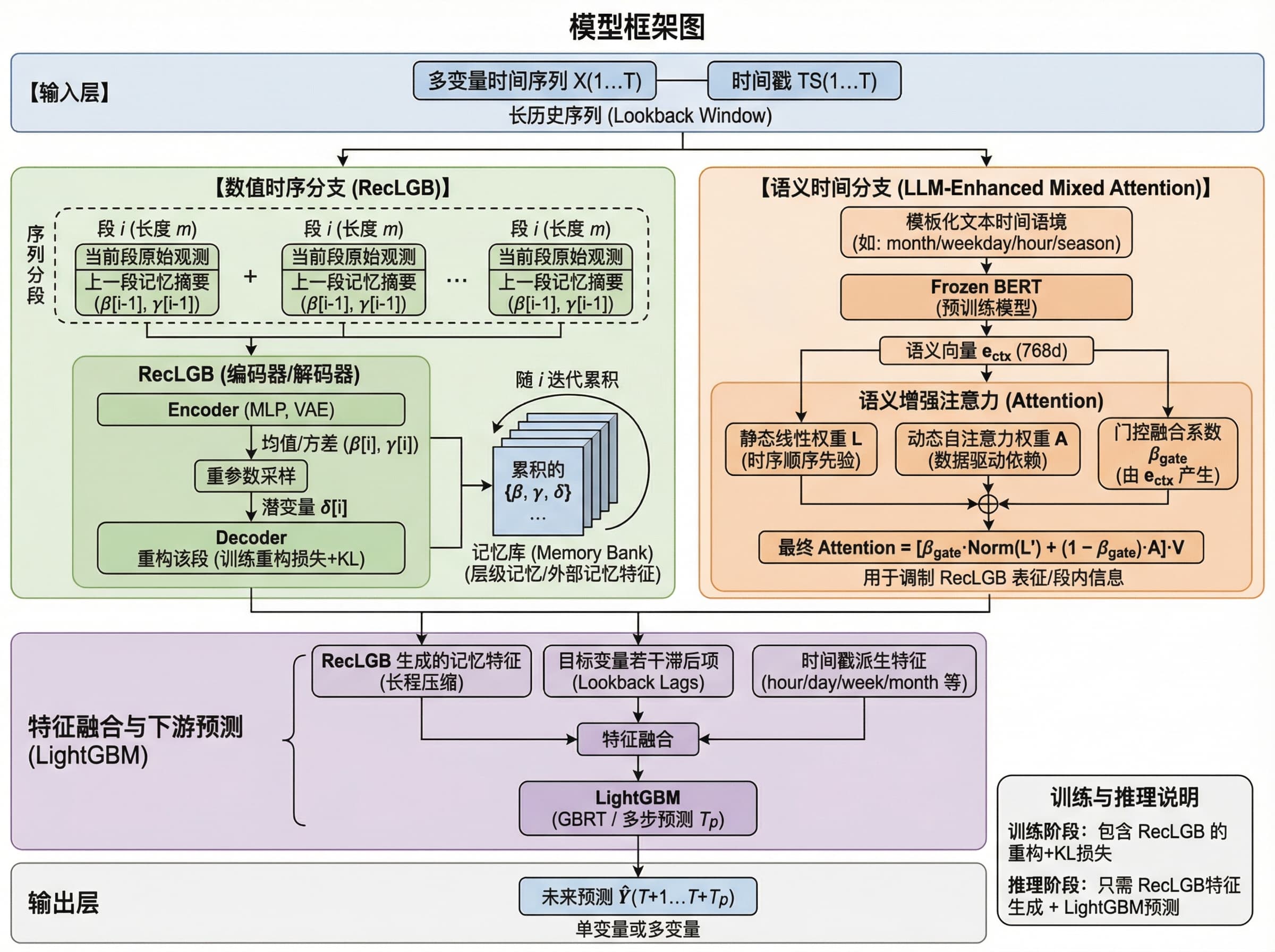
投 NeurIPS、CVPR,或一篇頂級期刊,方法章節裡那張模型架構圖往往得反覆改。用 draw.io 或 PowerPoint 一個方框一根箭頭慢慢拉,Transformer 的多頭注意力還沒畫完,deadline 先到了——做 AI 的研究者大概都熟悉這種痛。
我們在 SciDraw AI 上生成了 360 多張 AI 系統架構圖,順手統計了大家實際在畫什麼:模型框架圖、特徵提取流程、資料流架構、最佳化演算法流程圖是四類高頻需求。這篇就按這幾類,用真實案例講清楚每一種怎麼快速畫出來。工具可以直接用 AI 架構圖產生器。
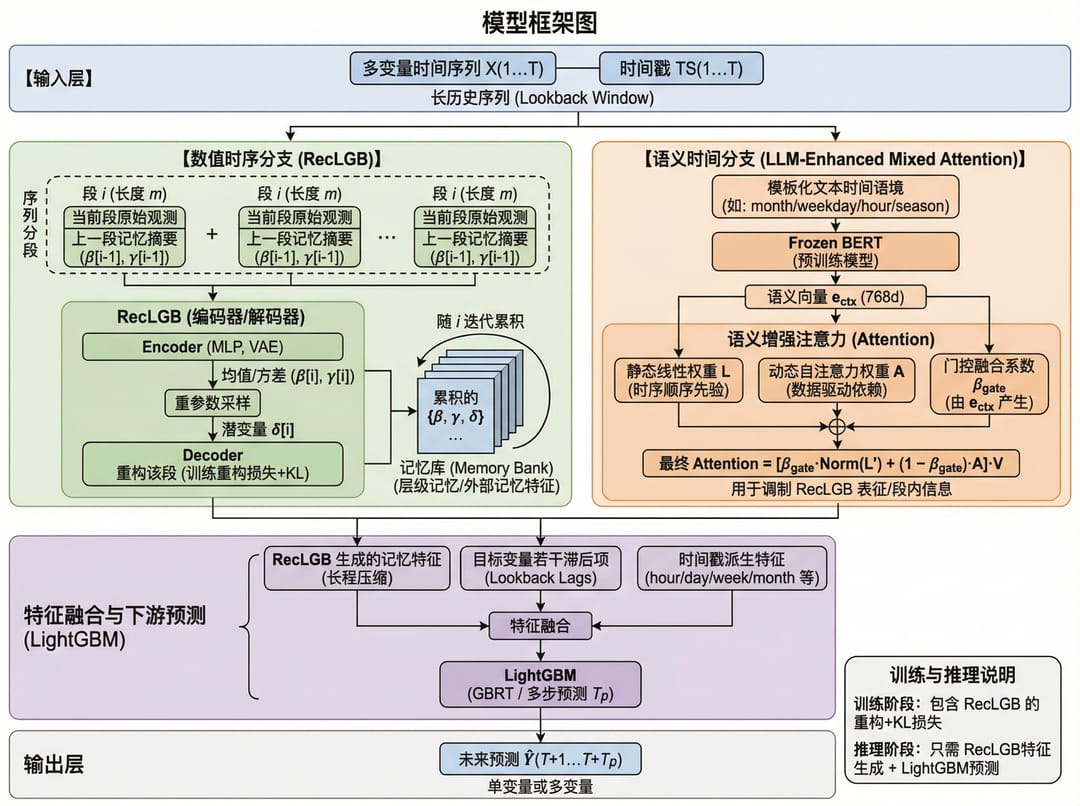 AI 生成的模型框架圖,包含輸入層、時間編碼和預測模組
AI 研究人員正在繪製什麼
根據對 368 個真實 AI 系統提示詞(prompts)的關鍵字分析,熱門主題包括:
- 數據流與流水線 (49% 提及 "data",34% 提及 "data flow")
- 神經網路架構 (26% "network",25% "architecture")
- 基於模組的框架 (28% "module",21% "modules")
- 特徵提取 (27% "feature",26 次出現 "feature extraction")
- 優化演算法 (19% "optimization")
- 預測模型 (16% "prediction")
最頻繁出現的雙詞組合(bigrams)說明了明確的趨勢:「architecture diagram」(出現 37 次)、「neural network」(34 次)、「data flow」(34 次)和「feature extraction」(26 次)佔據主導地位。
神經網路架構圖
如果要畫的是 CNN、LSTM 或 Transformer 這類模型的層結構,可以直接用神經網路結構圖產生器,它會逐層標註,並標出張量維度與資料流向。
時間序列預測模型
社群中最詳細的架構圖之一展示了一個完整的多元時間序列預測框架:
Model Framework Diagram:
1) Input Layer:
- Input consists of multivariate time series X(1…T)
  and corresponding timestamps TS(1…T)
  (labeled as "lookback window/long historical sequence")
2) Temporal Encoding Module:
- Timestamps processed through positional encoding
- Learnable temporal embeddings
3) Feature Extraction:
- Multi-head self-attention mechanism
- Convolutional feature maps
4) Prediction Head:
- Output: forecasted values Y(T+1…T+H)
Academic paper style, vector illustration,
soft color scheme with blue-green palette.
XGBoost 演算法改進路線圖
Roadmap for improving XGBoost algorithm,
focusing on leaf fine-tuning
(Newton-BCD for post-optimization).
Show: original XGBoost tree structure →
leaf value initialization →
Newton-BCD optimization iterations →
convergence criteria check →
pruned and fine-tuned tree output.
Include performance comparison metrics.
Algorithm design academic paper style.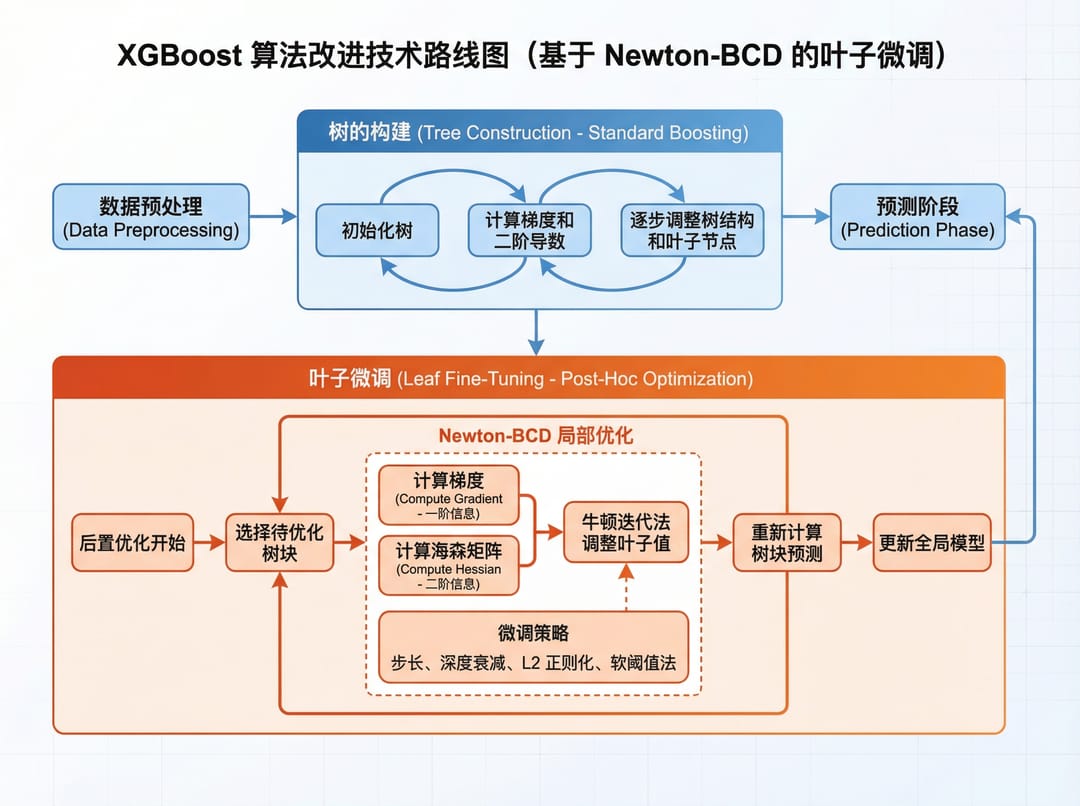 XGBoost 葉子節點微調演算法改進路線圖
演算法流程圖
流程圖是 AI 論文的基石。研究人員在方法論章節中需要它們,且必須符合學術標準。
基於 CRF 的邊界優化
Flowchart conforming to academic paper standards,
focusing on process logic with extremely concise text.
Theme: "CRF-based Broiler Instance Mask
Boundary Optimization Process."
Steps: Input segmentation mask →
Edge detection → CRF energy function construction →
Unary potential (appearance model) +
Pairwise potential (spatial smoothness) →
Mean-field inference iterations →
Refined boundary output.
Clean academic flowchart, minimal text labels.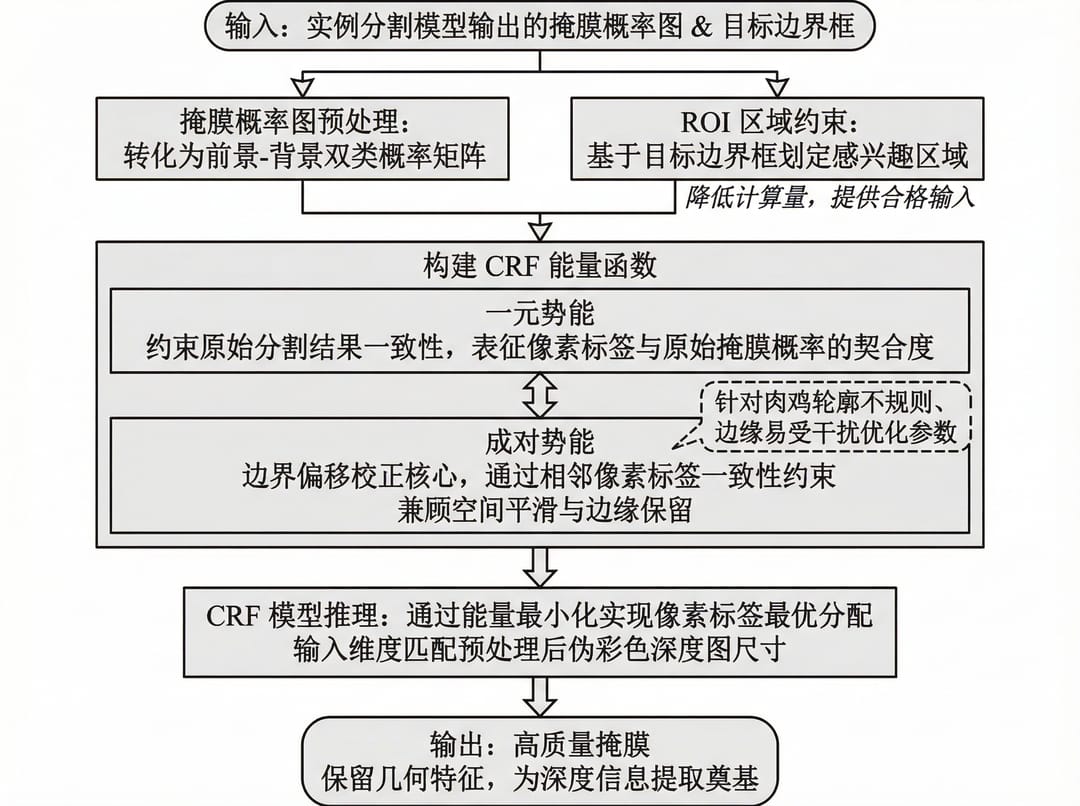 基於 CRF 的實例遮罩邊界優化流程圖
用於機器人控制的擴散模型
Algorithm flowchart for robotic arm control.
Input: trajectory of robotic arm motion
and corresponding torque data.
Processing: hierarchical diffusion model
with noise injection schedule,
denoising steps with conditional guidance.
Output: executed trajectory matching expert demonstrations.
Evaluation: trajectory error metrics, torque smoothness.
Robotics + deep learning paper style.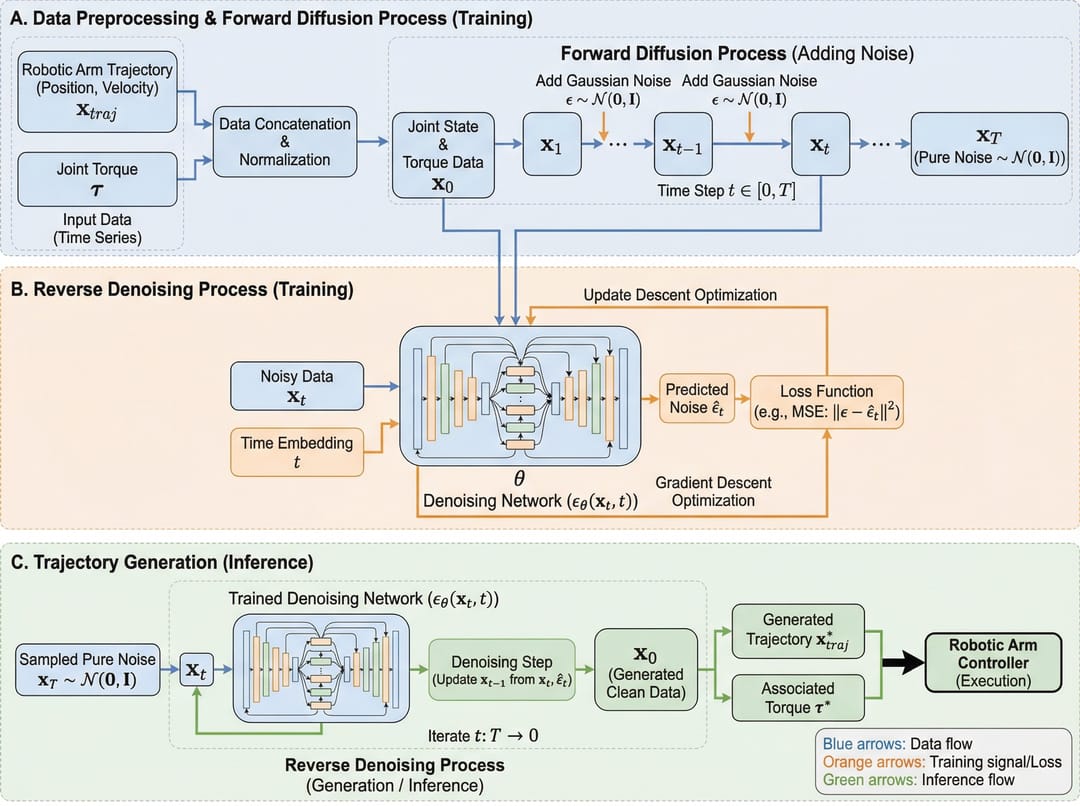 用於機械手臂軌跡生成的層次化擴散模型流程圖
多模組系統架構
無人機協作調度
無人機邊緣雲協作是一個熱門研究領域,具有複雜的多模組架構:
Collaborative scheduling protocol for large-scale
unmanned aerial vehicle (UAV) clusters.
Integrate UAV image input size selection
and task offloading path planning.
Three-tiered architecture:
- UAV layer: trajectory planning + image capture
- Edge layer: local inference + task queue
- Cloud layer: heavy model + global optimization
Data flow arrows between tiers,
latency and energy consumption constraints labeled.
Technical architecture diagram, IEEE style.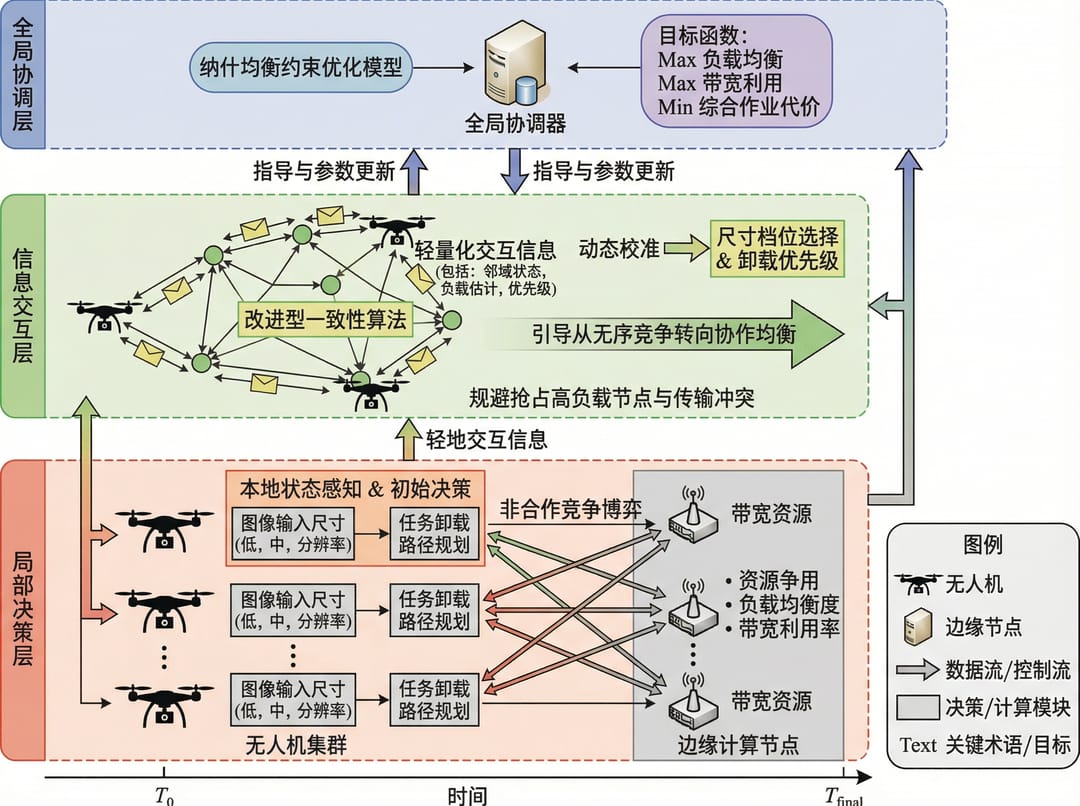 無人機-邊緣-雲端協作調度協定架構
多智能體優化框架
Co-evolutionary Multi-Agent Optimization Architecture (MAT-EMO).
Agent Role Allocation table:
- Architect: structure optimization
- Explorer: search space expansion
- Exploiter: local refinement
- Evaluator: fitness assessment
Show agent communication topology,
shared memory pool for population exchange,
co-evolutionary cycles with performance feedback.
Academic paper figure, optimization conference style.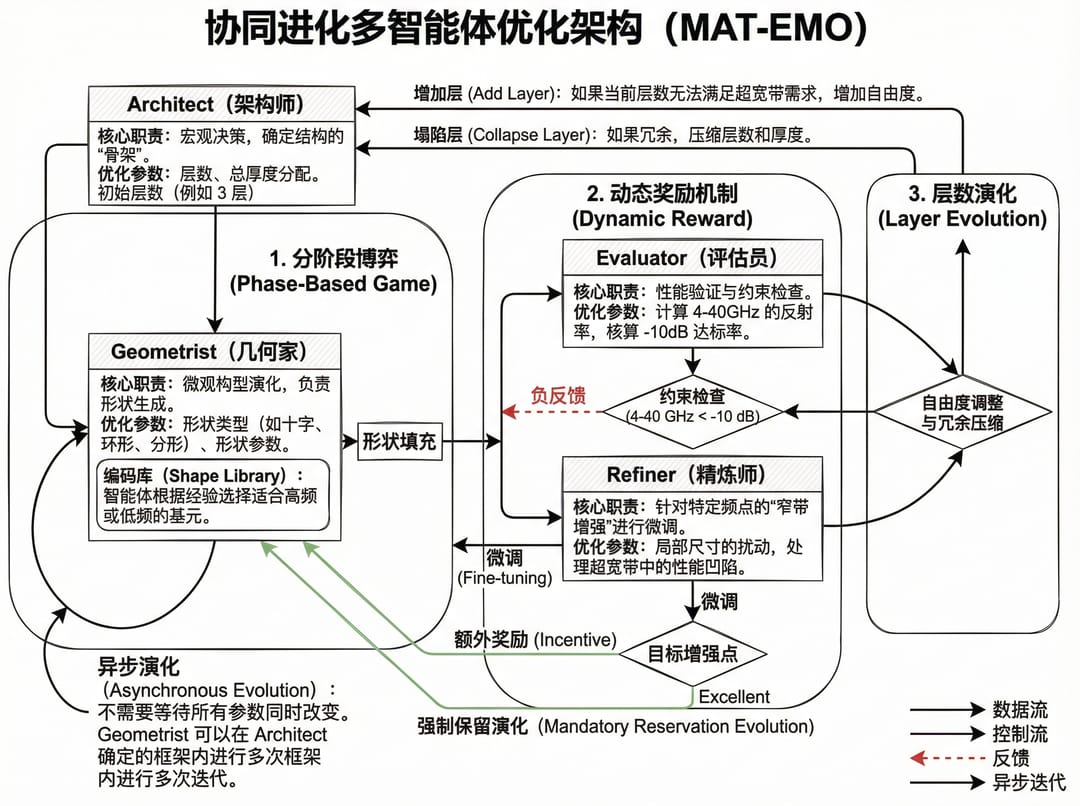 協同演化多智能體優化架構
研究框架圖
三段式模組佈局
一種流行的佈局模式將圖表分為三個不同的部分:
Diagram divided into three sections from left to right,
distinguished by light-colored rounded rectangle backgrounds.
Title text centered at the top.
Color scheme: soft, mainly light blue, light green,
light purple pastel tones.
Section 1: Data preprocessing and input
Section 2: Core model architecture with sub-modules
Section 3: Output and evaluation metrics
Connecting arrows showing data flow between sections.
Academic paper style, clean vector illustration.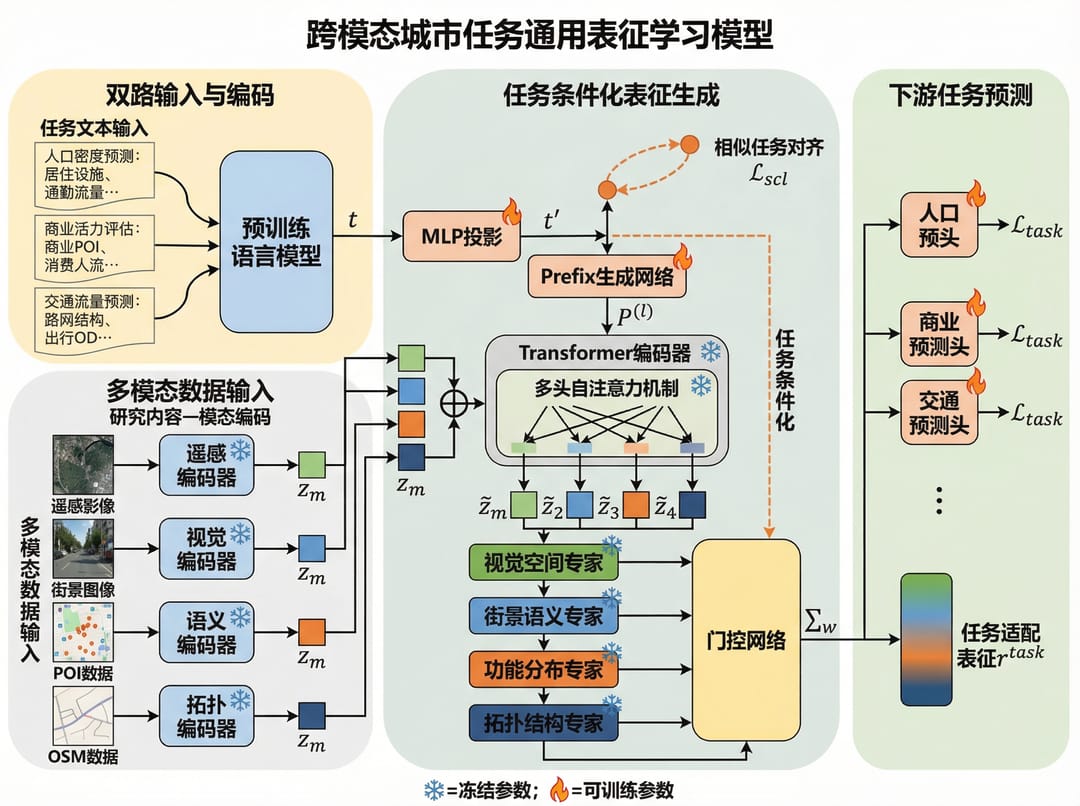 採用粉彩色系的三段式研究框架
方法論框架
Methodological framework diagram.
Approach: hierarchical diffusion model.
Inputs: expert trajectories and corresponding torques.
Output: executed trajectory.
Evaluation metrics: trajectory tracking error,
torque smoothness score, success rate.
Show training phase (top) and inference phase (bottom).
Loss function components labeled.
Machine learning paper methods section style.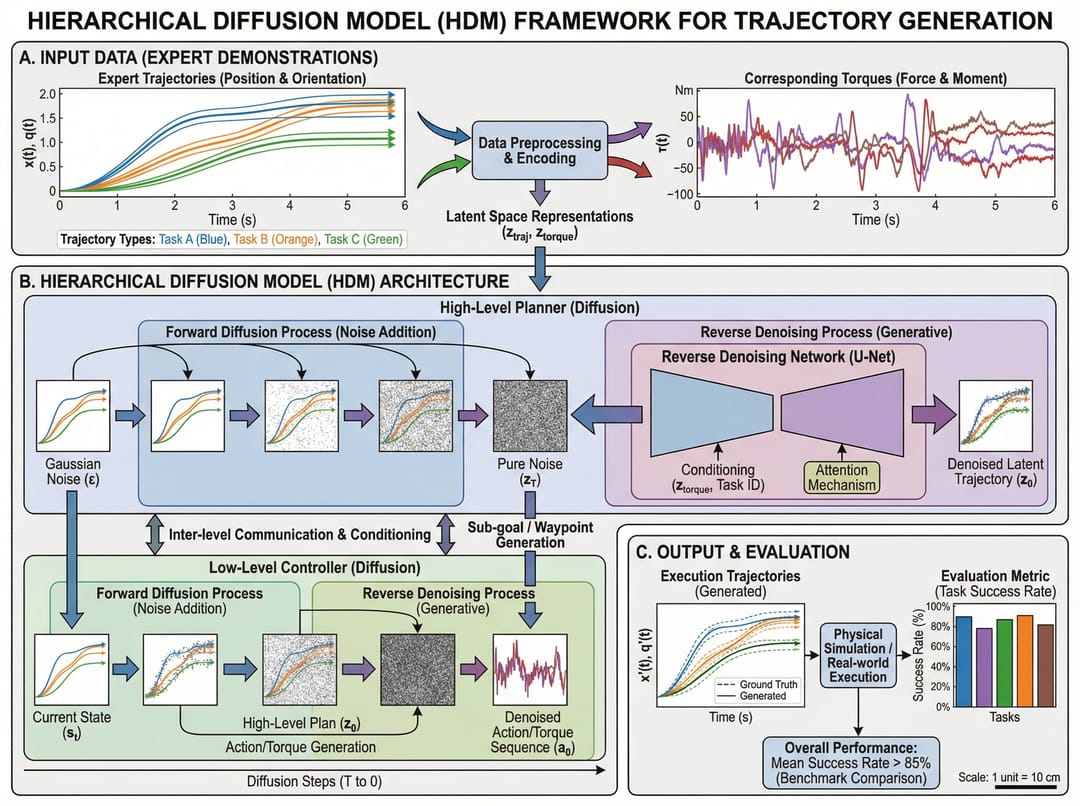 層次化擴散模型方法論框架
AI 架構圖的提示詞撰寫技巧
有效的結構元素
根據對 368 個 AI 系統提示詞的分析,成功的圖表通常具有以下結構模式:
| 模式 | 頻率 | 目的 |
|---|---|---|
| 「劃分為多個部分」 | 出現 47 次 | 建立清晰的視覺層次 |
| 「輸入 → 輸出」流程 | 33% 的提示詞 | 確立數據流水線 |
| 指定「配色方案」 | 出現 55 次 | 確保視覺一致性 |
| 模組命名 | 28% | 明確組件角色 |
| 「學術論文」風格 | 20% | 設定專業基調 |
需指定的關鍵組件
- 輸入格式:使用 "multivariate time series X(1…T)" 而不僅是 "data input"
- 模組名稱:使用您論文中實際的模組名稱
- 數據流方向:「從左到右」或「從上到下」
- 配色方案:使用 "soft pastel"(柔和粉彩)或 "blue-green palette"(藍綠色調)以提高可讀性
- 佈局類型:「三欄式」、「層次化」、「圓形」
應避免的事項
- 模組過多:為了清晰起見,將主要組件限制在 5-7 個
- 缺少連接:每個模組都應有清晰的輸入/輸出箭頭
- 粒度不一致:不要將高階區塊與詳細的子組件混在一起
- 沒有圖例:使用多種視覺編碼時,請包含顏色/符號圖例
開始建立 AI 架構圖
提升您的 AI 研究視覺化效果:
- 訪問 SciDraw AI 繪圖
- 選擇 System Architecture 模板
- 描述您的模型模組、數據流和連接
- 生成可用於發表的架構圖
加入數百名已經在使用 SciDraw AI 建立神經網路架構、演算法流程圖和模型框架插圖的 AI 研究人員行列。
相關條目:
- AI 架構圖產生器 — AI 建立神經網路與系統架構圖
- 科學圖表生成器:AI 研究論文工具
- SciDraw AI 繪圖模式教程
- 論文與學位論文 AI 圖表指南