How to Make a Neural Network Diagram with AI: Step-by-Step (2026)
A step-by-step how-to for making neural network and deep learning architecture diagrams with AI — from input to output, with a four-step workflow, worked examples by field (computer vision, NLP, tabular), and tips for thesis and paper-ready figures.
A neural network diagram has to communicate an architecture at a glance: every layer in order, the tensor shapes flowing through, and the path from input to output. This guide is the step-by-step how-to — the workflow you follow from a blank canvas to an export-ready figure, not just a bank of prompts. If you want ready-made prompts to copy, see our companion post, neural network diagram prompts; here you'll learn the method that makes any architecture figure come out clean.
By the end of this guide you'll be able to:
Make a neural network diagram with AI in four repeatable steps — plan, generate, refine, export.
Adapt the workflow to your own field, whether that's computer vision, NLP, or tabular deep learning.
Produce thesis- and paper-ready architecture figures with labeled layers, tensor shapes, and clean left-to-right data flow.
Avoid the mistakes that make AI architecture diagrams look messy or wrong.
Everything happens in the SciDraw AI editor, the AI-native workspace where the figure is your canvas and plain language is your tool.
CNN, Transformer, RNN/LSTM, autoencoder — every architecture figure comes from the same four steps.
Plan the architecture. Decide the input, the ordered stack of layers/blocks, the shapes that matter, and the output head.
Generate a first draft. Turn the plan into one sentence naming the input, each layer in order, the tensor shapes, and the output, with left-to-right flow.
Davie Chen is a researcher at the Faculty of Animation and Intermedia, University of Arts in Poznan, studying generative AI for scientific figure creation, patent illustration, and manuscript drafting. SciDraw AI is one of the research-to-product tools built from this work.
Thousands of researchers use SciDraw AI to make publication-ready figures for papers, grants, and journal submissions — in minutes, with no design skills.
Template for step 2: "Draw a [architecture] from [input] through [layer1, layer2, layer3] to [output head]. Label each layer, show the tensor/feature-map shapes, and use left-to-right data-flow arrows on a white background."
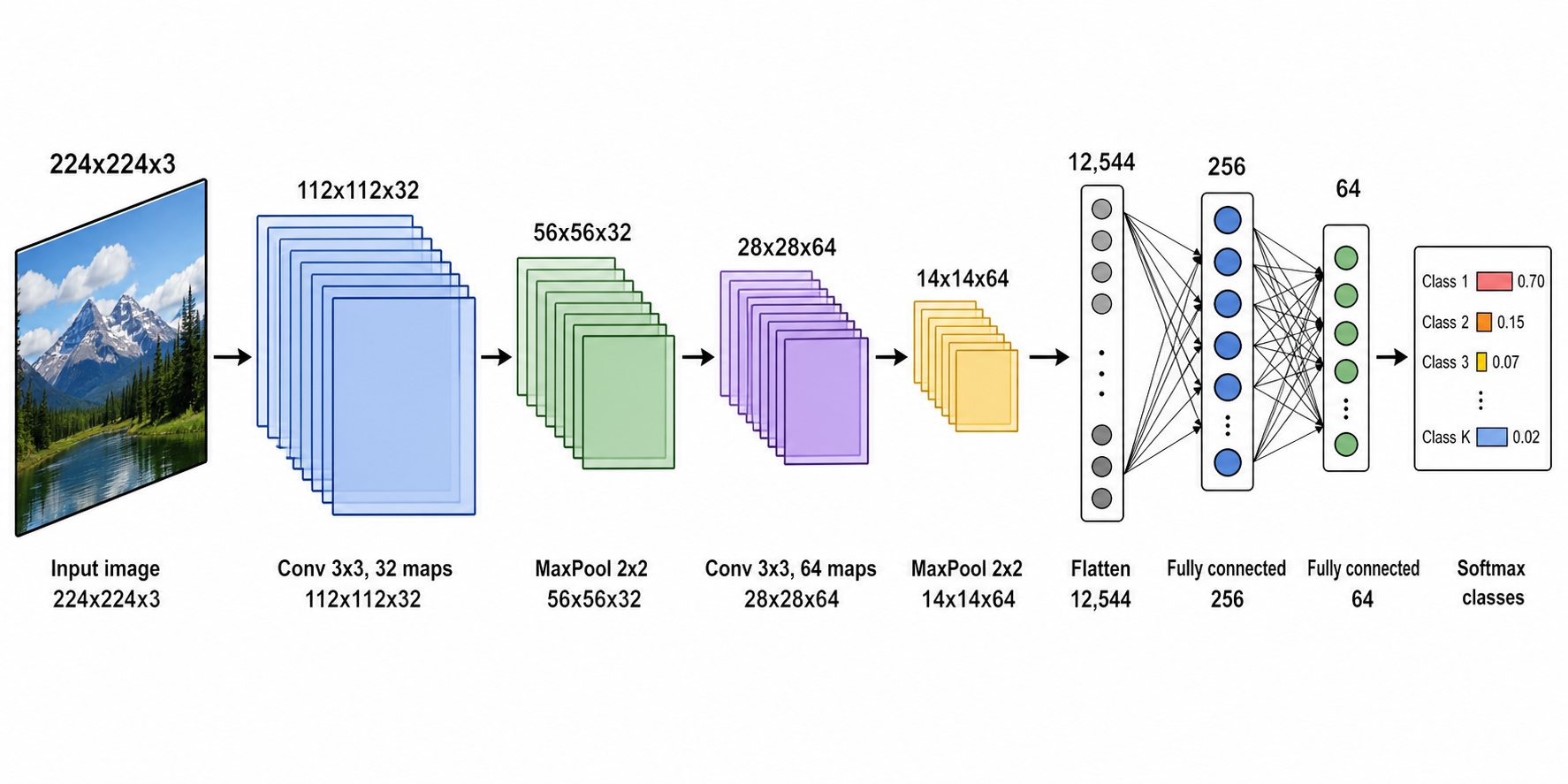
Convert the plan into one sentence. For a CNN, the plan ("input image → conv/pool blocks → flatten → fully connected → softmax, with feature maps shrinking") becomes a single prompt and the clean architecture above.
Tips that make the first draft land:
Name every layer you want labeled. The AI labels exactly what you name.
State the order explicitly. "From the input through X, then Y, then Z, ending in the output."
Ask for shapes. "Show the feature-map sizes shrinking along the way" turns a generic stack into an informative figure.
Set the style. "Left-to-right data-flow arrows, flat technical style, white background" keeps it publication-clean.
The AI-native advantage is editing by description. Typical refinements for an architecture figure:
"Color the convolution blocks blue and the dense layers green."
"Add the output shapes under each block."
"The label 'FC' should read 'Fully Connected'."
"Add skip connections from the encoder blocks to the matching decoder blocks."
Each instruction edits the existing image in place — so the encoder/decoder layout you like stays put while you tune labels and shapes. For label-only changes, see how to edit text and labels in an AI figure.
Message: how an image becomes a class. Plan a CNN from input image through convolution and pooling to flatten and dense layers, ending in softmax, with feature maps shrinking. This is the figure above; for segmentation, replan as an encoder-decoder (U-Net) with skip connections and refine to add them.
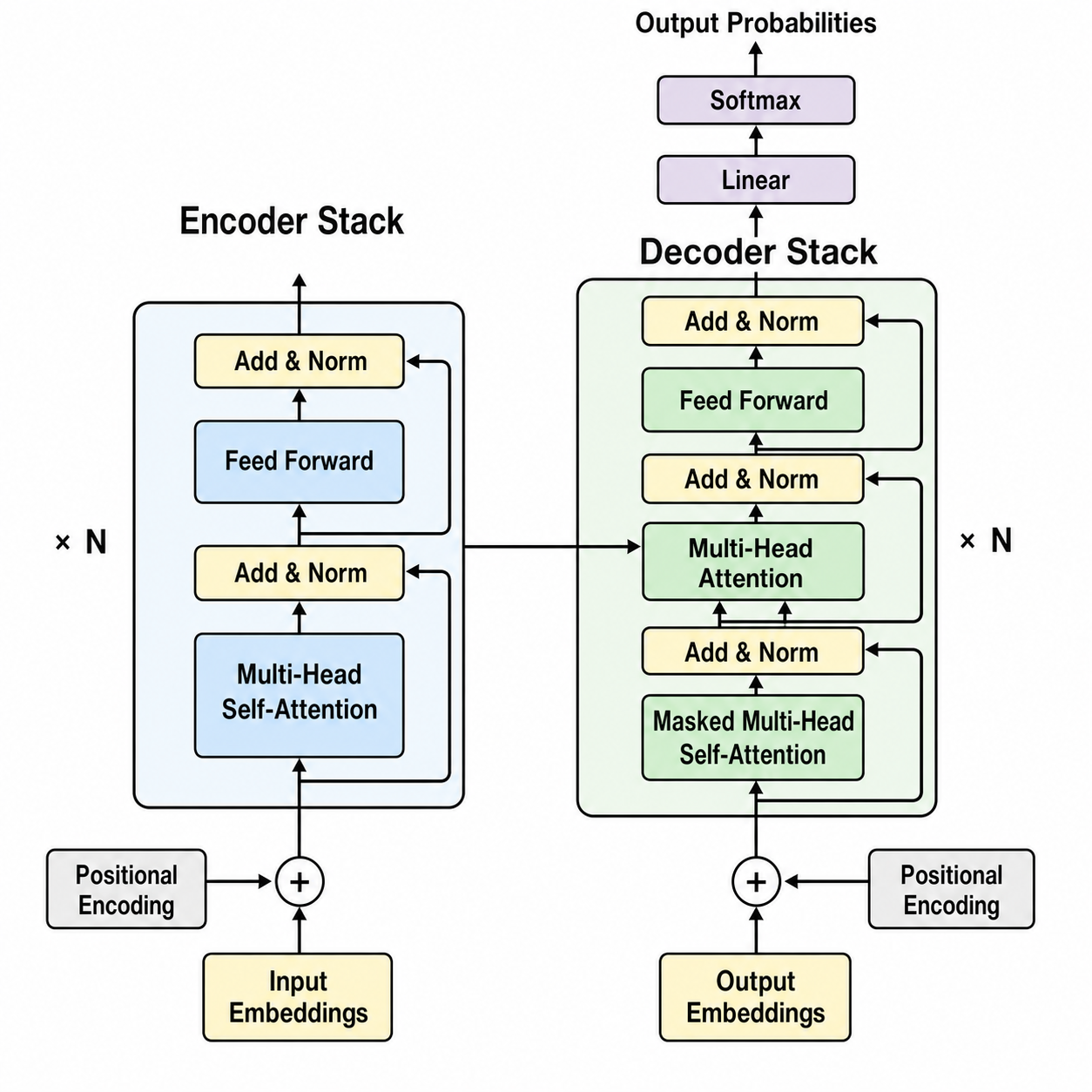
Message: how a sequence model attends and generates. Plan a Transformer with encoder and decoder stacks — input embeddings plus positional encoding, multi-head self-attention, feed-forward blocks, add-and-norm, and an output softmax. Refine to highlight the multi-head attention block if that's your contribution.
Message: a compact model others can reproduce. Plan a multilayer perceptron (input features → hidden layers → output) or an unrolled RNN/LSTM showing the recurrent cell across timesteps. Keep it small and label the units per layer so reviewers can rebuild it.
For thesis chapters and journal submissions, build in these constraints:
Fit the column. A deep stack reads well as a wide, single-row left-to-right figure for a double column; a compact model fits a single column. Generate at high resolution.
Show shapes, not jargon. Tensor shapes under each block let readers reproduce the model; long prose belongs in the methods.
Add panel letters for composites: "add a panel letter 'A' top-left."
Stay consistent. Reuse one color per layer type (conv, pool, dense, attention) across every figure so the thesis reads as one design system.
When it's right, export to editable SVG or PowerPoint (PPTX), or download a high-resolution image for your manuscript, slides, or poster. Need a colorblind-safe palette before publishing? See how to recolor a scientific diagram. Want pre-written starting points? Browse the neural network diagram prompts and drop any into the editor.
How do I make a neural network diagram with AI?
Plan the architecture (input, ordered layers, shapes, output), describe it in one sentence in the Neural Network Diagram Generator, refine conversationally, then export. The four-step workflow gives a publication-ready figure without design software.
How do I show tensor shapes in an architecture diagram?
Name them in the prompt — "show the feature-map sizes shrinking along the way" or "add the output shapes under each block" — and the AI labels the dimensions at each stage so readers can reproduce the model.
Can I create a deep learning architecture figure for a paper for free?
Yes — start generating architecture diagrams for free in the SciDraw AI editor, then upgrade for more credits and editable SVG/PPTX export for your manuscript.
How do I draw a Transformer or CNN diagram?
List the layers in order (for a CNN: conv, pool, flatten, dense, softmax; for a Transformer: embeddings, multi-head attention, feed-forward, add-and-norm, softmax), ask for left-to-right flow, then refine labels and shapes conversationally.
Is an AI architecture generator a good alternative to drawing tools?
If you'd rather describe a model than place every block by hand, an AI generator is a fast, low-cost way to make CNN, Transformer, RNN/LSTM, and MLP figures, with editable export for collaborators.
Open the Neural Network Diagram Generator, write your ordered plan, and turn it into a figure in the SciDraw AI editor. From a CNN classifier to a Transformer stack, your next paper or thesis figure is one workflow away.