Chloroplast Diagram Generator
Turn a description into a labeled chloroplast structure
Describe the chloroplast you need and SciDraw AI draws a clean, accurate diagram with the double membrane, fluid stroma, thylakoids stacked into grana, and connecting lamellae, all clearly labeled. Perfect for biology lessons, revision, manuscripts, and slides.
Chloroplast diagram examples
Click any example to load its prompt, or use it as a starting point for your own chloroplast diagram.
What is a chloroplast diagram?
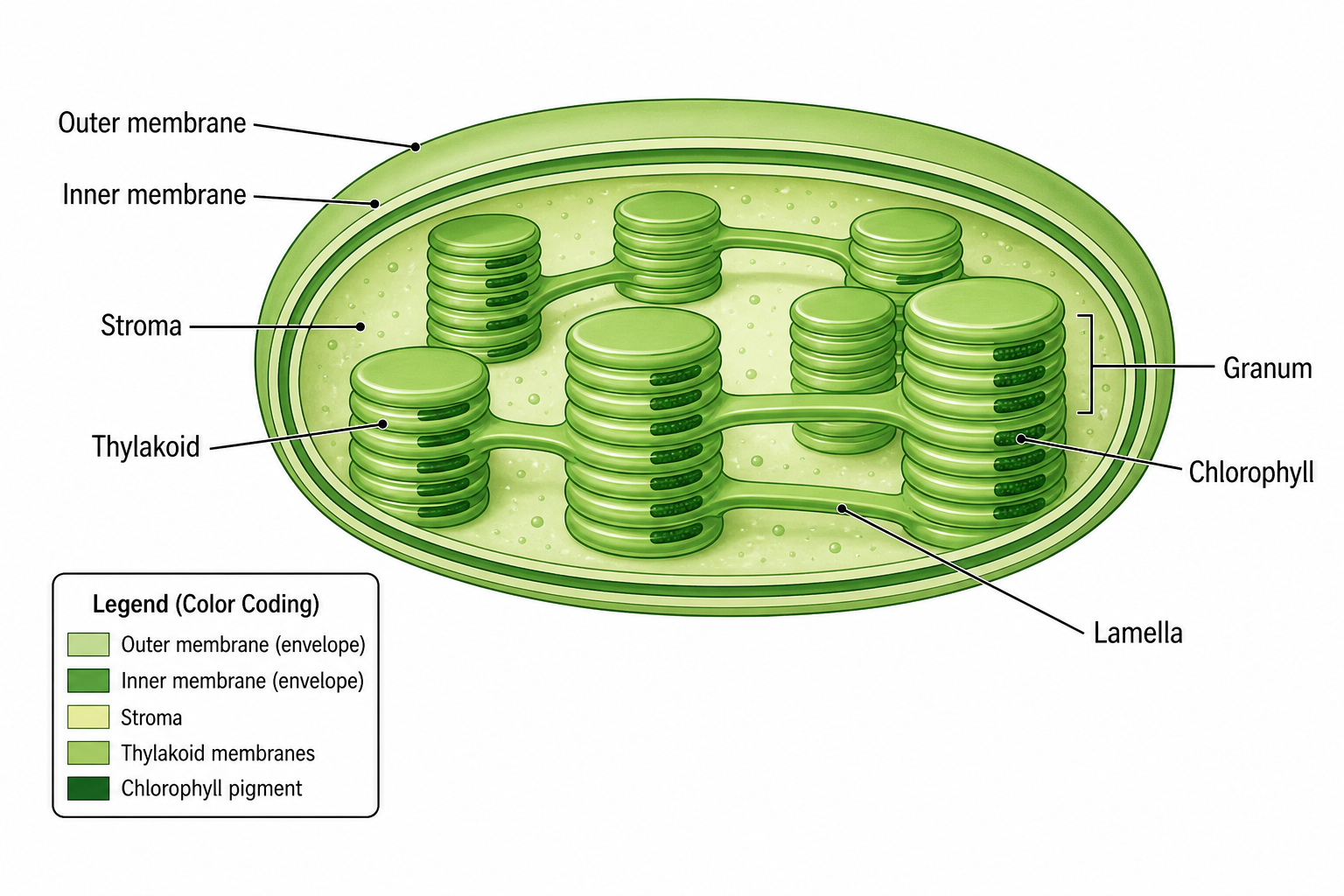
A chloroplast diagram is a labeled drawing of the chloroplast, the green organelle in plant and algal cells where photosynthesis takes place. It shows the chloroplast in cross-section with its double membrane envelope, the fluid stroma inside, and the internal thylakoid system, where flattened thylakoid discs stack into grana that are linked by stroma lamellae. Callout labels connect each part to its role, so students can see that the thylakoid membranes hold the chlorophyll and carry out the light-dependent reactions, while the stroma is where the Calvin cycle fixes carbon. SciDraw AI turns a short description of the chloroplast into a clean, accurate diagram with these structures and labels in place, without illustration software, manual drawing, or stock-image licensing.
Why use a chloroplast diagram generator
- The chloroplast is a core topic in biology and photosynthesis, and a clear diagram makes its structure easy to learn.
- Drawing an accurate organelle with membranes, thylakoids, grana, and stroma by hand takes time and skill.
- Labeled parts help students and readers connect each structure to its function in photosynthesis.
- Teachers and researchers need clean, presentable figures for lessons, worksheets, papers, and slides.
- Regenerating from a description is faster than redrawing the chloroplast every time labels or focus change.
How to make a chloroplast diagram
Describe the chloroplast you need and what to emphasize — for example a fully labeled organelle, a close-up of the grana, or a map of where photosynthesis happens. Say which parts to include: the outer and inner membrane, the intermembrane space, the stroma, thylakoids, grana, stroma lamellae, chlorophyll, and optionally chloroplast DNA, ribosomes, and starch grains. Add style notes like a legend, color-coded structures, or a plain white background, then choose an aspect ratio and resolution. Generate the figure, check that the structure and labels are accurate, and refine your wording until it matches what you are teaching or reporting.
Parts of a chloroplast
- Outer and inner membrane — the double membrane envelope that surrounds the chloroplast, with an intermembrane space between them.
- Thylakoid — a flattened, membrane-bound disc whose membrane holds chlorophyll and carries out the light-dependent reactions.
- Granum — a stack of thylakoids; many grana are spread through the chloroplast (plural: grana).
- Stroma — the fluid that fills the chloroplast around the thylakoids, where the Calvin cycle takes place.
- Lamellae — the stroma lamellae (intergranal thylakoids) that connect one granum to another.
- Chlorophyll — the green pigment in the thylakoid membranes that absorbs light energy for photosynthesis.
Chloroplast Diagram Generator FAQ
What are the parts of a chloroplast?
A chloroplast is bounded by a double membrane: an outer membrane and an inner membrane separated by an intermembrane space. Inside is the stroma, a fluid that contains enzymes, circular chloroplast DNA, ribosomes, and often starch grains. Suspended in the stroma is the thylakoid system, where flattened thylakoid discs stack into grana that are connected by stroma lamellae. The thylakoid membranes contain chlorophyll. The generator can show all of these parts with clear labels.
How do I make a labeled chloroplast diagram online?
Open the generator above, describe the chloroplast diagram you need, and list the parts you want labeled, such as the outer and inner membrane, stroma, thylakoid, granum, lamella, and chlorophyll. Choose your aspect ratio and resolution, then click Generate Chloroplast Diagram. Review the structure and labels, adjust your prompt if you want to add or move anything, and download the finished diagram as a high-resolution image ready for your slides or handout.
What is the difference between a thylakoid, a granum, and the stroma?
A thylakoid is a single flattened, membrane-bound disc inside the chloroplast, and its membrane holds the chlorophyll. A granum is a stack of these thylakoid discs, and a chloroplast contains many grana. The stroma is the fluid that surrounds the thylakoids and grana and fills the rest of the chloroplast. You can ask the generator for a close-up that shows thylakoids stacking into grana within the stroma so the relationship is clear.
Where does photosynthesis happen in a chloroplast?
Photosynthesis happens in two stages in different parts of the chloroplast. The light-dependent reactions take place in the thylakoid membranes of the grana, where chlorophyll captures light to make ATP and NADPH and oxygen is released. The light-independent reactions (the Calvin cycle) take place in the stroma, where carbon dioxide is fixed into sugar. The generator can map both stages onto a labeled chloroplast.
Is the chloroplast diagram generator free to use?
You can start generating chloroplast diagrams for free with SciDraw AI. Free credits let you create and download diagrams to try the tool, and paid plans add more monthly credits plus higher-resolution exports for teachers and students who need a steady supply of figures.
Can I use these chloroplast diagrams in class?
Yes. The diagrams are generated as original artwork, so you can use them in lecture slides, worksheets, lab handouts, study guides, and revision posters for biology and botany courses. Because you control the prompt, you can match each figure to your exact syllabus, labeling conventions, and the level of your students. Always check the diagram against your textbook before using it.
Need other biology figures?
Generate plant and animal cell diagrams, photosynthesis pathways, and other science figures with SciDraw AI.