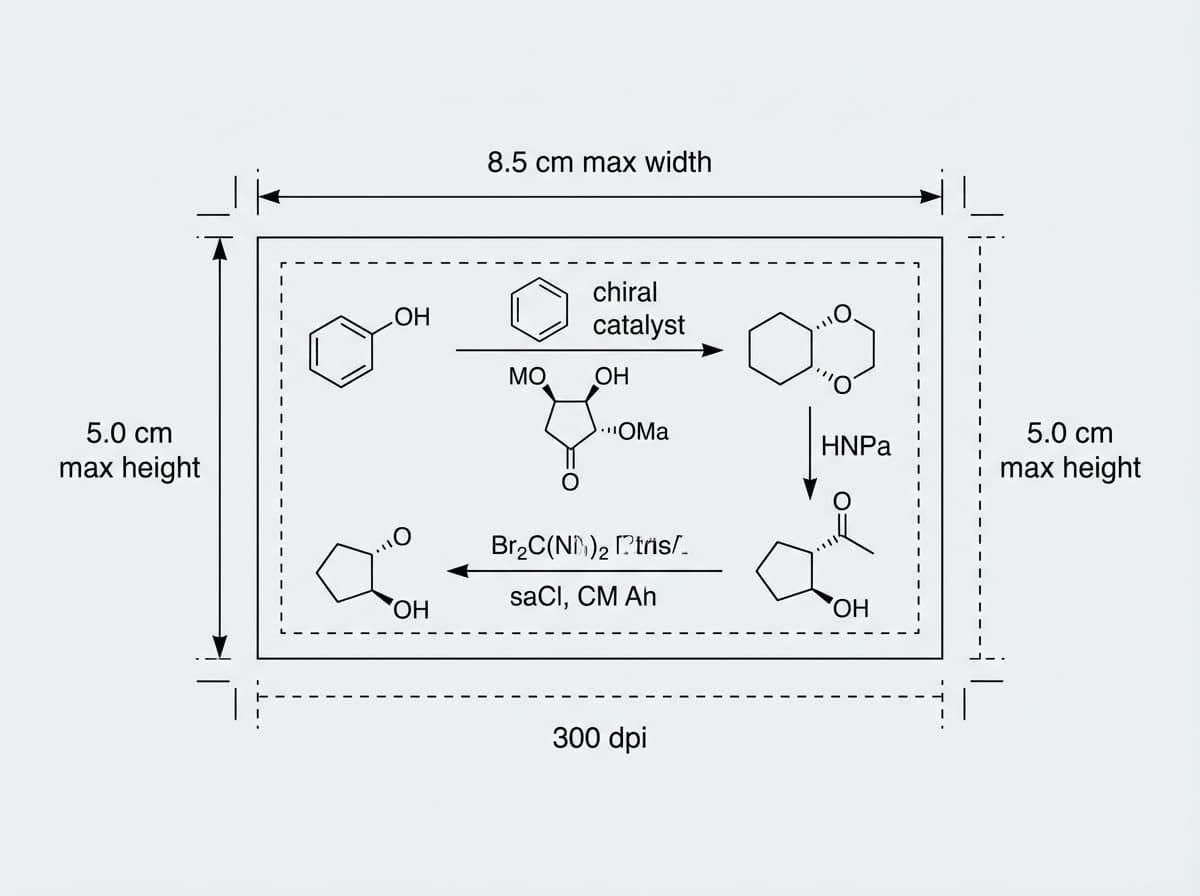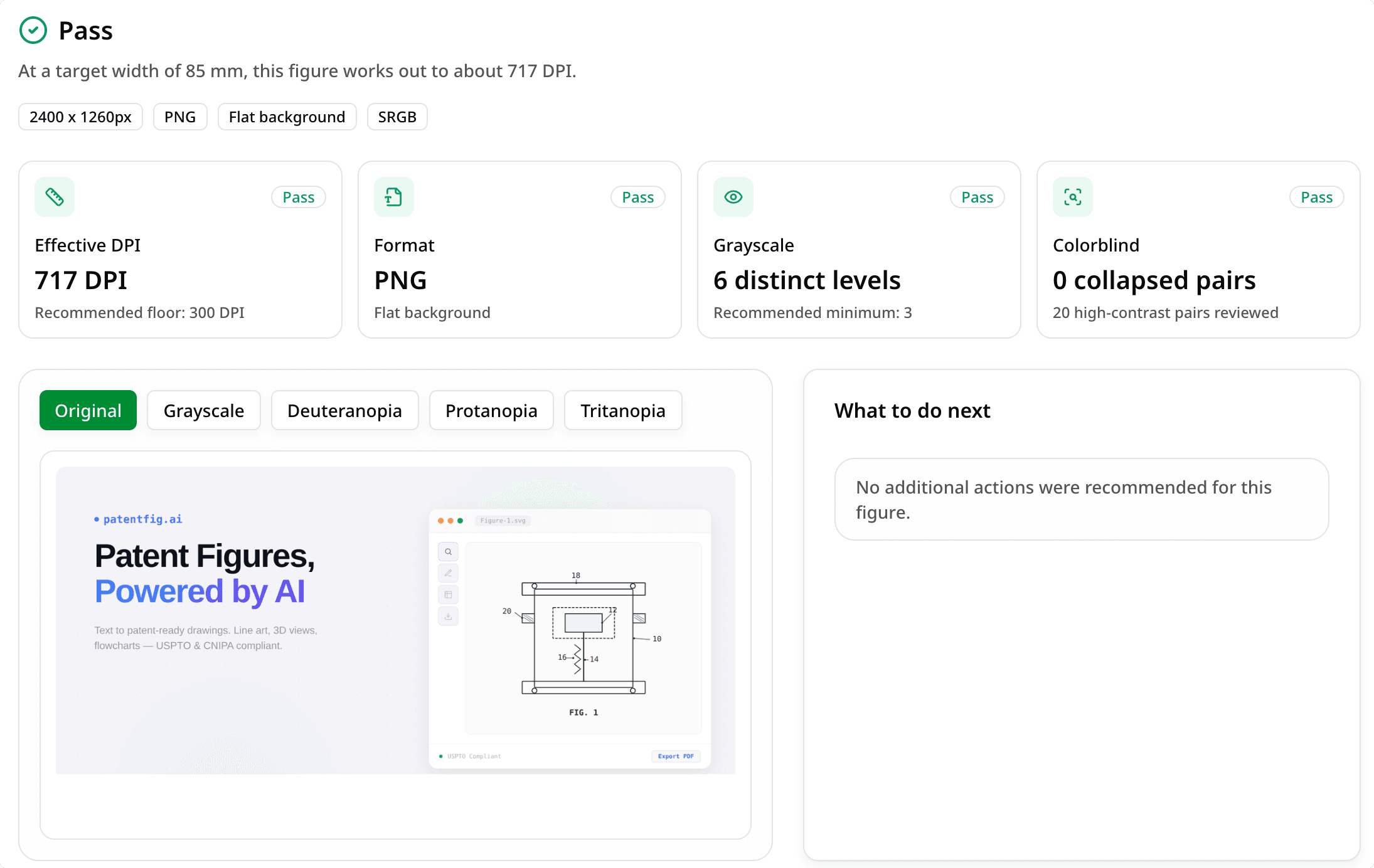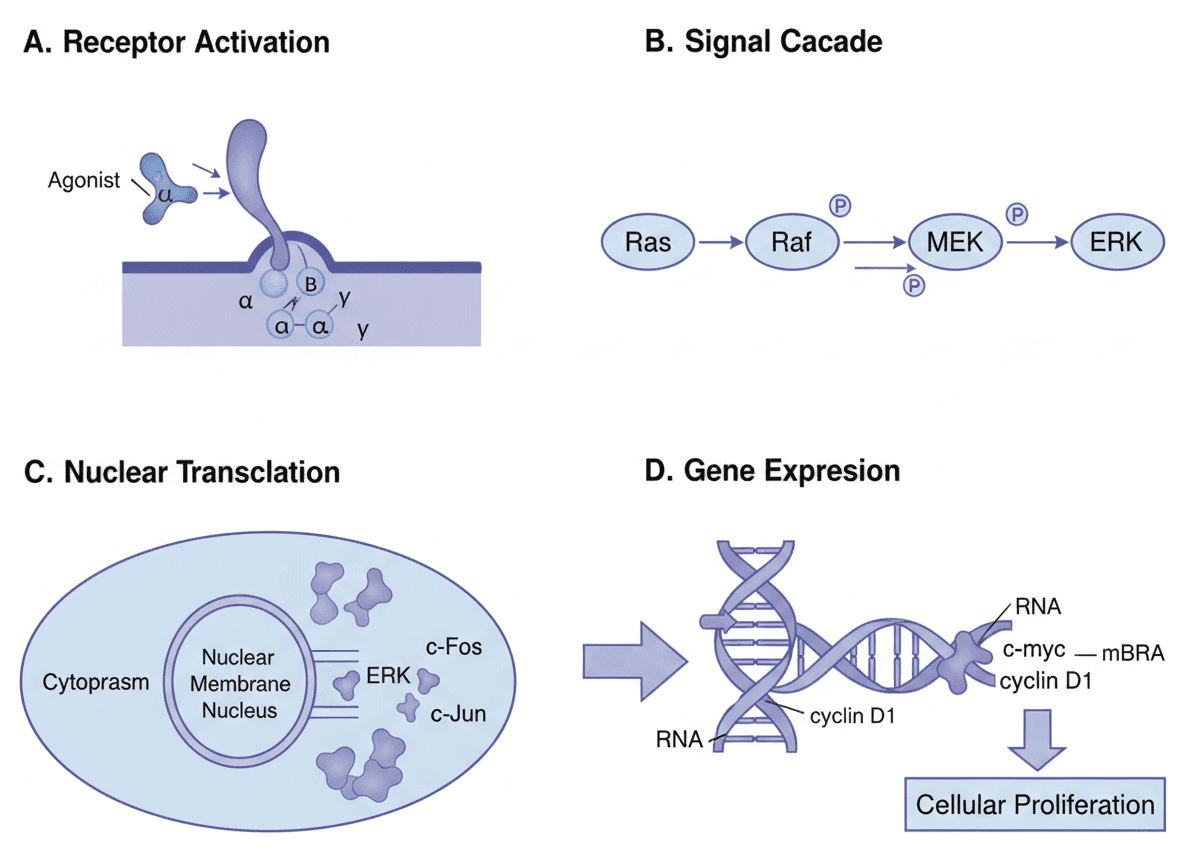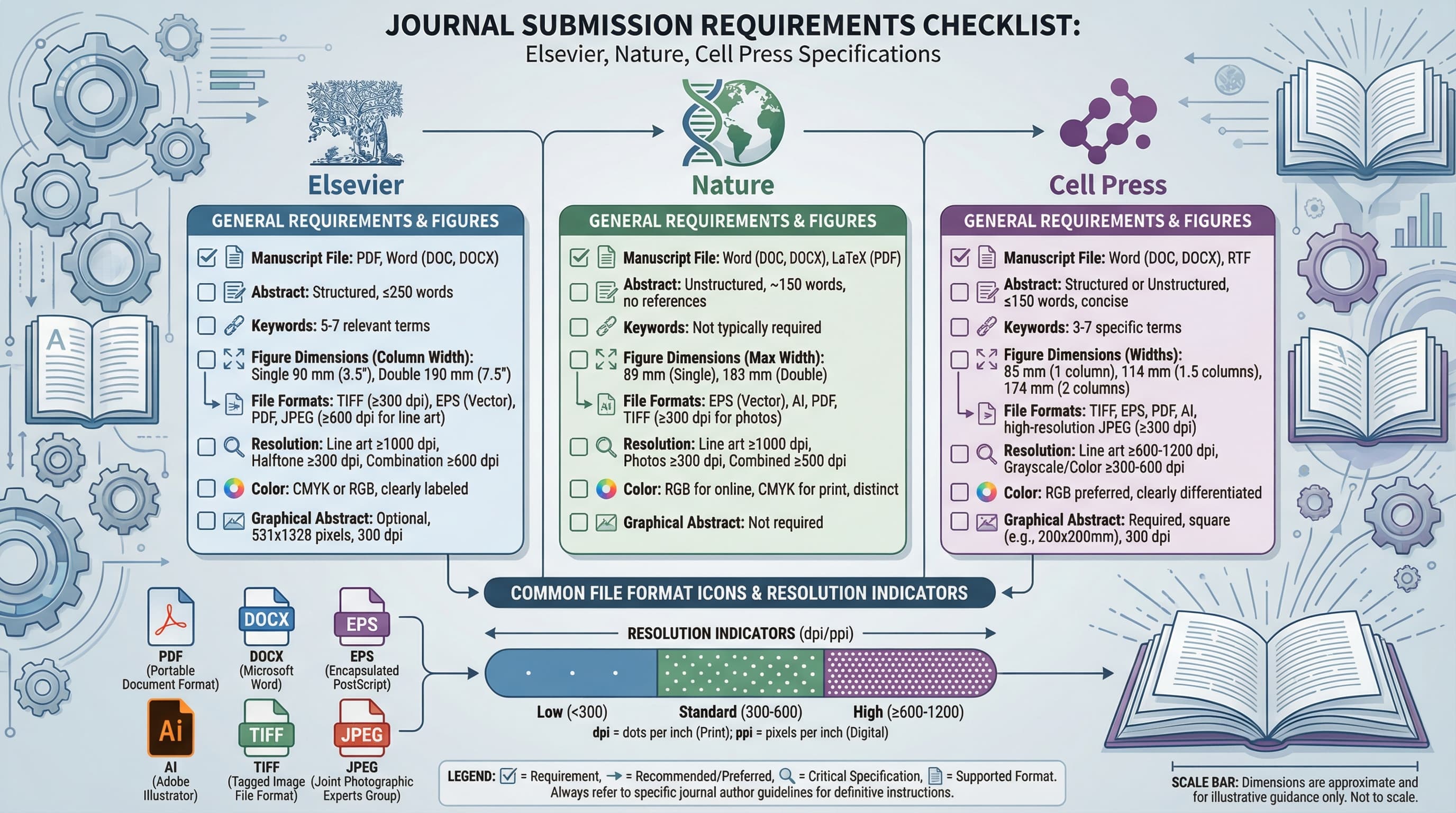
SciDraw AI Advantage: AI Generation → SVG Vector Export → Edit freely in PowerPoint/Illustrator. Try it now →
Want one now? Paste your abstract into the free Graphical Abstract Maker and get an editable, journal-ready draft in about a minute.
Introduction: Why Journal Requirements Matter
You've spent months (or years) on your research, crafted the perfect graphical abstract, and you're ready to submit. Then you discover your image doesn't meet the journal's specifications—wrong dimensions, incorrect format, or resolution too low.
This scenario is frustratingly common. Each major publisher has different requirements for graphical abstracts, and failing to meet them can delay your submission or result in a lower-quality final publication.
This comprehensive guide covers the exact specifications for major scientific publishers, helping you create compliant graphical abstracts the first time.
Quick Reference Table
| Publisher | Dimensions | Format | Resolution | Background |
|---|---|---|---|---|
| Elsevier | 1328 x 531 px | JPEG/PNG/TIFF | 300 DPI | White preferred |
| Nature | 180mm width | TIFF/EPS/PDF | 300 DPI | Any |
| Cell Press | Square (1:1) | TIFF/EPS | 300 DPI | White |
| Wiley | Varies | TIFF/EPS | 300 DPI | Journal-specific |
| ACS | 3.25 x 1.75 in | TIFF | 600 DPI | White |
| Springer Nature | 180mm width | TIFF/EPS | 300 DPI | Any |
| PLOS | 2000px width | PNG/TIFF | 300 DPI | White |
Elsevier Journals
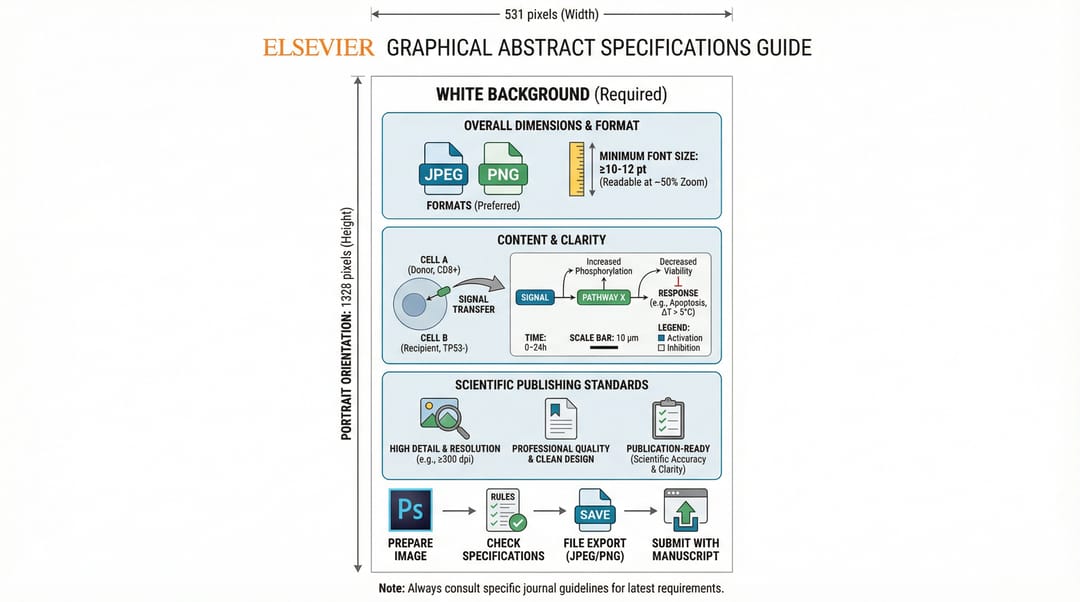
Elsevier is one of the largest scientific publishers, with over 2,500 journals spanning all disciplines. Their graphical abstract requirements are standardized across most publications.
Specifications
| Requirement | Specification |
|---|---|
| Dimensions | 1328 x 531 pixels (width x height) |
| Aspect Ratio | Approximately 2.5:1 (landscape; 500:200 ratio) |
| File Format | JPEG, PNG, or TIFF |
| Resolution | Minimum 300 DPI |
| Color Mode | RGB |
| Background | White or light preferred |
| File Size | Under 10 MB |
Important Notes
- Elsevier uses a landscape orientation with a 500:200 display ratio
- The graphical abstract appears in ScienceDirect alongside your paper
- Images are displayed at reduced size in search results—ensure readability
- Some Elsevier journals have specific requirements; always check author guidelines
Common Mistakes to Avoid
- Portrait orientation - Elsevier requires a wide landscape format
- Text too small - Must be readable at thumbnail size
- Complex backgrounds - White backgrounds work best for their display system
- Wrong file type - PDF is not accepted for graphical abstracts
Elsevier Journals Requiring Graphical Abstracts
- Journal of Controlled Release
- Biomaterials
- Chemical Engineering Journal
- Food Chemistry
- Journal of Cleaner Production
- And 100+ more
Nature Portfolio
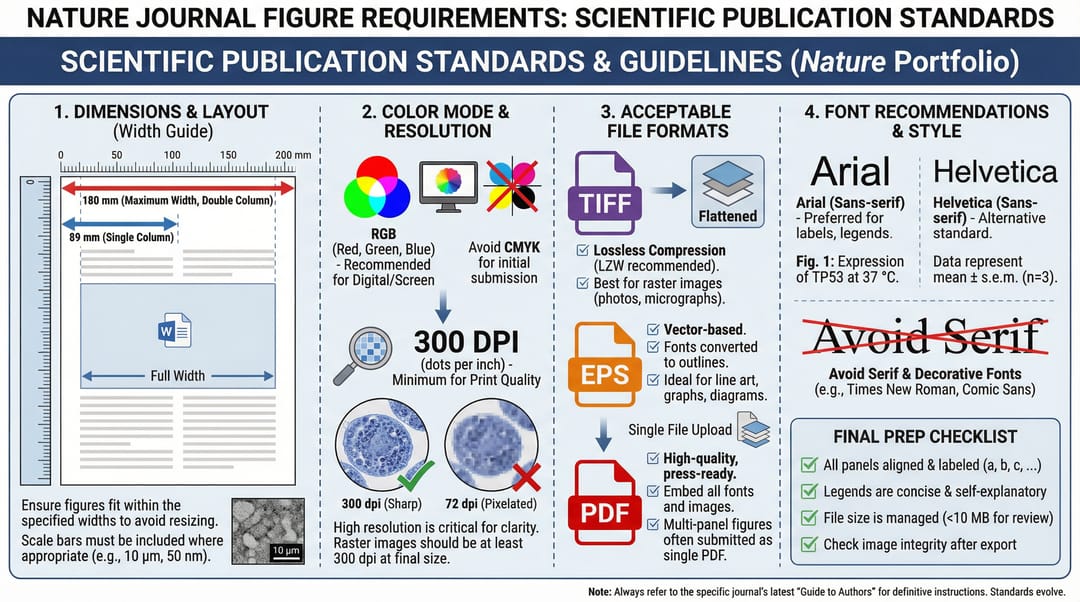
Nature and its portfolio of journals have specific requirements that emphasize high visual quality and scientific accuracy.
Specifications
| Requirement | Specification |
|---|---|
| Width | 180mm (approximately 2126 px at 300 DPI) |
| Height | Flexible, but typically 50-100mm |
| File Format | TIFF, EPS, or PDF |
| Resolution | Minimum 300 DPI (1200 DPI for line art) |
| Color Mode | RGB for online, CMYK available for print |
| Fonts | Arial, Helvetica, or Times New Roman |
| File Size | Under 20 MB |
Important Notes
- Nature journals call these "Summary Figures" or "Graphical Abstracts" depending on the journal
- High emphasis on scientific accuracy over artistic design
- Figures must be self-explanatory without the caption when possible
- Some journals (Nature Communications) have specific graphical abstract programs
Font Requirements
| Font Type | Recommended |
|---|---|
| Sans-serif | Arial, Helvetica |
| Serif | Times New Roman |
| Minimum size | 6-8 pt in final figure |
| Maximum size | 12 pt for emphasis |
Nature Portfolio Journals with Graphical Abstract Requirements
- Nature Communications
- Scientific Reports
- Nature Methods
- Nature Chemical Biology
- Nature Medicine
Cell Press
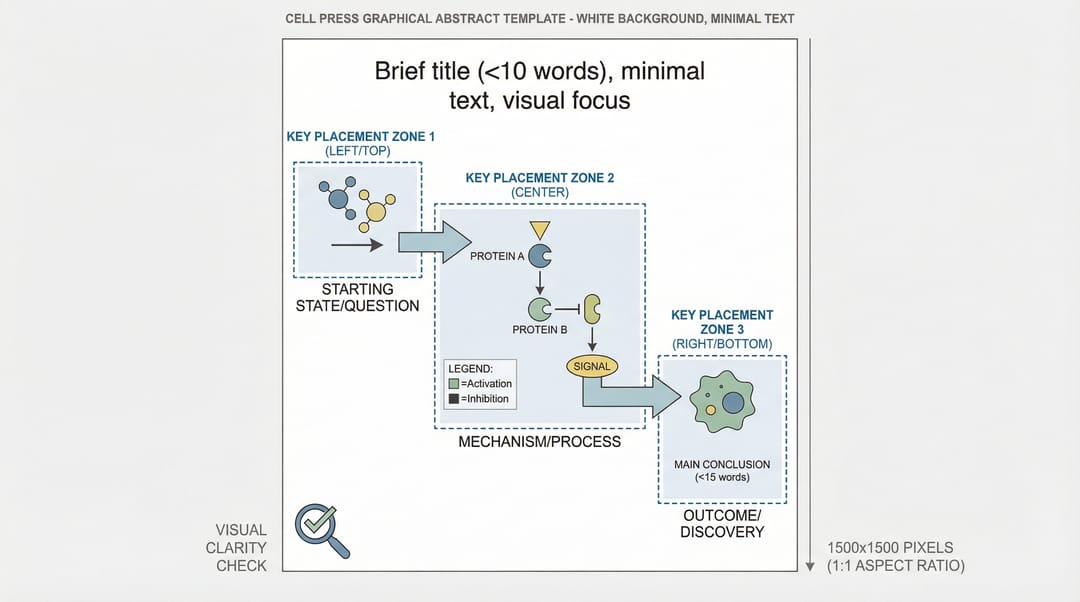
Cell Press journals (Cell, Neuron, Immunity, etc.) have their own distinct requirements, with a strong emphasis on visual impact and scientific storytelling.
Specifications
| Requirement | Specification |
|---|---|
| Dimensions | Square format preferred (1:1 aspect ratio) |
| Size | 1500 x 1500 pixels recommended |
| File Format | TIFF or EPS |
| Resolution | 300 DPI minimum |
| Color Mode | RGB |
| Background | White required |
| File Size | Under 20 MB |
Important Notes
- Cell Press calls these "Graphical Abstracts" specifically
- Strong preference for visual storytelling over text
- Must convey the main finding at a glance
- Appears prominently on the journal website and in search results
Cell Press Style Guidelines
- Minimal text - Let visuals tell the story
- Clear visual hierarchy - Most important finding should dominate
- Consistent style - Match the aesthetic of your paper figures
- No copyrighted material - All elements must be original or licensed
Cell Press Journals Requiring Graphical Abstracts
- Cell
- Cell Reports
- Cell Stem Cell
- Neuron
- Immunity
- Current Biology
- Molecular Cell
Wiley Journals
Wiley publishes over 1,600 journals with varying requirements. Unlike Elsevier, specifications can differ significantly between journals.
General Specifications
| Requirement | Specification |
|---|---|
| Dimensions | Journal-specific (typically 500-800 px width) |
| File Format | TIFF or EPS preferred |
| Resolution | 300 DPI minimum |
| Color Mode | RGB or CMYK |
| Background | Usually white |
Notable Wiley Journals and Their Requirements
| Journal | Dimensions | Notes |
|---|---|---|
| Angewandte Chemie | 400 x 200 px | Chemistry-focused |
| Advanced Materials | 600 x 400 px | Materials science |
| ChemBioChem | 400 x 200 px | Biochemistry |
| Small | 500 x 300 px | Nanoscience |
Important Notes
- Always check individual journal guidelines - Wiley has no universal standard
- Many Wiley journals use "Table of Contents Graphics" rather than "Graphical Abstracts"
- Chemistry journals often have specific requirements for molecular representations
American Chemical Society (ACS)
ACS journals have unique requirements, particularly their "Table of Contents (TOC) Graphics" which serve a similar purpose to graphical abstracts.
Specifications
| Requirement | Specification |
|---|---|
| Dimensions | 3.25 x 1.75 inches (8.26 x 4.45 cm) |
| Resolution | 600 DPI (higher than most publishers) |
| File Format | TIFF |
| Color Mode | RGB |
| Background | White |
| File Size | Under 5 MB |
Important Notes
- ACS calls these "TOC Graphics" not graphical abstracts
- Higher resolution requirement (600 DPI vs 300 DPI)
- Specific aspect ratio must be followed exactly
- Appears in journal table of contents and search results
ACS Style Guidelines
- Clear chemical structures - Must be accurate and readable
- Minimal text - Focus on visual elements
- Highlight key findings - Not methodology
- Use ACS colors - Many journals have recommended palettes
Springer Nature
Springer Nature (different from Nature Portfolio) has standardized requirements across many journals.
Specifications
| Requirement | Specification |
|---|---|
| Width | 180mm (similar to Nature Portfolio) |
| Height | Typically 50-80mm |
| File Format | TIFF, EPS, or PDF |
| Resolution | 300 DPI |
| Color Mode | RGB |
| Fonts | Standard system fonts |
Important Notes
- Requirements similar to Nature Portfolio but may vary by journal
- Many Springer journals make graphical abstracts optional
- Check "Artwork and Illustrations Guidelines" in author instructions
PLOS Journals
PLOS (Public Library of Science) has open-access journals with specific figure requirements.
Specifications
| Requirement | Specification |
|---|---|
| Width | Minimum 2000 pixels |
| Height | Proportional to content |
| File Format | PNG or TIFF |
| Resolution | 300 DPI |
| Color Mode | RGB |
| Background | White preferred |
Important Notes
- PLOS emphasizes accessibility—figures should be understandable to broad audiences
- Alt text is required for accessibility compliance
- Graphical abstracts appear in article previews and social media shares
Universal Best Practices
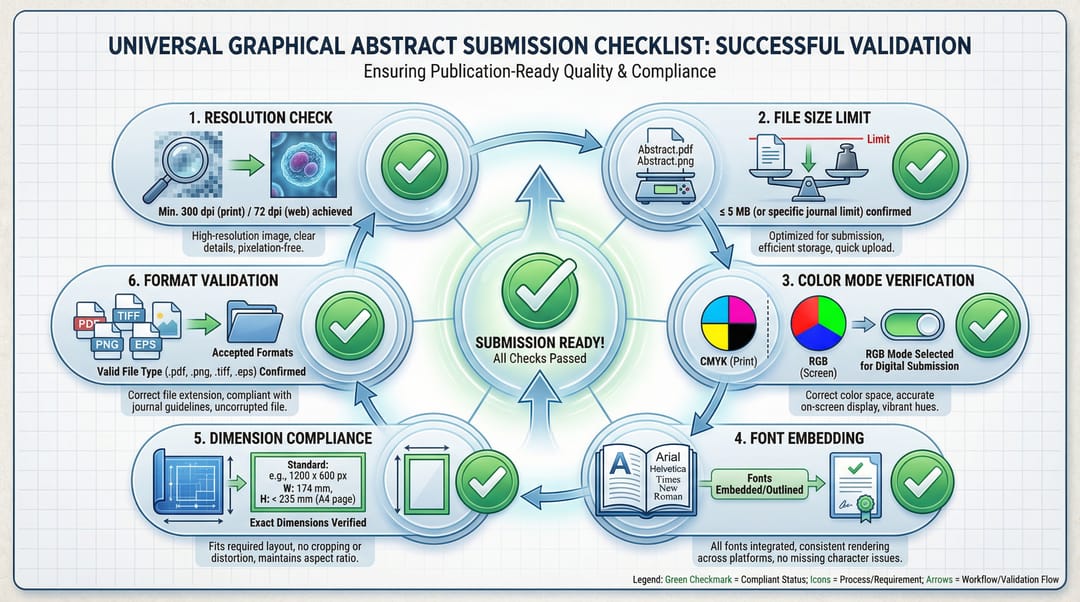
Regardless of the publisher, these guidelines will help ensure your graphical abstract meets requirements:
Before You Start
- Read the author guidelines - Every journal has specific instructions
- Check recent issues - See examples of accepted graphical abstracts
- Contact the editor - When in doubt, ask
Design Principles
| Principle | Implementation |
|---|---|
| Simplicity | One main message, minimal elements |
| Readability | Test at 50% zoom for thumbnail size |
| Accuracy | Match your paper's findings exactly |
| Originality | Create new graphics, avoid copyright issues |
Technical Checklist
- Dimensions match journal requirements
- Resolution meets minimum (typically 300 DPI)
- File format is accepted (TIFF, PNG, or EPS)
- File size is under the limit
- Color mode is correct (usually RGB)
- Background color is appropriate
- All text is readable at display size
- Fonts are embedded or outlined
Common Rejection Reasons
| Issue | Solution |
|---|---|
| Wrong dimensions | Check guidelines before starting |
| Low resolution | Design at 300 DPI or higher |
| Unreadable text | Use minimum 8pt font, test at thumbnail size |
| Copyright violation | Create original graphics or get permission |
| Too complex | Simplify to one main message |
| Poor image quality | Export from vector source, avoid compression |
Tools That Help Meet Requirements
SciDraw AI for Journal-Compliant Graphics
SciDraw AI helps you create graphical abstracts that meet journal specifications:
- Describe your research in natural language
- Generate professional graphics instantly
- Export as SVG for precise dimension control
- Adjust in Illustrator/Inkscape to exact specifications
Advantages:
- Start with AI-generated concepts
- SVG export allows exact dimension matching
- Quick iteration for multiple journal submissions
- No design expertise required
Checklist by Publisher
Elsevier Submission Checklist
- 1328 x 531 pixels (landscape)
- JPEG, PNG, or TIFF format
- 300 DPI resolution
- White background
- Under 10 MB file size
- RGB color mode
Nature Portfolio Submission Checklist
- 180mm width
- TIFF, EPS, or PDF format
- 300 DPI (1200 for line art)
- Arial or Helvetica fonts
- Under 20 MB file size
Cell Press Submission Checklist
- Square format (1:1)
- 1500 x 1500 pixels recommended
- TIFF or EPS format
- White background required
- 300 DPI resolution
- Minimal text, visual focus
ACS Submission Checklist
- 3.25 x 1.75 inches exact dimensions
- TIFF format only
- 600 DPI resolution (higher than others)
- White background
- Under 5 MB file size
Conclusion
Meeting journal requirements for graphical abstracts isn't difficult—it just requires attention to detail and checking specifications before you start designing. The key points to remember:
- Every publisher is different - Always check specific guidelines
- Dimensions matter - Wrong size can delay submission
- Resolution is critical - 300 DPI minimum, 600 for ACS
- Format varies - TIFF is most universally accepted
- Test at thumbnail size - Your graphic will be viewed small
By following the specifications in this guide and using the checklists provided, you can create compliant graphical abstracts that showcase your research effectively.
Create Journal-Ready Graphical Abstracts
Need to create a graphical abstract that meets your target journal's requirements? SciDraw AI generates publication-quality graphics that you can export and adjust to any specification.
Why use SciDraw AI:
- AI-generated professional graphics
- SVG export for precise dimension control
- No design skills needed
- Works for any journal requirements
Try SciDraw AI Free - Create Your Graphical Abstract
Related Guides
- Free AI Graphical Abstract Maker — create journal-ready abstracts in minutes
- How to Create a Graphical Abstract — complete design process guide
- Nature, Science & Cell Figure Requirements — DPI, size, and format cheat sheet
- Journal Figure Conversion Guide — convert figures to 300/600 DPI TIFF
- Graphical Abstract Maker Tool — free online graphical abstract creator
- Journal Figure Requirements Reference — filterable, sourced specs for 10 publishers (CSV/JSON download)