SciDraw AI Advantage: AI Generation → SVG Vector Export → Edit freely in PowerPoint/Illustrator. Try it now →
Introduction: A Revolution in Scientific Visualization
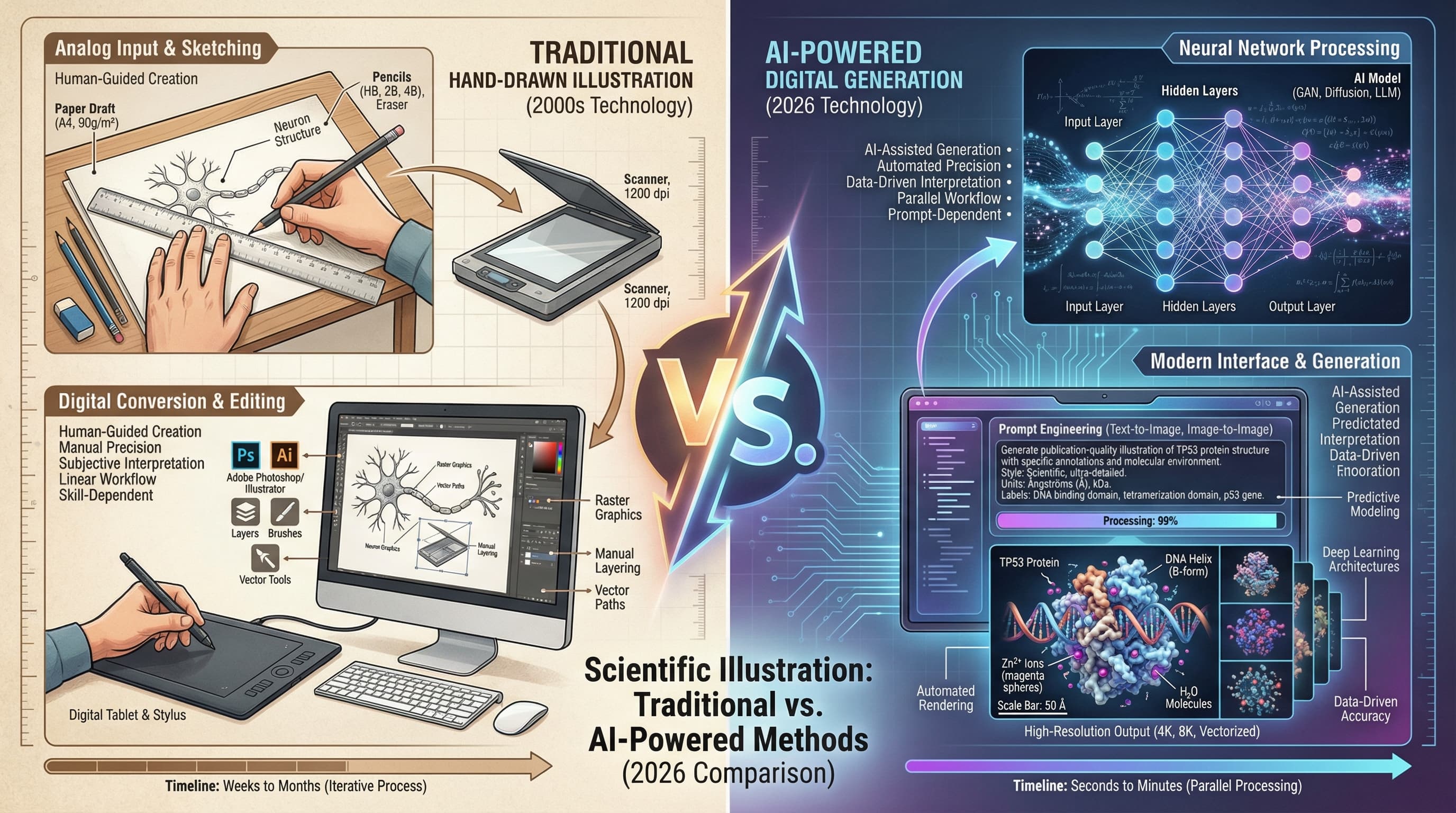
The way researchers create scientific illustrations is undergoing a fundamental transformation. For decades, creating publication-quality figures meant either mastering complex design software or hiring professional illustrators—both requiring significant time and money.
In 2026, AI-powered illustration tools have emerged as a viable alternative, promising to democratize scientific visualization. But are they ready to replace traditional methods? What are the trade-offs?
This guide provides an objective comparison of AI and traditional approaches, helping you decide when to use each method for your research.
The Traditional Approach: Time-Tested but Time-Consuming
How Traditional Scientific Illustration Works
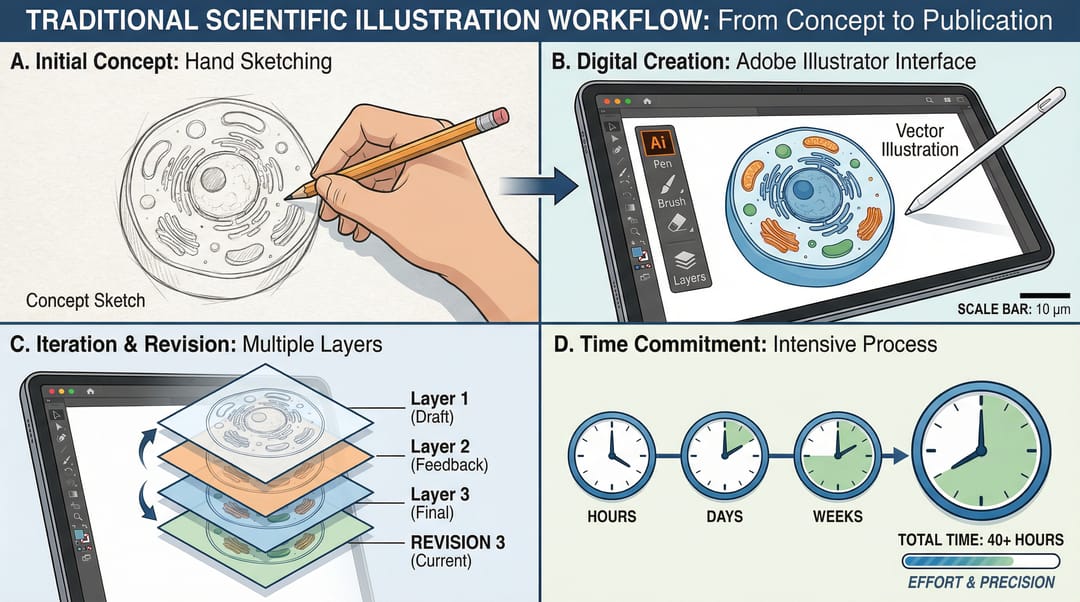
Traditional scientific illustration involves manually creating graphics using vector software (Adobe Illustrator, Inkscape) or specialized tools (BioRender, ChemDraw). The process typically follows these steps:
- Conceptualization - Sketch ideas on paper
- Asset gathering - Find or create visual elements
- Composition - Arrange elements in design software
- Refinement - Adjust colors, typography, alignment
- Review - Get feedback from co-authors
- Revision - Iterate based on feedback
- Export - Prepare for publication
Pros of Traditional Methods
| Advantage | Description |
|---|---|
| Complete control | Every pixel can be customized |
| Proven quality | Decades of accepted standards |
| Precision | Exact scientific accuracy achievable |
| Software maturity | Well-documented tools and workflows |
| No AI uncertainty | What you design is what you get |
Cons of Traditional Methods
| Disadvantage | Impact |
|---|---|
| Time-intensive | 4-20+ hours per complex figure |
| Steep learning curve | Months to master Illustrator |
| Cost | Software subscriptions + potential illustrator fees |
| Skill dependency | Quality varies with designer expertise |
| Iteration fatigue | Major changes require significant rework |
Time Investment
| Figure Type | Typical Time (Traditional) |
|---|---|
| Simple diagram | 2-4 hours |
| Graphical abstract | 4-8 hours |
| Mechanism figure | 8-16 hours |
| Multi-panel figure | 10-20+ hours |
The AI Approach: Speed Meets Sophistication
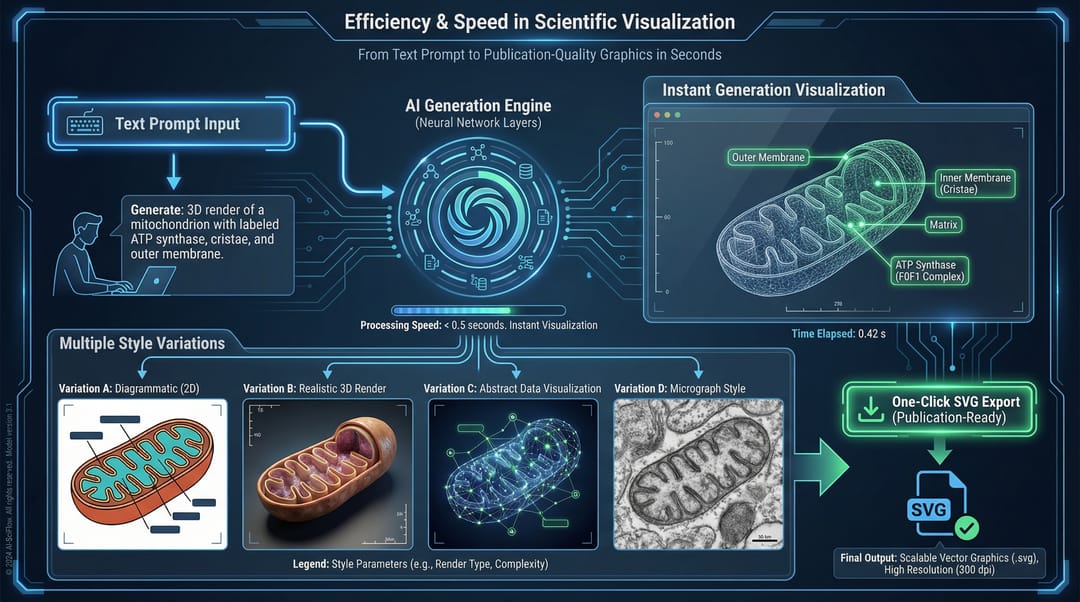
How AI Scientific Illustration Works
AI-powered tools like SciDraw AI use large language models and image generation to create scientific graphics from text descriptions:
- Describe your need - Write what you want to visualize
- Generate options - AI creates multiple concepts
- Select and refine - Choose the best version
- Export - Download as SVG or raster image
- Polish (optional) - Fine-tune in traditional software
Pros of AI Methods
| Advantage | Description |
|---|---|
| Speed | Minutes instead of hours |
| Accessibility | No design skills required |
| Iteration | Generate multiple concepts quickly |
| Cost-effective | Lower per-figure cost |
| Inspiration | AI suggests approaches you might not consider |
| Consistency | Maintain style across multiple figures |
Cons of AI Methods
| Disadvantage | Impact |
|---|---|
| Less precise control | May require post-editing |
| Learning prompt craft | Optimal descriptions take practice |
| Accuracy concerns | Must verify scientific correctness |
| Style limitations | May not match existing figure style |
| Newer technology | Less established in publishing |
Time Investment
| Figure Type | Typical Time (AI + Refinement) |
|---|---|
| Simple diagram | 10-30 minutes |
| Graphical abstract | 15-45 minutes |
| Mechanism figure | 30-60 minutes |
| Multi-panel figure | 1-2 hours |
Head-to-Head Comparison
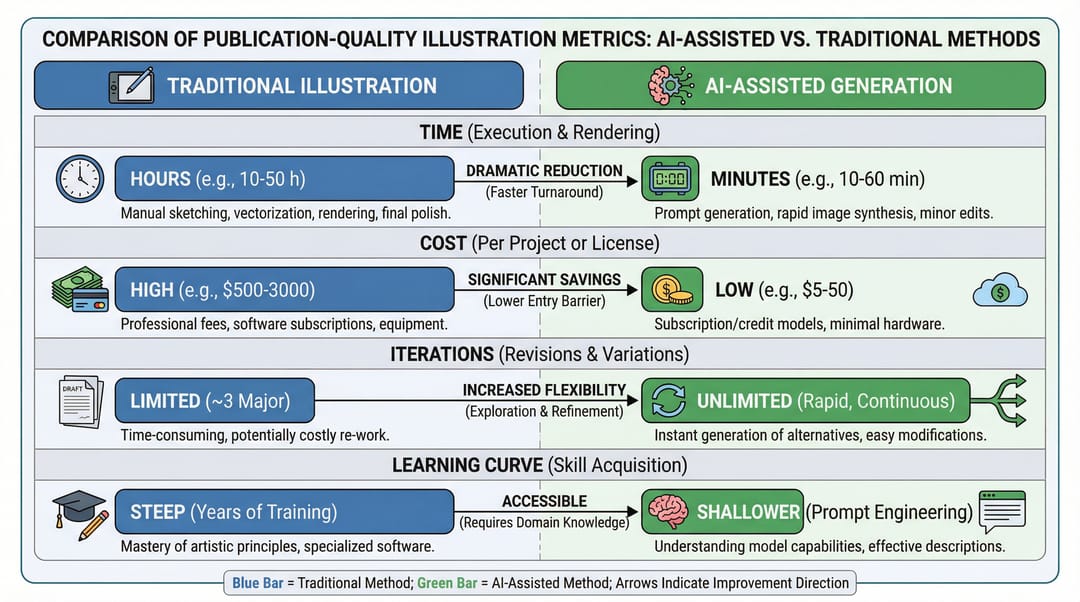
Time and Efficiency
| Metric | Traditional | AI-Powered | Winner |
|---|---|---|---|
| Initial concept | 1-2 hours | 5 minutes | AI |
| First draft | 4-8 hours | 15-30 min | AI |
| Major revision | 2-4 hours | 10-20 min | AI |
| Fine-tuning | 1-2 hours | 30-60 min | Tie |
| Total time | 8-16 hours | 1-2 hours | AI |
Cost Analysis
| Factor | Traditional | AI-Powered |
|---|---|---|
| Software | $240-600/year | $0-200/year |
| Per-figure time cost* | $200-800 | $25-100 |
| Professional illustrator | $500-2000/figure | N/A |
| Learning investment | 50-200 hours | 2-10 hours |
*Assuming researcher time valued at $50/hour
Quality Factors
| Factor | Traditional | AI-Powered |
|---|---|---|
| Maximum precision | Excellent | Very Good |
| Consistency | Very Good | Excellent |
| Creativity | Very Good | Excellent |
| Scientific accuracy | Excellent | Very Good (needs review) |
| Publication readiness | Excellent | Very Good |
When to Use Each Approach
Choose Traditional Methods When:
-
Exact precision is critical
- Molecular structures with specific angles
- Scale bars and measurements
- Regulatory or compliance figures
-
Matching existing style
- Multi-paper figure consistency
- Lab group visual identity
- Journal-specific requirements
-
Complex data integration
- Statistical graphs with exact values
- Multi-panel figures with shared axes
- Figures requiring live data links
-
You have design expertise
- Professional illustrators
- Researchers with design training
- Teams with dedicated graphics support
Choose AI Methods When:
-
Speed is essential
- Conference deadlines
- Grant applications
- Rapid prototyping ideas
-
Conceptual visualization
- Graphical abstracts
- Mechanism overviews
- Process diagrams
-
Limited design skills
- Graduate students
- Researchers without design training
- Small labs without graphics support
-
Exploring options
- Comparing visual approaches
- Getting inspiration
- Early-stage figure planning
The Hybrid Workflow: Best of Both Worlds
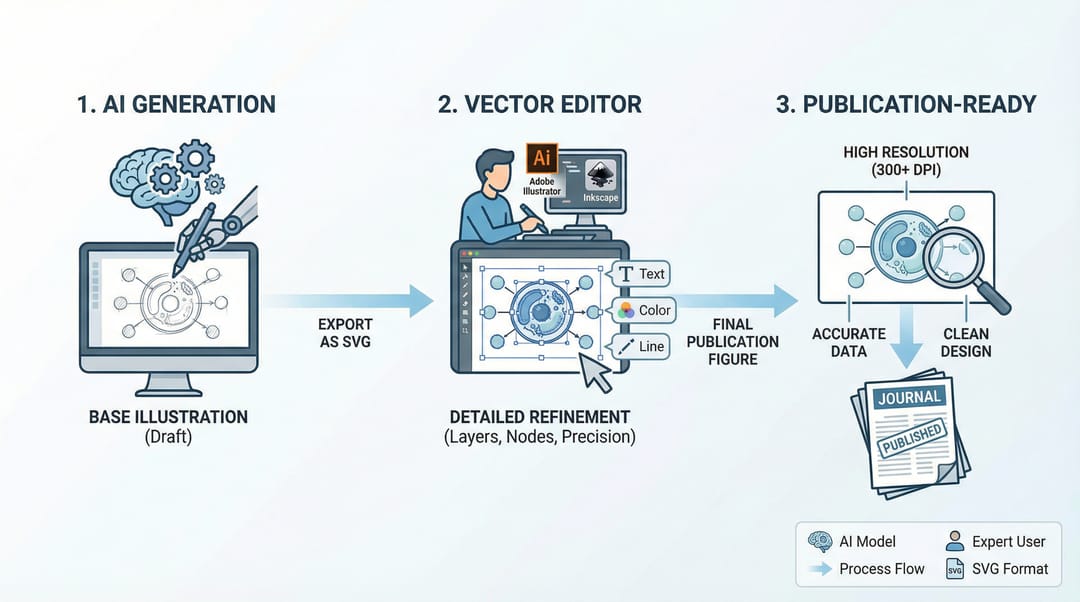
The most effective approach in 2026 combines AI generation with traditional refinement:
Step 1: AI Generation
Use SciDraw AI or similar tools to generate initial concepts:
Prompt example:
"Create a mechanism diagram showing:
- Drug molecule binding to cell receptor
- Intracellular signaling cascade (MAPK pathway)
- Nuclear translocation
- Gene expression changes
- Downstream cellular response
Vertical flow, molecular biology style, blue and orange accents"
Step 2: Export as SVG
Export the AI-generated graphic as SVG (Scalable Vector Graphics) for editing:
- Maintains vector quality
- All elements are editable
- Compatible with Illustrator, Inkscape, Figma
Step 3: Traditional Refinement
Open in your preferred vector editor and:
- Adjust scientific details for accuracy
- Match existing figure style
- Fine-tune typography and spacing
- Add specific data or measurements
- Ensure journal compliance
Step 4: Final Polish
Complete final checks:
- Verify scientific accuracy
- Check dimension requirements
- Confirm color accessibility
- Proofread all text
Time Comparison: Pure Traditional vs Hybrid
| Approach | Mechanism Diagram | Graphical Abstract |
|---|---|---|
| Pure Traditional | 12-16 hours | 6-10 hours |
| Pure AI | 30-45 min (may need fixes) | 20-30 min |
| Hybrid | 2-3 hours | 1-2 hours |
The hybrid approach typically saves 70-80% of time while maintaining publication quality.
Ethical Considerations
AI in Academic Publishing
As AI becomes more prevalent in scientific illustration, important ethical questions arise:
Disclosure Requirements
| Publisher | AI Disclosure Policy (2026) |
|---|---|
| Nature | Recommended disclosure in methods |
| Cell Press | Required if AI significantly contributed |
| Elsevier | Encouraged but not required |
| ACS | Under development |
Best Practices for Ethical AI Use
- Disclose AI assistance when required or appropriate
- Verify scientific accuracy - AI can make errors
- Don't misrepresent data - AI-generated graphs must reflect real data
- Maintain originality - Don't replicate copyrighted styles
- Review before submission - Final responsibility is yours
What AI Should NOT Be Used For
- Fabricating data visualizations
- Creating misleading representations
- Copying protected artistic styles
- Generating figures without human review
Accuracy Concerns and Solutions
Common AI Accuracy Issues
| Issue | Example | Solution |
|---|---|---|
| Incorrect structures | Wrong molecular bonds | Expert review + manual correction |
| Mislabeled elements | Wrong protein names | Verify all labels against source |
| Impossible processes | Incorrect pathway order | Check against literature |
| Proportions | Cell sizes unrealistic | Adjust in vector editor |
Quality Control Workflow
- Generate AI concept
- Export as editable format
- Review against source material
- Correct any inaccuracies
- Verify with co-authors/experts
- Finalize for publication
Future Trends
Where AI Illustration Is Heading
- Better scientific training - Models specifically trained on scientific content
- Interactive editing - Describe changes in natural language
- Data integration - Direct connection to analysis software
- Style learning - Match your existing figures automatically
- Real-time collaboration - AI assists teams simultaneously
What Won't Change
- Need for scientific accuracy
- Human oversight and verification
- Publisher quality standards
- Importance of clear communication
Making the Right Choice for Your Research
Decision Framework
Ask yourself these questions:
-
How much time do I have?
- Limited: AI
- Flexible: Either
-
How precise must it be?
- Exact measurements: Traditional
- Conceptual: AI
-
What are my design skills?
- Expert: Traditional may be faster
- Beginner: AI is accessible
-
What's my budget?
- Limited: AI
- Available: Either
-
Is speed or polish more important?
- Speed: AI
- Polish: Traditional or Hybrid
Recommended Approach by Figure Type
| Figure Type | Recommended Approach |
|---|---|
| Graphical abstract | AI or Hybrid |
| Data visualization | Traditional |
| Mechanism diagram | Hybrid |
| Chemical structures | Traditional (ChemDraw) |
| Conceptual overview | AI |
| Journal cover art | Hybrid or Traditional |
| Conference poster | AI or Hybrid |
| Grant figures | Hybrid |
Conclusion: Embrace the Best of Both Worlds
The debate isn't really "AI vs Traditional"—it's about using the right tool for the job. In 2026, the most effective researchers:
- Use AI for speed - Generate concepts and drafts quickly
- Apply traditional skills for precision - Refine where accuracy matters
- Combine approaches - Hybrid workflows maximize efficiency
- Stay adaptable - Technology continues to evolve
The future belongs to researchers who can leverage AI's speed while maintaining the scientific rigor that traditional methods provide.
Key Takeaways
| Insight | Implication |
|---|---|
| AI saves 70-80% of time | Use for initial concepts |
| Traditional offers precision | Use for final refinement |
| Hybrid is optimal | Combine for best results |
| Accuracy needs human review | Never skip verification |
| Both will continue evolving | Stay current with tools |
Experience AI-Powered Scientific Illustration
Ready to try the hybrid workflow? SciDraw AI generates professional scientific graphics from text descriptions, with SVG export for seamless traditional refinement.
The SciDraw AI advantage:
- Generate concepts in seconds
- Export as editable SVG
- Refine in any vector editor
- Publication-ready quality
Try SciDraw AI Free - Experience AI Illustration
Frequently Asked Questions
Will AI replace traditional scientific illustrators?
Not entirely. AI excels at speed and accessibility, but complex, highly precise work still benefits from human expertise. The most likely outcome is AI handling routine tasks while illustrators focus on premium, complex projects.
Can I publish AI-generated figures?
Yes, with appropriate disclosure where required. The key is ensuring scientific accuracy and originality. AI is a tool—the responsibility for accuracy remains with the researcher.
How do I know if my AI-generated figure is accurate?
Always verify against your source material. Check structures, labels, pathways, and proportions. Have co-authors or field experts review before submission.
What if my journal doesn't accept AI-generated content?
Most journals accept AI-assisted figures with disclosure. However, verify with your target journal. Using AI for initial concepts and refining traditionally is generally accepted everywhere.
Is the hybrid approach worth the extra step?
Absolutely. The time saved by AI generation far outweighs the refinement time. Most researchers find hybrid workflows 3-5x faster than pure traditional approaches while maintaining quality.
Related Guides
- Best Scientific Illustration Software 2026 — compare 10 free and paid tools
- 8 AI Prompt Rules for Scientific Figures — techniques for better AI output
- AI Image Generation for Academia — ethics, disclosure, and journal policies
- Publication-Ready Figures in Minutes — AI workflow guide
- AI Scientific Illustration Tool — try AI-powered figure creation