Free AI Krebs Cycle Diagram Generator
The citric acid (TCA) cycle, labeled and made simple
SciDraw AI turns a description into a clean, clearly-labeled circular Krebs cycle diagram - all eight intermediates, the entry of acetyl-CoA, the enzymes, the CO2 released, and the NADH, FADH2, and ATP outputs in one figure for teaching, study, and papers.
Krebs Cycle Diagram Examples
Browse Krebs cycle figures from simple overviews to fully labeled biochemistry, or generate your own above.
What is the Krebs cycle?
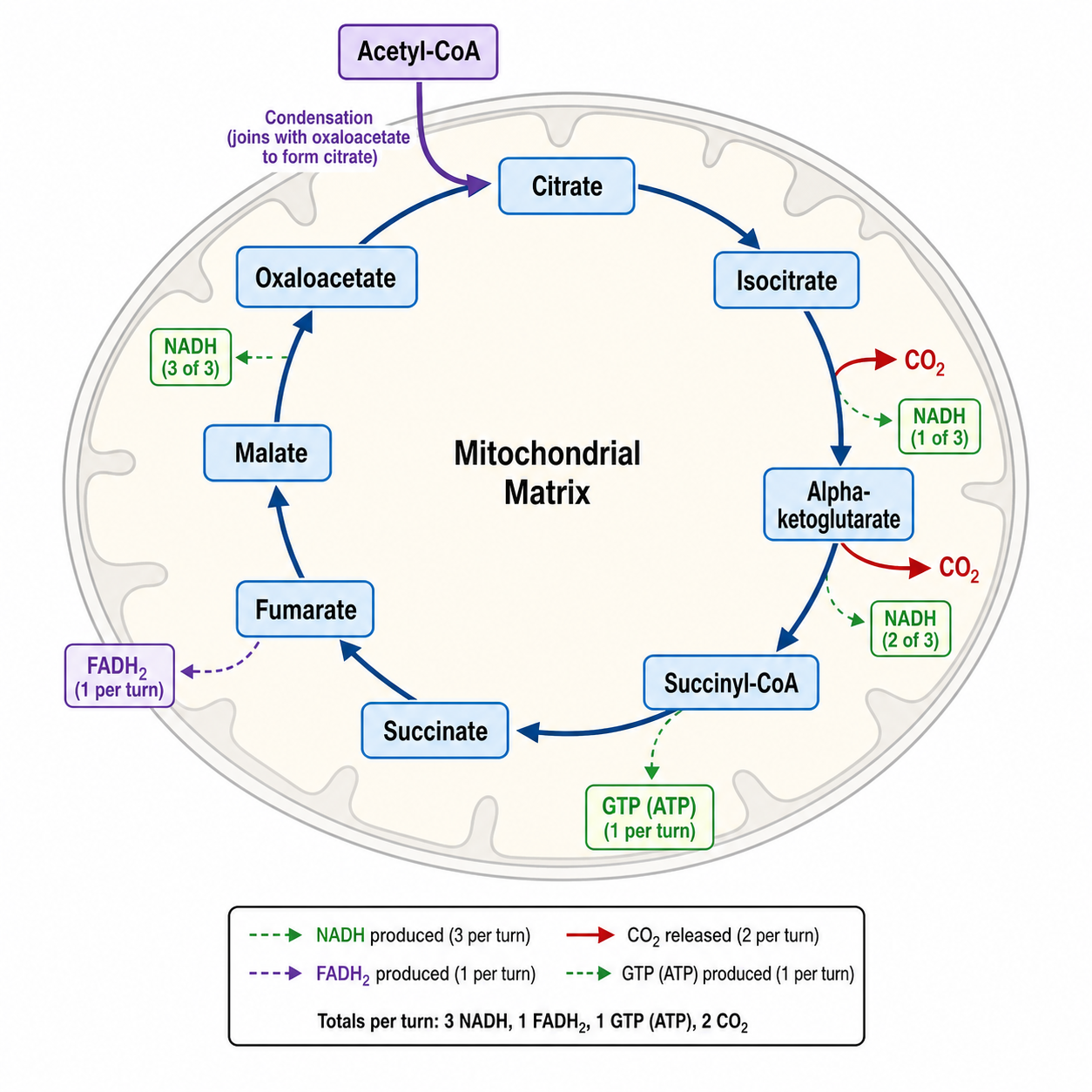
The Krebs cycle, also called the citric acid cycle or TCA (tricarboxylic acid) cycle, is the central stage of aerobic respiration that runs in the mitochondrial matrix. A 2-carbon acetyl group from acetyl-CoA combines with 4-carbon oxaloacetate to form 6-carbon citrate, which is then rearranged and oxidized through eight enzyme-catalyzed steps back to oxaloacetate. Along the way each turn releases two CO2 and captures energy as 3 NADH, 1 FADH2, and 1 GTP (or ATP). This tool draws and labels that whole cycle as a clean circular diagram, the eight intermediates, the enzymes, the arrows, the CO2 released, and the energy carriers, from the description you provide.
Why students and educators use Krebs cycle diagrams
- See all eight intermediates and their order at a glance
- Track where the two CO2 are released and carbon is lost
- Pinpoint where NADH, FADH2, and GTP (ATP) are produced
- Connect glycolysis, acetyl-CoA, and the electron transport chain
- Make a complex metabolic pathway simple to teach and revise
How to draw a Krebs cycle diagram
To draw the Krebs cycle, place oxaloacetate at the top and work clockwise through citrate, isocitrate, alpha-ketoglutarate, succinyl-CoA, succinate, fumarate, and malate, then back to oxaloacetate, joining each with a curved arrow. Show acetyl-CoA entering and condensing with oxaloacetate, and mark the two steps that release CO2, the three that yield NADH, the one that yields FADH2, and the one that yields GTP. Decide how much detail you want, enzyme names and carbon counts for a biochemistry figure, or plain labels for a simplified study aid. Paste that description into SciDraw AI and it lays out the ring, labels the intermediates and outputs, and exports an editable diagram you can refine before use.
Parts of the Krebs cycle
- Acetyl-CoA entering and condensing with oxaloacetate
- Citrate, the first 6-carbon intermediate formed
- The cyclic intermediates from isocitrate around to oxaloacetate
- The two CO2 molecules released per turn
- The energy carriers NADH and FADH2 captured at each step
- GTP (ATP) output plus the curved arrows linking every step
Frequently Asked Questions
What is the Krebs cycle?
The Krebs cycle is the central reaction sequence of aerobic respiration, run in the mitochondrial matrix. Acetyl-CoA combines with oxaloacetate to form citrate, which is oxidized through eight steps back to oxaloacetate. Each turn releases two CO2 and produces 3 NADH, 1 FADH2, and 1 GTP (ATP) that power the cell. It is also known as the citric acid cycle or TCA cycle.
How do I make a labeled Krebs cycle diagram online?
Describe what you want in plain text: say you need the eight intermediates from citrate to oxaloacetate, the enzymes if required, where the two CO2 are released, and where NADH, FADH2, and GTP form. SciDraw AI then draws and labels the circular cycle online, with no diagramming software to install. You can ask for a detailed biochemistry version or a simplified study version.
Is the Krebs cycle the same as the citric acid cycle?
Yes. The Krebs cycle, the citric acid cycle, and the TCA (tricarboxylic acid) cycle are three names for the same metabolic pathway. It is named after Hans Krebs, called the citric acid cycle because citrate is its first product, and the tricarboxylic acid cycle because citrate carries three carboxyl groups. SciDraw AI can label your diagram with whichever name your course uses.
How much ATP and NADH does one turn of the cycle produce?
One turn of the Krebs cycle produces 3 NADH, 1 FADH2, 1 GTP (equivalent to 1 ATP), and releases 2 CO2. Because one glucose yields two acetyl-CoA, the cycle turns twice per glucose, doubling those totals. The NADH and FADH2 then drive the electron transport chain to make most of the cell's ATP. SciDraw AI can label these outputs on your diagram so the energy yield is clear.
Is the Krebs cycle diagram generator free?
Yes. New accounts get 10 credits on signup and 5 more free credits each day, and a standard 2K diagram costs 5 credits, so you can draw a labeled Krebs cycle diagram without paying. Paid plans add a monthly credit allowance if you create many figures for a course or textbook.
Can I use these diagrams for my biochemistry class or textbook?
Yes. SciDraw AI exports clean, high-resolution Krebs cycle figures suitable for lecture slides, handouts, study notes, and textbook pages. Because this is a drawing tool, you supply the content, so always verify the intermediates, enzyme names, arrows, and energy outputs against your textbook before sharing or publishing.
Explore More Tools

Biological Pathway Diagram Generator
Create signaling pathway and molecular cascade diagrams
Try it free
Metabolic Pathway Diagram Generator
Create metabolic pathway diagram visuals for central carbon metabolism, glycolysis, TCA links, flux arrows, compartments, and energy outputs.
Try it free
Signaling Pathway Diagram Generator
Draw labeled signaling cascades — MAPK, PI3K-AKT, Wnt, NF-κB, JAK-STAT, and TGF-β.
Try it freeReady to Create Your Krebs Cycle Diagram?
Describe the level of detail you need, then export a clean, labeled citric acid cycle figure in minutes with SciDraw AI.