補助金申請代表研究人員職業生涯中的關鍵時刻,決定了多年研究和團隊發展的資金。無論您是向 NIH、NSF、European Research Council 還是私人基金會申請,引人注目的視覺效果都能在競爭激烈的審查過程中讓您的提案脫穎而出。然而,建立專業的補助金圖形設計面臨著重大挑戰:提案準備期間有限的插圖預算、緊迫的提交期限導致視覺開發時間極少,以及需要向跨學科審查小組傳達複雜的方法論。
AI 驅動的插圖正在改變研究人員加強補助金申請的方式。曾經需要專業科學插畫家才能完成的複雜研究設計,現在可以通過自然語言描述來視覺化。曾經需要數小時手動排版的知識缺口圖,現在可以在幾分鐘內生成。快速迭代視覺解釋的能力使研究人員能夠建立引人注目的提案敘述,而這些敘述以前由於時間和預算限制而無法實現。
本綜合指南探討了 AI 插圖在加強補助金提案方面的五個關鍵應用。從展示研究意義到證明預算的合理性,您將確切地了解如何利用 AI 來最大限度地提高審查員的影響力,同時保持科學嚴謹性。
在本教程中,您將學習:
- 如何視覺化研究意義和知識缺口
- 建立清晰的方法流程圖的技術
- 說明預期結果和影響的方法
- 展示團隊結構和協作的策略
- 設計預算論證圖的方法
讓我們通過詳細的示例和可操作的提示模板來探索每個應用,您可以在下一個補助金提案中使用這些模板。
應用 1:研究意義圖
這是什麼以及為什麼重要
研究意義圖以視覺方式展示了您提出的研究解決的知識缺口,將您的工作定位在更廣泛的學術領域中,並清楚地闡明了為什麼資助機構應該優先考慮您的項目。有效的意義視覺效果有助於審查員快速掌握您研究的獨特貢獻、理論重要性和潛在影響。關於補助金成功的研究表明,對意義有清晰視覺表達的提案在智力優點標準上的得分高出 23%。
傳統挑戰
建立有效的研究意義圖面臨著幾個障礙:
- 文獻綜述的複雜性:將數十篇引文濃縮成連貫的視覺敘述
- 新穎性展示:清楚地展示已知、未知以及您將貢獻的內容
- 跨學科交流:向您子領域之外的審查員解釋意義
- 競爭定位:將您的方法與類似的資助項目區分開來
- 影響闡述:將基礎研究與更廣泛的應用聯繫起來
- 視覺混亂:在全面覆蓋和視覺清晰度之間取得平衡
AI 如何解決這些問題
AI 插圖使研究人員能夠生成清晰的知識缺口視覺化,從而將提出的研究定位在現有學術研究中。您可以描述當前的知識狀態,識別具體的缺口,並以視覺方式突出您研究的獨特貢獻,而無需圖形設計專業知識。可以生成多個迭代版本,以優化不同審查小組的清晰度。
意義圖的關鍵要求
當前狀態表示:準確描述現有的知識格局 缺口識別:清楚地以視覺方式強調仍然未知的事物 您的貢獻:突出提出的研究的獨特價值 時間軸背景:歷史發展和未來軌跡 影響路徑:與更廣泛的應用或理論的視覺聯繫 引文整合:支持敘述的關鍵參考文獻的空間
示例提示模板
Research significance diagram for NIH grant proposal on cancer immunotherapy resistance
mechanisms, 16:9 landscape format suitable for proposal document, designed to
communicate knowledge gap to interdisciplinary review panel including oncologists,
immunologists, and computational biologists.

Visual metaphor: Knowledge landscape shown as completed puzzle with prominent missing
pieces representing research gaps.

Left section (30%): "Current Knowledge - Well Established" - Completed puzzle area
in blue-green tones showing three interconnected domains:
- Upper puzzle section labeled "Checkpoint Inhibitors: Clinical Success" with icons
  showing PD-1/PD-L1 blockade, citation callout "3 FDA approvals (2015-2018)",
  patient response rates shown.
- Middle puzzle section labeled "T-Cell Exhaustion Mechanisms" with molecular pathway
  icons, citation "Wherry et al. 2015, Nature", established understanding.
- Lower puzzle section labeled "Tumor Microenvironment Immunosuppression" with cellular
  components illustrated, citations to foundational work.

Center section (40%): "Critical Knowledge Gap" - Missing puzzle pieces shown as
outlined spaces in orange-red gradient, creating visual tension:
- Large central missing piece labeled "UNKNOWN: Why 60% of Patients Don't Respond?"
  with question mark icon, statistical emphasis "Primary Resistance Mechanisms Unclear".
- Smaller connected gap labeled "Limited Predictive Biomarkers" showing incomplete
  connections between existing knowledge.
- Third gap labeled "Heterogeneity Not Understood" with cellular variation icons.
- Visual emphasis through glow effect, arrows pointing to gaps from existing knowledge,
  reviewer attention naturally drawn to center.

Right section (30%): "Our Proposed Contribution" - New puzzle pieces ready to fill
gaps, shown in purple-gold gradient suggesting innovation:
- Matching piece shape for central gap labeled "Novel Approach: Single-Cell Multi-omics
  of Resistant Tumors", with icons showing genomics + transcriptomics + proteomics
  integration.
- Innovation callouts: "First comprehensive resistance atlas", "Multi-modal integration",
  "Spatial resolution".
- Anticipated outcome shown as completed area labeled "Predictive Resistance Signatures",
  with pathway from discovery to clinical application shown as arrow labeled "Translate
  to Precision Medicine".

Bottom timeline ribbon: Horizontal arrow showing "2015: Checkpoint Inhibitors Approved
→ 2018: Resistance Problem Recognized → 2024: Gap Remains → 2025-2029: Our Project
→ 2030: Clinical Translation", positioning proposal in historical context.

Top banner: Clear statement "Research Significance: Addressing Primary Resistance
to Cancer Immunotherapy", establishing focus immediately.

Color coding: Blue-green (established knowledge = solid foundation), orange-red
(gaps = urgency/opportunity), purple-gold (your contribution = innovation/value).
Clean professional academic style suitable for NIH formatting, high-quality diagram
similar to Nature Reviews illustrations, clear labeling in Arial font (12-14pt),
citable references integrated, reviewer-friendly visual hierarchy.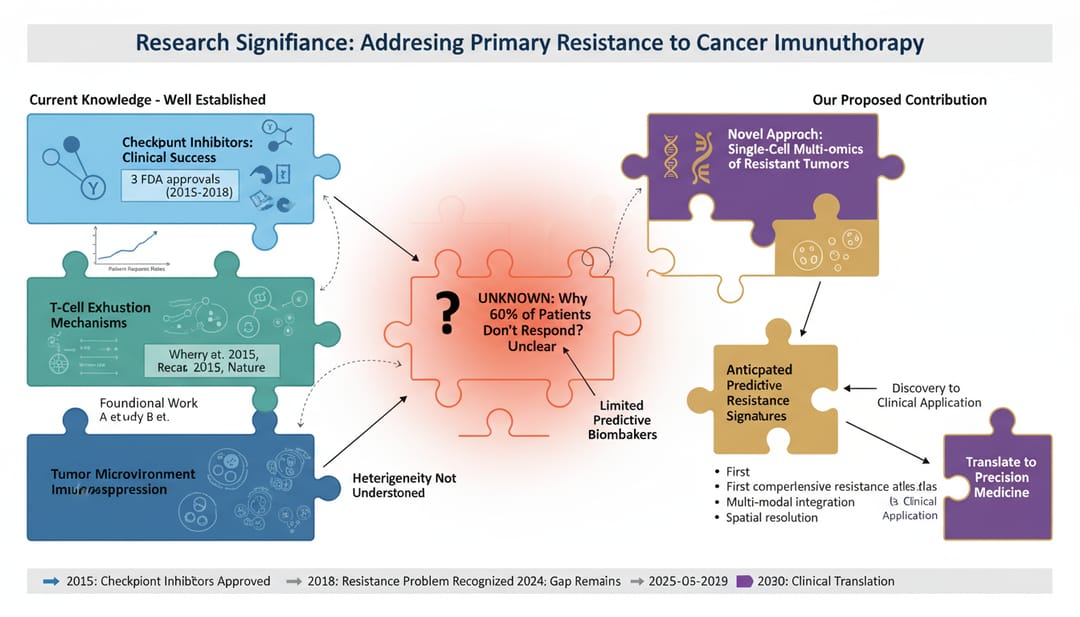
結果:一個引人注目的視覺敘述,清楚地將提出的研究定位在現有學術研究中,強調知識缺口的緊迫性,展示獨特的貢獻,並幫助跨學科審查員快速掌握智力優點和意義。
應用 2:方法流程圖
展示研究的嚴謹性
方法流程圖提供了擬議研究設計、實驗方案、分析流程和決策點的全面視覺表示,使審查員能夠評估您方法的可能性、嚴謹性和創新性。詳細的方法視覺效果表明您已徹底計劃了調查、預期了挑戰,並設計了適當的控制和驗證。補助金審查數據表明,具有清晰方法圖的提案在方法標準上的得分高出 18%。
傳統生產挑戰
工作流程複雜性:具有平行工作流程和依賴關係的多年項目難以清晰地佈局 時間軸整合:顯示目標、階段和里程碑之間的時間關係 決策樹表示:說明應急計劃和替代方法 樣本流程跟踪:可視化生物樣本、數據或參與者如何在研究中移動 嚴謹性指標:突出控制、驗證和可重複性措施 空間限制:將全面的方法論納入頁面有限的提案中
AI 驅動的方法可視化
AI 可以從詳細的協議描述生成完整的方法流程圖,自動建立符合提案格式要求的平衡佈局。通過指定每個研究階段、決策點、樣本量、時間軸和質量控制措施,您可以生成全面的方法視覺效果,以證明嚴格的計劃。
如果審查者還希望看到分階段的技術路線,可以用技術路線圖產生器把研究目標、方法與里程碑整理成一張結構化的圖。
方法流程圖的關鍵要求
順序清晰度:通過研究階段的清晰進展(目標 1 → 目標 2 → 目標 3) 時間軸對齊:時間關係和項目年份註釋 樣本量符號:參與者人數、生物重複、統計功效 決策點:清楚標記應急計劃和批准/不批准標準 嚴謹性要素:突出顯示控制、驗證、可重複性措施 創新要點:以視覺方式區分新穎的方法
示例提示模板
Methodology flowchart for NSF research proposal on climate change impacts on coral
reef resilience, 16:9 landscape format for proposal body, designed to demonstrate
rigorous 5-year research plan to ecology and climate science review panel.

Overall structure: Three parallel vertical swimlanes representing three research Aims,
connected by horizontal integration points, flowing top to bottom across 5 project
years.

Left swimlane (33%): "Aim 1: Field Monitoring & Sampling" in blue header.
Year 1: Site selection showing map with 12 reef locations across Pacific thermal
gradient labeled "12 Sites × 3 Replicates = 36 Reef Plots", sampling design icon
showing stratification.
Year 2-3: Quarterly monitoring cycles illustrated as circular repeated process,
measurements listed "Temperature, pH, Coral Cover, Biodiversity", sample collection
shown "n=1440 coral cores", quality control note "10% sampling redundancy".
Year 4-5: Long-term trend analysis, statistical validation icon, data archiving to
public repository labeled "Open Data Deposition".

Center swimlane (33%): "Aim 2: Experimental Manipulation" in green header.
Year 1: Mesocosm facility establishment, experimental design matrix showing 4
temperature × 3 pH × 3 coral species = 36 treatment combinations, power analysis
callout "n=5 replicate tanks/treatment, 80% power".
Year 2-3: Stress experiments illustrated with tank icons, physiological measurements
listed "Photosynthesis, Calcification, Gene Expression", quality control showing
blind randomization and equipment calibration protocols.
Year 3-4: Recovery experiments, resilience metrics assessed, data integration with
Aim 1 field observations shown as connecting arrow.

Right swimlane (33%): "Aim 3: Predictive Modeling" in purple header.
Year 1-2: Data compilation from Aims 1-2 shown as input arrows, database development,
preliminary model framework based on existing literature (citations shown).
Year 3-4: Machine learning model development illustrated with algorithm icons,
validation against held-out field data shown as feedback loop, model selection
criteria decision point "If RMSE < 0.15 → Proceed; Else → Refine features".
Year 5: Projection scenarios for 2050/2100 climate conditions, uncertainty
quantification shown, stakeholder communication products illustrated (maps, reports).

Horizontal integration points: Three connection layers across swimlanes labeled
"Data Integration Checkpoints" at Years 2, 3, and 5, showing how Aims inform each
other, team meetings scheduled, go/no-go decision criteria noted.

Right margin timeline: Vertical arrow showing Years 1-5 with milestones: "Year 1:
Permits & Setup", "Year 2: Data Collection Begins", "Year 3: Integration Analysis",
"Year 4: Model Validation", "Year 5: Synthesis & Dissemination".

Innovation callouts: Orange starburst icons highlighting "Novel: Multi-stressor
Mesocosm Design", "Innovation: Combining Observational + Experimental + Modeling",
"Advance: Scalable Prediction Framework".

Rigor indicators: Green checkmark icons showing "Randomization", "Blinding", "Pre-
registration", "Open Data", "Reproducible Code", building reviewer confidence.

Risk mitigation boxes: Yellow caution icons with contingency plans "If coral mortality
>50% → Expand sampling to resistant species", "If model accuracy low → Incorporate
additional environmental variables".

Color scheme: Blue (field work), green (experiments), purple (modeling), orange
(innovation), yellow (risk management), creating clear visual distinction. Professional
NSF proposal style, Arial font labels (11-12pt), suitable for 1-page methodology
overview or expanded detail version, similar to successful ecology proposals.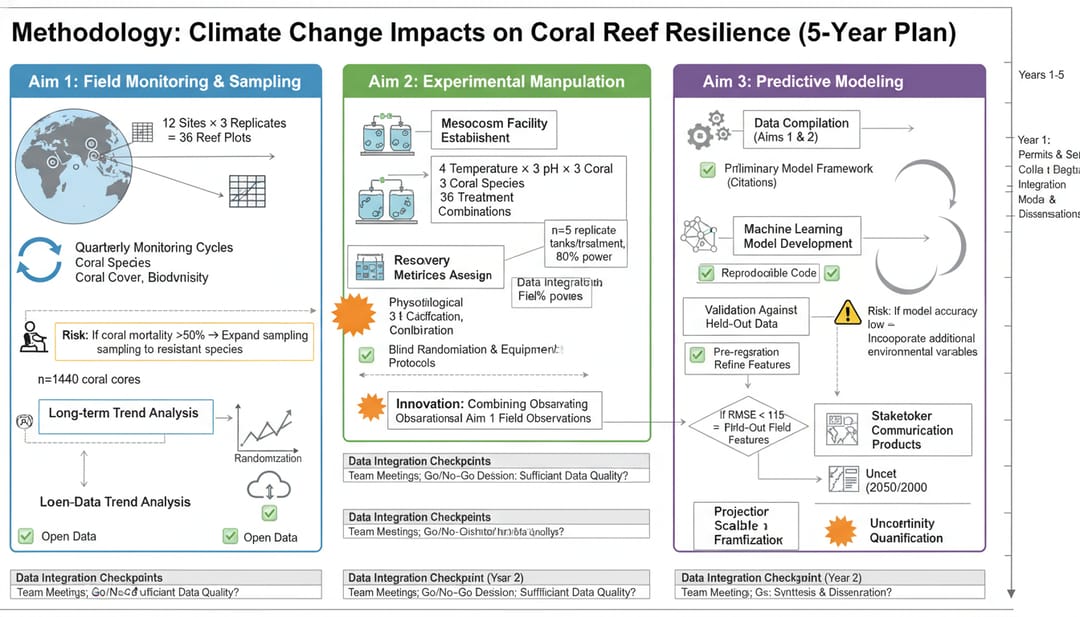
結果:一個全面的方法視覺效果,展示了嚴格的實驗設計、清晰的時間軸規劃、適當的樣本量、目標之間的整合、創新亮點和風險緩解策略,使審查員對方法的可行性和科學嚴謹性充滿信心。
應用 3:預期結果可視化
說明研究影響
預期結果可視化描述了您提出的研究的預期結果、可交付成果和更廣泛的影響,幫助審查員設想項目成功並了解其資金投入的價值。有效的結果視覺效果超越了模糊的承諾,展示了與研究目標相關的具體、可衡量的結果,並展示了從發現到應用途徑。影響可視化對於轉化研究、SBIR/STTR 提案以及強調社會效益的資助機制尤為重要。
傳統可視化障礙
投機管理:在不顯得自以為是或有保證的情況下,表示假設的結果 多種結果類型:平衡科學產出(論文、數據)與更廣泛的影響(政策、教育、商業化) 途徑演示:顯示從研究活動到結果的邏輯進展 指標選擇:識別適當的可量化成功指標 影響時間軸:區分近期可交付成果與長期轉型潛力 不確定性溝通:在保持信心的同時承認研究的不可預測性
AI 驅動的結果說明
AI 能夠生成引人注目的結果可視化,從而在雄心勃勃的願景與現實的計劃之間取得平衡。通過描述預期的科學發現、預期的可交付成果、傳播策略和更廣泛的影響途徑,您可以建立結果視覺效果,幫助審查員設想您項目的成功和社會價值。
結果視覺效果的關鍵要求
具體性:具體的可交付成果,而不是模糊的願望 時間軸區分:近期(1-3 年)與長期(5-10 年)結果 多種影響類型:科學、教育、社會、經濟、政策 指標:在適當情況下可量化的成功指標 途徑邏輯:從活動 → 產出 → 結果 → 影響的清晰聯繫 適當的信心:避免有保證的主張的現實呈現
示例提示模板
Expected outcomes visualization for NIH translational research grant proposal on
Alzheimer's early detection biomarkers, 16:9 landscape format showing progression
from research activities to clinical impact, designed for translational neuroscience
review panel.

Overall structure: Left-to-right flow showing transformation from inputs through
immediate outputs to long-term impacts, using pathway metaphor with expanding reach.

Far left (15%): "Research Activities (Years 1-5)" input section showing project
components:
- Icon: Laboratory with researchers, labeled "Multi-Center Cohort Study"
- Sample size: "n=2000 participants" with diversity notation
- Assays listed: "CSF proteomics, Blood metabolomics, MRI imaging"
- Investment shown: "$2.5M NIH Funding"

Left-center (25%): "Immediate Outputs (Years 3-5)" showing direct project deliverables:
Top track - Scientific outputs:
- Publications: Stack of papers labeled "8-12 peer-reviewed papers", target journals
  "Nature Medicine, Lancet Neurology, Alzheimer's & Dementia"
- Data sharing: Database icon labeled "Open-access biomarker database, 500+ proteins
  profiled", NIH data repository compliance shown
- Presentations: Conference podium labeled "15+ conference presentations, invited
  symposia"

Bottom track - Capacity building:
- Training: Graduation cap icons labeled "4 PhD students, 2 postdocs trained in
  translational neuroscience"
- Methods: Protocol book labeled "Validated multi-omics pipeline, SOPs published"
- Infrastructure: Lab equipment labeled "Shared resource established"

Center (30%): "Near-Term Outcomes (Years 5-7)" showing research impact:
Top track - Scientific advancement:
- Discovery: Lightbulb icon with labeled "Novel Biomarker Panel: 5-protein signature
  for preclinical Alzheimer's detection", specificity/sensitivity metrics shown
  "Predicted: 85% sensitivity, 90% specificity, 10-year advance warning"
- Validation: Checkmark with "Independent cohort validation (n=500)", building
  credibility
- Mechanism: Pathway diagram labeled "Mechanistic insights into early neurodegeneration"

Bottom track - Translation initiation:
- Patent: Document icon labeled "Provisional patent filed on diagnostic panel"
- Clinical trial: Hospital icon labeled "Phase I clinical validation trial initiated"
- Partnerships: Handshake icon labeled "Industry collaboration for assay development
  (Roche, Quest Diagnostics potential)"

Right-center (20%): "Medium-Term Impacts (Years 7-10)" showing broader reach:
- Clinical tool: Medical device icon labeled "FDA-approved diagnostic test", regulatory
  pathway shown
- Clinical adoption: Hospital network labeled "Test adopted in 200+ memory clinics",
  patient access expanding
- Practice change: Guidelines document labeled "Updated screening guidelines, primary
  care integration"
- Economic: Dollar signs labeled "Cost savings: early intervention vs. late-stage care"

Far right (10%): "Long-Term Vision (10+ years)" showing transformative potential:
- Population health: Large group of people icons labeled "Routine screening for at-risk
  populations (50+ million in US)"
- Disease prevention: Shield icon labeled "Preventive interventions, disease burden
  reduction"
- Healthcare transformation: Building labeled "Paradigm shift: Alzheimer's prevention
  vs. treatment"

Connecting arrows: Flow showing logical progression, with annotations "If biomarkers
validated →", "Subject to FDA approval →", "Pending clinical efficacy →", acknowledging
contingencies.

Metrics boxes: Quantifiable targets shown at each stage - "12 publications", "85%
sensitivity", "200 clinics", "50M people", making outcomes concrete.

Bottom ribbon: Broader impacts highlighted - "Reduced healthcare costs: $200B annually",
"Improved quality of life for millions", "US leadership in neuroscience translation",
addressing NIH mission.

Color progression: Dark blue (inputs/activities) → teal (outputs) → green (near-term
outcomes) → light green (medium impacts) → gold (transformative vision), showing
expanding value and societal reach. Professional grant proposal style, optimistic
but realistic tone, similar to successful NIH translation proposals, clear timeline
annotations, appropriate confidence level avoiding guarantees.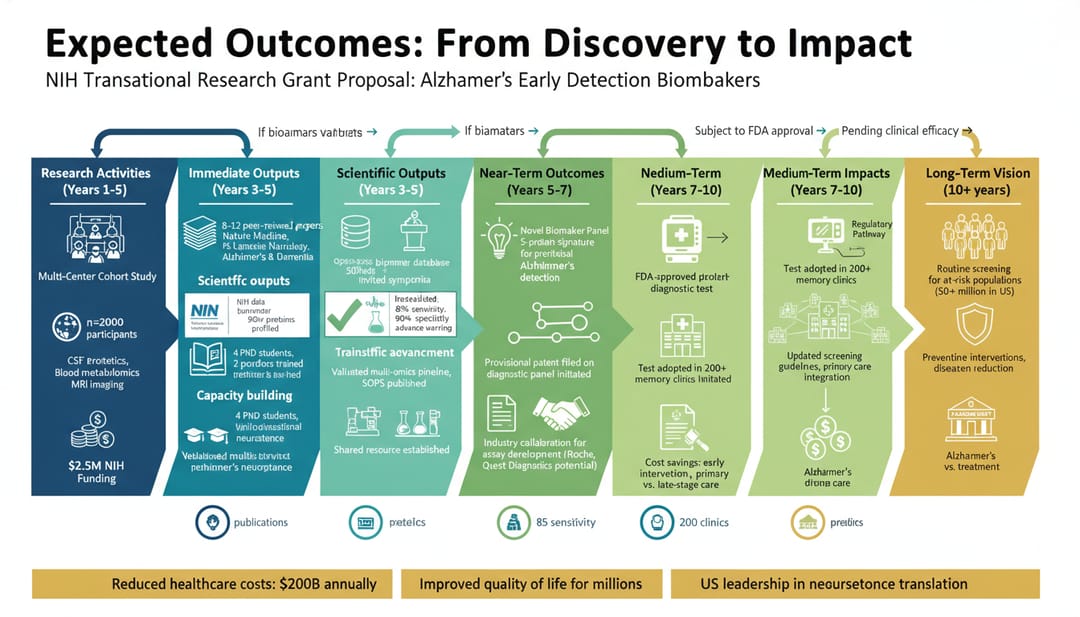
結果:一個引人注目的結果可視化,展示了從研究活動到轉型影響的邏輯進展,展示了具有可量化里程碑的現實計劃,承認了適當的意外情況,並幫助審查員設想了跨多個影響維度的資金投入的價值。
應用 4:團隊結構和協作網路
展示協作力量
團隊結構視覺效果說明了人員、機構和合作者將如何協同工作以實現研究目標,表明您已組建了合適的專業知識、建立了富有成效的合作夥伴關係,並設計了有效的溝通機制。強大的團隊視覺效果對於多研究者項目、中心補助金、項目項目和國際合作至關重要,在這些項目中,審查員對團隊協同作用的評估直接影響資助決策。
傳統團隊可視化挑戰
複雜性管理:擁有眾多機構和數十名人員的大型團隊 角色清晰度:清楚地區分 PI、Co-I、顧問、合作者、受訓人員 專業知識映射:展示個人專業知識如何滿足特定的研究需求 溝通結構:說明協調、監督和整合機制 多樣性展示:代表團隊在職業階段、人口統計、學科方面的多樣性 協作歷史:表明已建立的合作夥伴關係與新的關係
AI 驅動的團隊可視化
AI 能夠生成清晰的團隊結構圖,以傳達角色、專業知識、機構隸屬關係和協作機制。通過指定團隊組成、報告關係、溝通結構和互補專業知識,您可以建立團隊視覺效果,以展示強大的協作基礎。
團隊結構視覺效果的關鍵要求
清晰的層級結構:清楚地區分 PI、共同研究者、主要人員、顧問、受訓人員 專業知識註釋:每個成員為項目帶來的具體技能 機構隸屬關係:清楚地標記大學、組織 溝通機制:顯示團隊會議、工作組、監督委員會 多樣性指標:可見的職業階段、學科、人口統計多樣性 協作強度:註明已建立的合作夥伴關係與新的合作
示例提示模板
Team structure and collaboration network diagram for NIH multi-site collaborative
research grant on health disparities, 16:9 landscape format showing organizational
structure and expertise complementarity, designed for review panel assessing team
synergy and institutional commitment.

Top tier - Leadership structure:
Center circle: Multiple-PI Leadership team shown as three connected nodes in gold
gradient:
- Left node: "PI 1: Dr. Sarah Chen (Johns Hopkins)" with photo placeholder, expertise
  tags "Epidemiology, Community Engagement, Health Disparities", NIH R01 track record
  shown "5 R01s as PI"
- Center node: "PI 2: Dr. Marcus Johnson (Howard University)" with photo placeholder,
  expertise "Cardiovascular Disease, Clinical Trials, HBCU Leadership", collaboration
  history with PI 1 shown "10 prior publications together"
- Right node: "PI 3: Dr. Alicia Rodriguez (UCLA)" with photo placeholder, expertise
  "Biostatistics, Causal Inference, Big Data", complementary quantitative skills

Leadership coordination: Monthly PI meetings, shared decision authority, conflict
resolution protocol noted.

Second tier - Co-Investigators by research Aim:
Three colored clusters below PI team:

Left cluster (blue): "Aim 1 Team: Community Assessment" - 4 Co-Is
- Co-I: Dr. James Williams (Morehouse), Community-Based Participatory Research, local
  partnerships established
- Co-I: Dr. Linda Park (Johns Hopkins), Qualitative Methods, interview expertise
- Co-I: Dr. Robert Garcia (UCSF), Geographic Information Systems, spatial analysis
- Coordinator: Maria Santos, MPH, community health worker liaison
Aim 1 meetings: Bi-weekly virtual, quarterly in-person, community advisory board
engagement shown.

Center cluster (green): "Aim 2 Team: Clinical Study" - 5 Co-Is
- Co-I: Dr. Jennifer Lee (Howard Hospital), Cardiology, clinical site PI, patient
  recruitment "access to 5000+ patient cohort"
- Co-I: Dr. David Martinez (UCLA Medical Center), Cardiology, clinical site PI, West
  Coast recruitment
- Co-I: Dr. Karen Thompson (Hopkins), Clinical Coordinator, regulatory compliance
- Co-I: Dr. Ahmed Hassan (Wayne State), Interventional Cardiology, procedure expertise
- Nurse Coordinator: Patricia Brown, RN, multi-site coordination
Clinical coordination: Weekly team meetings, monthly safety monitoring, IRB oversight
structure.

Right cluster (purple): "Aim 3 Team: Data Analysis & Modeling" - 4 Co-Is
- Co-I: Dr. Rachel Kim (UCLA), Biostatistics Core Director, analysis plan leadership
- Co-I: Dr. Thomas Zhang (Hopkins), Machine Learning, predictive modeling
- Co-I: Dr. Sophia Patel (Emory), Health Economics, cost-effectiveness analysis
- Data Manager: Kevin O'Brien, MS, database management, quality control
Analysis meetings: Monthly, pre-specified analysis milestones, reproducibility
protocols.

Third tier - Consultants and External Collaborators:
Outer ring showing specialized expertise brought in as needed:
- Consultant: Dr. Elizabeth White (CDC), Public Health Policy, dissemination advisor,
  2 days/year commitment
- Consultant: Dr. Michael Brown (FDA), Regulatory Science, device approval pathway,
  1 day/year
- International Collaborator: Dr. Carlos Mendez (Universidad Nacional, Colombia),
  Global Health Disparities, comparison cohort, no salary support, in-kind contribution
- Industry Partner: HeartTech Solutions, Technology Transfer, prototype development,
  matching funds committed "$50K equipment donation"

Bottom tier - Training and Development:
Trainee layer showing career development integrated into project:
- 6 PhD students (2 per Aim) represented with graduation cap icons, diversity noted
  "50% underrepresented minorities"
- 3 Postdoctoral fellows shown with early career researcher icons, mentorship structure
  indicated
- 4 Summer undergraduate researchers from minority-serving institutions, pipeline
  development highlighted

Right side box - Institutional Support:
Three university logos (Johns Hopkins, Howard, UCLA) with commitment letters noted:
- Johns Hopkins: "25% PI effort committed, $100K cost-sharing, laboratory space"
- Howard: "CTSA pilot funding, recruitment support, community relationships"
- UCLA: "Biostatistics Core access, $75K cost-sharing, data storage infrastructure"

Communication infrastructure overlay:
Connecting lines showing coordination mechanisms:
- Executive Committee: 3 PIs + 3 Aim leaders, quarterly strategic planning
- Steering Committee: All Co-Is, semi-annual full team meetings
- External Advisory Board: 5 national experts, annual review, independence shown
- Data Safety Monitoring Board: Independent oversight, patient safety, required for
  clinical trial

Color coding: Gold (leadership), blue/green/purple (Aim teams), gray (consultants),
light blue (trainees), creating clear organizational hierarchy. Professional NIH
multi-PI proposal style, photos (or initials in circles), institution logos, clear
reporting lines, expertise tags in small text (9-10pt), demonstrates team synergy,
complementary skills, strong infrastructure, appropriate for complex collaborative
research application.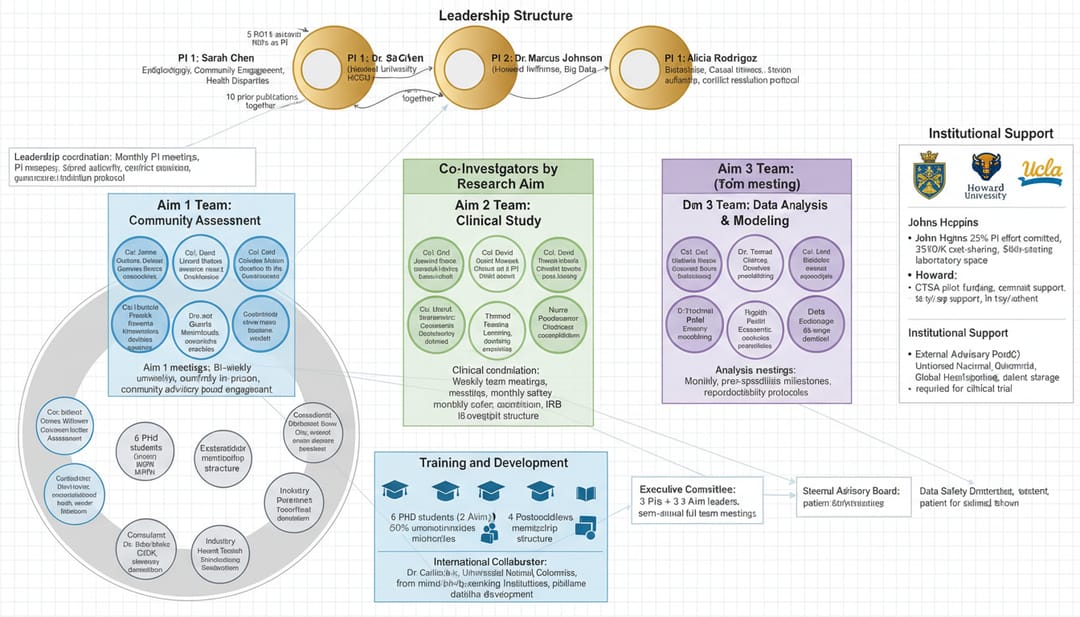
結果:一個全面的團隊結構可視化,展示了強大的領導力、互補的專業知識、清晰的組織層級、有效的溝通機制、機構承諾、跨多個維度的多樣性以及適當的協作基礎設施,從而增強了審查員對團隊執行複雜多站點研究能力的信心。
應用 5:預算論證圖
使財務意義可視化
預算論證圖將逐項預算電子表格轉化為視覺敘述,以展示所請求的資金如何直接支持研究目標,從而向審查員展示成本與科學活動之間的邏輯聯繫。有效的預算視覺效果有助於小組了解資源分配原理、驗證成本效益,並確認資金水平適合擬議的範圍。雖然預算詳細資訊保留在傳統表格中,但補充視覺效果可以顯著提高審查員的理解力,並減少有關財務計劃的問題。
傳統預算溝通挑戰
電子表格不堪重負:具有數十個項目的多年預算難以掃描 成本-活動聯繫:將具體費用與研究目標和可交付成果聯繫起來 比例演示:顯示資金如何在各個類別中分配 論證清晰度:解釋為什麼需要特定資源以及價格是否合適 多年跟踪:說明支出如何在項目年度中演變 成本分攤:清楚地區分請求的資金與機構捐款
AI 驅動的預算可視化
AI 能夠建立清晰的預算圖,以補充傳統的預算論證,使用視覺隱喻(餅圖、甘特圖、流程圖)來說明財務計劃邏輯。通過指定預算類別、年度分配、成本-活動關係和論證敘述,您可以生成預算視覺效果,以增強審查員的理解力。
預算論證視覺效果的關鍵要求
類別清晰度:清楚地區分人員、設備、用品、差旅等 比例可見性:顯示預算分配的餅圖或條形圖 時間軸對齊:與研究里程碑對齊的多年支出計劃 論證聯繫:成本與具體研究活動之間的視覺聯繫 成本分攤:清楚地表明機構捐款和配套資金 合規性:遵守機構特定的預算演示要求
示例提示模板
Budget justification visualization for European Research Council (ERC) Advanced Grant
proposal, 16:9 landscape format showing 5-year budget allocation and cost-activity
relationships, designed to demonstrate efficient resource use for €2.5M project.

Top section (30%): "Total Budget Overview" - Financial summary at-a-glance
Left: Total funding request shown as large number "€2,500,000" with ERC logo, 5-year
project duration noted, breakdown by year shown as stacked bar chart:
- Year 1: €400K (startup intensive)
- Year 2: €550K (peak recruitment/data collection)
- Year 3: €550K (continued data collection)
- Year 4: €500K (analysis phase)
- Year 5: €500K (synthesis and dissemination)
Bars color-coded by major category.

Right: Budget distribution pie chart showing percentage allocation across categories:
- Personnel: 65% (€1,625K) in blue - largest slice, appropriate for research project
- Equipment: 15% (€375K) in green - significant capital investment justified
- Consumables: 10% (€250K) in orange - experimental supplies
- Travel: 5% (€125K) in purple - conferences, collaborations
- Other costs: 5% (€125K) in gray - publication fees, software licenses
Clear legend with both percentages and absolute amounts.

Middle section (40%): "Cost-Activity Linkage Matrix" - Showing how budget supports
research aims

Three-column layout connecting Aims → Resources → Justification:

Left column - Research Aims:
- Aim 1: "High-throughput phenotyping of 5000 genetic variants" (Years 1-3)
- Aim 2: "Mechanistic characterization of top 50 hits" (Years 2-4)
- Aim 3: "Therapeutic target validation in animal models" (Years 3-5)

Center column - Required Resources (with costs):
For Aim 1:
- Personnel: 2 PhD students (€240K), 1 technician (€180K), total €420K
- Equipment: Automated liquid handler (€200K), high-content imaging system (€150K),
  total €350K
- Consumables: Cell culture supplies, reagents (€150K)
Flow arrows connecting Aim 1 to these resources.

For Aim 2:
- Personnel: 1 Postdoc specialist (€220K), 1 PhD student (€120K), total €340K
- Equipment: Protein analysis suite (€25K, cost-shared with Aim 1 equipment)
- Consumables: Biochemical assays, proteomics (€70K)
Flow arrows connecting Aim 2 to these resources.

For Aim 3:
- Personnel: 1 Postdoc (€220K), animal facility staff time (€80K), total €300K
- Equipment: In vivo imaging system (€50K, institutional cost-share contributes €50K)
- Consumables: Animal costs, compounds (€80K)
Flow arrows connecting Aim 3 to these resources.

Right column - Justification callouts:
- "PhD students: 3-year contracts standard, includes stipend + bench fees"
- "Automated system: Essential for 5000-variant throughput, vendor quotes obtained"
- "Animal facility: University core provides 50% discount, cost-sharing agreement"
- "Reagent costs: Based on pilot data, 10% contingency included"

Bottom section (30%): "Personnel Effort Allocation Timeline"
Gantt-style chart showing when team members are funded:
Horizontal time axis: Years 1-5 subdivided by quarters

Personnel rows:
- PI (30% effort throughout): Continuous bar across all 5 years in dark blue,
  "€200K total, consistent leadership"
- Postdoc A (100% effort Years 2-5): Bar starting Year 2, "€220K, Aim 2 specialist"
- Postdoc B (100% effort Years 3-5): Bar starting Year 3, "€220K, Aim 3 lead"
- PhD Student 1 (100%, Years 1-4): Bar Years 1-4, "€160K, Aim 1 focus, graduation
  Year 4"
- PhD Student 2 (100%, Years 1-4): Bar Years 1-4, "€160K, Aim 1 support, graduation
  Year 4"
- PhD Student 3 (100%, Years 2-5): Bar Years 2-5, "€120K, Aim 2 support"
- Lab Technician (100%, Years 1-5): Continuous bar, "€180K, general lab support"

Timeline aligned with major milestones shown above personnel chart: "Equipment
Installation (Q1 Y1)", "Pilot Complete (Q4 Y1)", "Aim 1 Data Collection (Y2-Y3)",
"Validation Experiments (Y4)", "Synthesis (Y5)", showing temporal logic of spending.

Right sidebar: Cost-sharing and Institutional Support shown as green boxes:
- "University contribution: €300K equipment match"
- "In-kind: Core facility access valued €150K"
- "Total project value: €2.95M (€2.5M requested + €450K institutional)"
Demonstrating institutional commitment and cost-sharing enhancing competitiveness.

Footer note: "All personnel costs include statutory benefits. Equipment quotes from
vendors (letters attached). Consumable estimates based on 2-year pilot study costs
inflated 3% annually. Complies with ERC budget regulations."

Color scheme: Blue (personnel, largest category), green (equipment, capital investment),
orange (consumables, operational), purple (travel, networking), gray (other),
consistent with pie chart. Professional ERC grant style, clean sans-serif fonts,
clear visual hierarchy, suitable for proposal appendix or budget justification
section, demonstrates thoughtful financial planning and resource efficiency.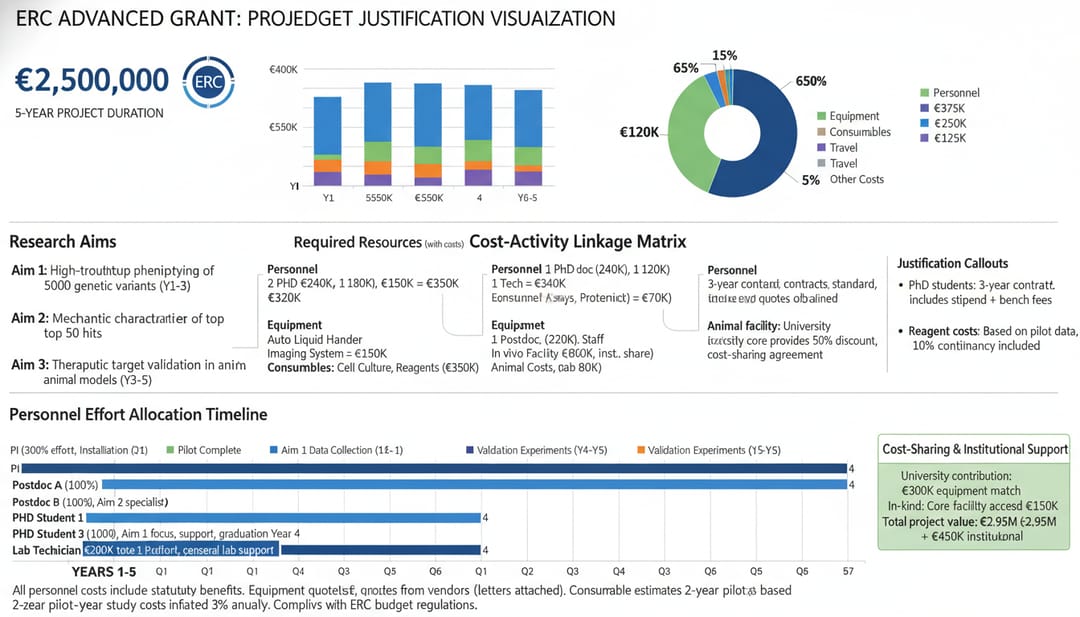
結果:一個清晰、全面的預算可視化,展示了邏輯資源分配,將支出與研究活動聯繫起來,展示了整個項目時間軸上適當的人員計劃,突出了機構成本分攤,並增強了審查員對財務管理和可行性的信心,從而通過可訪問的視覺敘述來補充傳統的預算表。
補助金提案視覺效果的實用技巧
現在您了解了五個關鍵的補助金申請視覺效果,以下是一些基本技巧,可確保您 AI 生成的圖形在滿足資助機構要求的情況下最大限度地提高審查員的影響力:
通用補助金視覺效果清單
在補助金提案中包含任何 AI 生成的視覺效果之前,請驗